Thursday, 26 March 2009

Windfarms!

June was apoplectic on Tuesday morning when she read the BBC News email. There was a story headlined RSPB calls for more UK wind farms. Our first reaction was that we had somehow lost a week and that it was April Fools Day but no, it was still only 24th March. So what on Earth is going on? Is the RSPB finally coming clean about its business partnership with Scottish & Southern Energy? Is it finally admitting that all the accusations that have been made against it over the past few years are true? This unqualified and enthusiastic endorsement of wind farms is otherwise hard to understand from an organisation that is supposed to be about bird protection. It is difficult not to conclude that the RSPB has been ’bought’. Well, whatever they are being paid will have to offset the loss of subscription income that will surely result. We wonder what Peter Condor would make of it all.

Anyway, yesterday we went to have a look at one of these wind farms. It’s in the Serra do Caldeirão and about two hours drive from here. Of course, we were birding really but our all-day trip through the rolling hills and valleys west of Ameixal inevitably took us to the highest point in the area at Mu (577 m above sea level) where wind turbines are currently still under construction. In fact we sat and had our picnic under the shadow of one of these giants. Not to beat about the bush any longer, WE HATE THEM! But the bandwagon is rolling and, with the help of Europe’s largest wildlife charity and all the other vested interests, looks to be unstoppable, so be prepared for one near you anytime soon. Don't expect to see any change to the climate though!

Otherwise it was a lovely, mostly sunny day with Nightingales singing in the valleys, Bee-eaters hawking over the rivers, Subalpine Warblers skulking in the Cistus scrub, Short-toed Eagles soaring, hirundines gathering mud for nest-building and much much more. A very noticeable feature of the day was the continuous passage of Painted Lady butterflies - thousands of them going by all day.

We took a few photographs...

European Bee-eaters

Following the RSPB's lead, Peter got one fitted to his bird...

Red-rumped Swallow collecting mud

Rock Bunting

Tuesday, 24 March 2009

Sunshine After The Rain

The day started cloudy and there was even a slight rain shower but by lunchtime, as we were watching the local Little Owls in trees across the road, the sun appeared. Time to forget about 'admin', grab the camera and bins and head off to the saltpans!

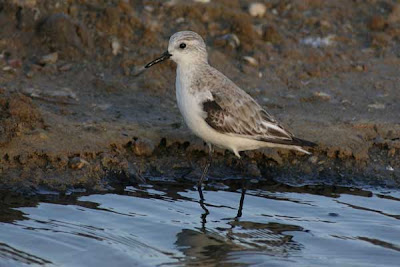
In no time we were watching Bee-eaters prospecting for nest sites. Numbers have increased over the last few days; today there were about a dozen but none came near enough for a photograph. At the same time a pair of Zitting Cisticolas was displaying and several times the 'wet-my-lips' call of a Quail came from an adjacent cereal crop over which many House Martins, Barn and Red-rumped Swallows hawked for insects. We tried hard to photograph Yellow Wagtails but had to settle for just watching them busily feeding just out of camera range, numerous but unco-operative. Most were iberiae but there were also one or two flava. In the end, like yesterday, we had to be content with a few more wader images.
Kentish Plover


Stone-curlew

Sanderling

On the way home we made a slight diversion to see whether Nightingales had arrived at what is the nearest regular site. Here our luck changed as we almost immediately located our target and with just about enough light for a photograph. No doubt there will soon be evenings when we go there simply to listen.


Nightingale

Monday, 23 March 2009

Tavira saltpans

We spent a couple of hours or so this afternoon around the saltpans here in Tavira. The area forms part of the Parque National da Ria Formosa, designated a wetland of international importance under the Ramsar Convention. It's a wonderful place to see wading birds and we can routinely see more than 20 species here in the winter months and at migration times. Just now most of the pans are dry and wader numbers are relatively low but in our short visit this afternoon we still managed to find 17 species.

They say that salt was harvested in the Tavira area as long ago as 2,000 BC and the expertise required to produce high quality salt, flor de sal as it is called here, is passed down from generation to generation. Today we were pleased to see work being done to prepare the pans for this year's production and we hope that it won't be long before the pans are flooded again and providing feeding areas for the many migrant waders that will be passing through here in the next few weeks.

In the meantime, we managed to photograph a few of the current 'residents'.

Friday, 20 March 2009

That Was The Week

We’ve had a bit more variety this week, visiting Alvor, Monchique, Quinta do Lago, Lagoa dos Salgados and Castro Marim and everywhere (not surprisingly) we have seen newly arrived migrants.

At Alvor we spent a very pleasant Monday morning walking round the marsh where there were plenty of birds to keep us interested. Among the 14 species of waders identified was a single Northern Lapwing, interestingly the only one we have seen since we returned to the Algarve on 5th March. A Little Owl staring back at us from the wall of a ruin near the parking area was a popular find and while we were having our picnic lunch there we saw our first Common Redstart of the year.

Later the same day we drove up through Monchique to Foia, at 902 metres above sea level, the highest point in the Algarve. Apart from the magnificent views and an array of telecommunications and radar installations, Foia offers Rock Buntings and Blue Rock Thrushes, both of which we found without too much trouble. We also had very good views of four Dartford Warblers together, presumably two pairs engaged in some territorial dispute. A brief stop on the drive back down produced a Common Cuckoo.

We stayed at home all day on Tuesday as PT Comunicações had promised to send out a technician to look at a problem we have been experiencing with our phone line. It wasn’t a complete surprise that nobody came but the day was saved when a male Montagu’s Harrier sailed past the kitchen window!

On Wednesday at Quinta do Lago we saw a Purple Heron, a drake Garganey, a Glossy Ibis, the long-staying Red-knobbed Coot plus the usual Red-crested Pochards and Purple Swamp-hens that are always crowd-pleasers. From Lago do São Lourenço we walked part of the way towards Ludo Farm and found five Slender-billed Gulls on one of the saltpans. There was also a single Audouin’s Gull on the estuary. However, there was a gale blowing and it really wasn’t a great day to be trying to find birds.

We took our picnic to Lagoa dos Salgados only to find that the lagoon has been drained yet again. That this excellent site for birds is treated so badly can only be described as a disgrace. A stunning male Black-eared Wheatear on the dry lake bed cheered us up a little and there was a brief and distant view of the four Northern Bald Ibises that have taken up residence on the adjacent golf course, birds that have absconded from the re-introduction programme in Spain.

Yesterday was spent at Castro Marim. Highlights among the 82 species recorded were a Purple Heron, two Collared Pratincoles, four European Bee-eaters, at least seven Slender-billed Gulls, a Spectacled Warbler, a Common Whitethroat and numerous Yellow Wagtails that included the subspecies iberiae, flava and flavissima all feeding together.

Yellow Wagtail (iberiae)

Today we’ve doing a bit of 'admin' but we did try to find some birds to photograph around Tavira. A Hoopoe and Crested Lark were the only ones that co-operated at all.

Eurasian Hoopoe

Crested Lark

Saturday, 14 March 2009

A Busy Week

Another busy few days of birding has seen us spending lots more time in the Baixo Alentejo, making several visits to Castro Marim and still finding a few minutes to have a look round Tavira. Today we rounded off the week with a trip to Quinta do Lago.

In the Castro Verde area we have seen countless Great Bustards and Little Bustards, there have been excellent views of Lesser Kestrels, several sightings of Spanish Imperial Eagle, Great Spotted Cuckoos have been easy to find, Black-eared Wheatears have returned and yesterday a Black Vulture was soaring with about 20 Eurasian Griffons. After really good views of them last weekend, on our last two trips we have struggled to find Black-bellied Sandgrouse but while we have been searching we have enjoyed watching and listening to the song flights of the many Calandra Larks. There hasn’t been time for much photography but it would be a poor show if we couldn’t get a picture of the area’s most numerous species - Corn Bunting.

Corn Bunting

Our walk around the saltpans at Castro Marim on Tuesday morning took us six hours to complete - there were just so many birds to look at. After lunch, we walked some more! Highlights for us among more than 80 species seen were the single Little Bustard that was virtually the first bird we saw when we arrived, a high count of 30 Caspian Terns, Audouin’s Gulls, a Spectacled Warbler, several Stone-curlews and a Bluethroat.

We made a further brief visit to Castro Marim on Thursday when this colour-ringed Spoonbill was very obliging. In an immediate response to our report, we learned from Otto Overdijk that the bird, a male, had been ringed as a nestling 2120 km away in the Netherlands on 24th May 2008.

Eurasian Spoonbill

Around Tavira we have seen Blue Rock Thrushes, Stone-curlews and Dartford Warbler, heard Water Rail, Cetti’s Warbler and Quail and managed to photograph Woodchat Shrike. On Monday, we saw two different grey egrets, presumably the same birds that we have seen many times before and which are thought to be Little Egret x Western Reef Egret hybrids.

Highlights from Quinta do Lago today were three Glossy Ibises, two Audouin’s Gulls, a Purple Heron and a Bluethroat.

Monday, 9 March 2009

Alentejo - again

Yesterday was another long day out in the Alentejo. We visited many of the same areas that we went to on Saturday and saw most, but not all, of the same birds. Once again there were several good views of both Great and Little Bustards, including a flock of 66 Little Bustards; Black-bellied Sandgrouse were easily found and two Common Cranes still remain. In as much as we saw fewer species, it wasn’t such a good day for raptors but what we might have lacked in quantity we made up for with quality - excellent views of Spanish Imperial Eagle, Lesser Kestrel and Short-toed Eagle, the latter perched on the top of a tree above our regular lunch site. A Great Spotted Cuckoo was a popular choice as ’bird of the day’ but a Black Stork soaring with Red Kites against a background of clear blue sky took some beating.

Saturday, 7 March 2009

Castro Verde

Most of today was spent in the Castro Verde area of the Alentejo - yes, we’re back in Portugal again! What started as a grey, cloudy day cleared later and by lunchtime it was warm and sunny, although there was still a bit of a breeze.

Great Bustards were easily found, we saw Little Bustards and had very good views of Black-bellied Sandgrouse. Eleven species of raptors included a Peregrine Falcon chasing a Black-bellied Sandgrouse, a Golden Eagle and, of course, our favourite Black-shouldered Kites. Other highlights included Great Spotted Cuckoos, Blue Rock Thrush and two Common Cranes.

We mentioned last November that many of the White Storks’ nests along the roadside between Castro Verde and Mé rtola had been removed when the power poles were replaced and we wondered what would happen when the birds returned. Well today we were pleased to see that platforms had been put up to help the storks get new nests built and there were storks all along the road. Of course, while some storks found themselves homeless and were having to start from scratch, for others it was just the usual renovation job. The pictures tell the story.

Lucky Stork...

...Unlucky Stork

We made a brief visit to Castro Marim on the way back to Tavira. In just 20 minutes or so, while standing in one spot, we recorded about 25 species including Little Bustard, Mediterranean Gull, Common Shelduck, Black-necked Grebe and Greater Flamingo, making a nice end to the day.