Showing posts with label Great Spotted Cuckoo. Show all posts

Saturday, 31 May 2014

Here Comes Summer

Even at the end of May there are still some waders to be found in the Ria Formosa and at Castro Marim, mostly Dunlin and Sanderling but also Knot, Oystercatcher and Bar-tailed Godwit.  However, for some time now our attention has been not so much on passage migrants as on the local breeding birds.

Dunlin

Species such as European Bee-eater, Little Bustard, Collared Pratincole, Iberian Grey Shrike and Spectacled Warbler have been in demand as usual and all have been easily viewable even from the car.  We have found Little Bitterns at two sites in the Eastern Algarve, close to Castro Marim and nearby there have also been Audouin’s Gulls, Great Spotted Cuckoos, Glossy Ibises and Stone-curlews.  In the same area, there have been regular sightings of Montagu’s Harriers and Marsh Harriers and occasionally a Short-toed Eagle.

Spectacled Warbler

 Great Spotted Cuckoo

Audouin's Gull

Inevitably, we have spent quite a lot of time looking for the scarcer and less easily found species and the last week or so has seen us earn the gratitude of visitors for whom Iberian Chiffchaff, White-rumped Swift and Western Orphean Warbler have been ‘lifers’.  This has taken us inland to areas where we have been able to enjoy the song of countless Nightingales and Blackcaps and often Woodlarks and Golden Orioles.  The White-rumped Swifts have been difficult and so far we have found them at only one of the five sites we have been to where they have bred in previous years.

Non-breeding birds still here include more than 600 Greater Flamingos, plus a handful of Caspian Terns and Slender-billed Gulls.  Once again, there was a Lesser Flamingo recently amongst the Greaters.

Caspian Tern

 Slender-billed Gull

Of course, we have also been making frequent trips to the Baixo Alentejo where Great Bustard, Little Bustard, Spanish Imperial Eagle, Short-toed Eagle, Montagu’s Harrier, Griffon Vulture, Black-bellied Sandgrouse, Roller, Lesser Kestrel, Collared Pratincole, Great Spotted Cuckoo and Calandra Lark have all been seen on virtually every visit.  Golden Eagle, Bonelli’s Eagle and Gull-billed Tern have also been fairly reliable. 

Collared Pratincole

We’ve been across the border to Doñana only once recently.  We found large areas of the National Park to be completely dry and it certainly wasn’t at its best.  It was good to see plenty of people visiting the Dehesa de Abajo (where Red-knobbed Coots seem now to be regular) but in contrast we were the only visitors at the JAV and so the only ones to enjoy seeing a Spanish Imperial Eagle pass low overhead!  Even so, we probably enjoyed the Purple Herons as much as any of the birds we saw.


Purple Heron

Summer has now arrived; temperatures are regularly reaching 26ºC and higher and there are more and more people here.  It will soon be time for us to retreat to the UK!

Saturday, 8 March 2014

Great Spotted Cuckoos

Almost everywhere we have been this week we seem to have seen (and heard) Great Spotted Cuckoos.  At Castro Marim, around Tavira and all over the Mértola / Castro Verde area we have watched them engage in their annual battle of wits with the local Common Magpies.  In other parts of the world Great Spotted Cuckoos lay eggs in the nests of various species of corvids but in Europe, including Portugal, the Common Magpie is definitely their preferred victim.


During a season, a female Cuckoo is said to lay as many as 30 eggs, often laying more than one egg in each nest.  Frequently at least one Magpie’s egg may be damaged by the Cuckoo and that must reduce the competition for food when the chicks hatch.  However, as the young Cuckoos generally hatch several days before the Magpies, it is an uneven contest; the Cuckoos are always favourites to out-compete the young of the host species.

Common Magpie isn’t a widely distributed or particularly numerous species in the Algarve.  However, where there are Magpies we expect to find Great Spotted Cuckoos and we wonder what effect they have on the Magpie population.  In the absence of Cuckoos would there be more Magpies?  Maybe the introduction of Great Spotted Cuckoos into the UK would be a way of controlling the seemingly ever-increasing Magpie population there!

Sunday, 14 April 2013

Days out from Tavira

Last week was a busy one for us with days spent in the Castro Verde area of the Baixo Alentejo and across the border in Doñana as well as around some of the usual sites in the Algarve.

The Alentejo is at its very best right now.  Both Great Bustards and Little Bustards are displaying and easy to see, there are raptors everywhere (13 species this week), Calandra Larks singing, Black-bellied Sandgrouse, Collared Pratincoles, Great Spotted Cuckoos, Rollers, Black-eared Wheatears and more.  However, what makes this time of the year really stand out is the amazing display of wild flowers – carpets of yellow, white and purple with patches of red.  Truly spectacular!


Alentejo flower show...

...too many to name!

Black-eared Wheatear

Lesser Kestrel

Doñana, too, is really looking good.  In complete contrast to last year’s disappointment following the drought, currently there is water everywhere and, as a result, lots of birds fixing to breed.  In particular, there were hundreds of Greater Flamingos and Glossy Ibises and seven species of herons and egrets.  Throw in a few Gull-billed & Whiskered Terns, some Greater & Lesser Short-toed Larks, Red-knobbed Coots, Great Spotted Cuckoos and an assortment of raptors and waders and it makes a great day trip from Tavira.  There was even a Long-tailed Duck at the Cañada de Rianzuela.

Great Spotted Cuckoo

Little Ringed Plover

In the Algarve, we’ve been to Ludo, Quinta do Lago, Olhão and, of course, Tavira, all of them within the Ria Formosa.  Highlights for our visitors have included Collared Pratincoles, Little Bittern, Bee-eaters, Caspian Terns, Slender-billed Gulls and Stone-curlews.  Just as much as those, we’ve enjoyed hearing the air filled with the songs of Nightingales, Cetti’s & Reed Warblers and watching Black-headed Weavers busy building their nests.

Collared Pratincole

Black-headed Weaver

Finally, news of the colour-ringed Common Redshank, H19, which we previously blogged about here.  This bird, which has now spent three winters in the saltpans here, is so faithful to one particular area that when we couldn’t find it on 15th March we were confident that it had left to start its migration to The Netherlands.  At the time, the weather there was awful with temperatures down to minus-3 and it didn’t seem like a good place to be going.  We were worried!  Anyway, the good news is that ‘our’ bird (which we share with Wim Tijsen who ringed it) arrived back on the breeding grounds on 9th April having presumably stopped somewhere on the way to wait for better weather.  We hope for news of a successful breeding season.       

Sunday, 25 March 2012

Castro Verde, Castro Marim and more

March is a month when we expect to spend a lot of time in the Castro Verde area and we’ve had two more trips up there this week, making three visits in the past eight days. The number of species recorded on each visit has averaged 76 but these days in the Alentejo are more about quality than quantity. During these trips we have not just seen but had really great views of 16 species of raptors with Golden Eagle, Bonelli’s Eagle, Peregrine Falcon, Common Buzzard, Griffon Vulture and Black Vulture now added to the list that was included in our last report. We’ve watched countless Great Bustards displaying, almost seeming to turn themselves inside out and looking like big white powder puffs; some Little Bustards are also displaying now but many still seem to be in flocks. Other popular species have been Calandra Larks and Great Spotted Cuckoos, Black Stork and the numerous nesting White Storks.

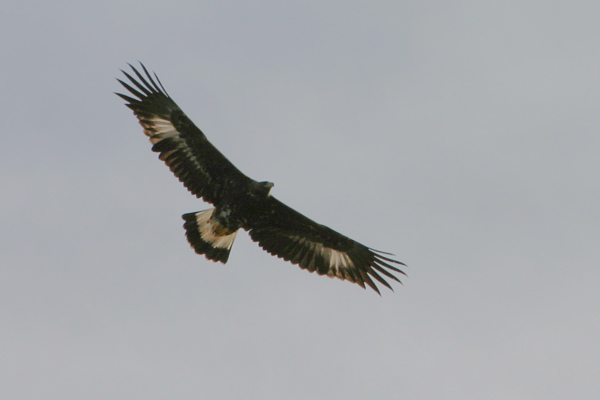
Golden Eagle

Short-toed Eagle

Of course, we’ve also visited several of our favourite sites in the Algarve. At Quinta do Lago, we were pleased to get good views of a Purple Heron and a Little Bittern and once again a couple of Sacred Ibises were seen alongside the more familiar Glossy Ibises. At Ludo, we expected to find Booted Eagles and we weren’t disappointed.

Little Bittern

At Castro Marim, we had several encounters with noisy Great Spotted Cuckoos and at Aldeia Nova there was a Common Cuckoo. Last year we sponsored ‘Chris’, one of the Common Cuckoos that the BTO tagged and have been tracking by satellite throughout the winter months. It’s interesting that we have Cuckoos returning here now to the Algarve but ‘Chris’ and the other BTO Cuckoos, that are presumably going to return to the UK, are still in West Africa.

Great Spotted Cuckoo

Yesterday, during the high tide period, we were at Castro Marim again to carry out a count of the waders and other birds, mostly Greater Flamingos and Spoonbills, on the saltpans there. Avocets, Dunlins, Grey Plovers and Ringed Plovers were the most numerous species but the job wasn’t made any easier by a male Montagu’s Harrier that spooked the birds on a couple of occasions. Normally we love to see Montagu’s Harriers but when we’re half way through counting a flock of several hundred birds and they all take off in panic…well that does tend to change our views! It recalled occasions at Belvide Reservoir years ago when a Peregrine Falcon would often be the culprit that disrupted wildfowl counts.

Meanwhile, here in Tavira we’re starting to see a few more migrants. This morning we came across several Woodchat Shrikes, Greater Short-toed Larks and a Subalpine Warbler and heard the familiar calls of Bee-eaters. Our ‘bird of the morning’, however, was probably a lovely Black-necked Grebe in fine summer plumage. We have still been seeing Bluethroats this week but they will soon be on their way north. The Slender-billed Gulls that have wintered here will also soon be leaving; there are currently 14 of them. Only three years ago this species was classified as a rarity in Portugal but in the south-east of the country we go out most of the year almost expecting to see them and maybe it won’t be long before they join Audouin’s Gulls and breed here.

Woodchat Shrike

Bluethroat

Slender-billed Gull

Sunday, 4 April 2010

Tavira update

It's been a busy few weeks for me while Pete has been away leading an Avian Adventures tour in Costa Rica. I've visited most of our favourite sites - Tavira saltpans, Castro Marim, Ludo and Quinta do Lago and the Baixo Alentejo - most of them more than once! The weather is taking longer to settle this year and some of my birding has been in pretty wet conditions. Migration has really picked up though with Northern and Black-eared Wheatears, Woodchat Shrikes, Great Spotted and Common Cuckoos and European Bee-eaters all here in reasonable numbers now.

I saw my first of the season Collared Pratincoles at Castro Marim on the 22nd March but the Black-tailed Godwits, which a couple of weeks ago were looking very smart in their brick-red plumage, seem now to have headed north to their breeding grounds. I'm sure the Dunlins that are now showing smart black bellies will follow very soon.

Collared Pratincole

Dunlin

On the 29th whilst visiting Cerro do Bufo I watched a pair of Great Spotted Cuckoos in their courtship routine. I first saw the male, sitting on a fence post with a huge caterpillar in its beak. The bird then flew to another post and called whilst still holding its prey. This brought the female in and the male quickly mounted her, at the same time presenting her with the caterpillar. Mating is invariably preceded by courtship feeding but the whole episode was over in a matter of a few seconds.

Great Spotted Cuckoo

Male Great Bustards in the Alentejo are in fine plumage and their leks have been fascinating to watch as they throw back their heads, fluff up their feathers and throw their wings forward - almost turning themselves inside out!!

Along the Mértola to Castro Verde road, White Storks are nesting in good numbers, although some of them have had to build new nests. Last year some of them returned to find that their nests had ‘disappeared’ - some of the power poles that support the nests had been replaced as part of the road improvement scheme. Platforms have been provided to help the re-building project and all seems to be going well – let’s hope they have a successful year.

At Quinta do Lago the Purple Swamp-hens, Great Crested Grebes and Red-crested Pochards don't seem to mind that the reeds were very severely cut back earlier in the year - they seem to have other things on their mind!

A Slender-billed Gull that was hanging out on saltpans near the Hotel Vila Galé here in town seems now to have moved on. Not very far from there I have twice recently seen Black-crowned Night-Herons which was something of a surprise. On the first occasion, there were two birds and on the second there appeared to be two adults and a sub-adult bird. We saw a couple of Night-Herons locally before Christmas but these latest birds are presumably migrants.

Saturday, 14 March 2009

A Busy Week

Another busy few days of birding has seen us spending lots more time in the Baixo Alentejo, making several visits to Castro Marim and still finding a few minutes to have a look round Tavira. Today we rounded off the week with a trip to Quinta do Lago.

In the Castro Verde area we have seen countless Great Bustards and Little Bustards, there have been excellent views of Lesser Kestrels, several sightings of Spanish Imperial Eagle, Great Spotted Cuckoos have been easy to find, Black-eared Wheatears have returned and yesterday a Black Vulture was soaring with about 20 Eurasian Griffons. After really good views of them last weekend, on our last two trips we have struggled to find Black-bellied Sandgrouse but while we have been searching we have enjoyed watching and listening to the song flights of the many Calandra Larks. There hasn’t been time for much photography but it would be a poor show if we couldn’t get a picture of the area’s most numerous species - Corn Bunting.

Corn Bunting

Our walk around the saltpans at Castro Marim on Tuesday morning took us six hours to complete - there were just so many birds to look at. After lunch, we walked some more! Highlights for us among more than 80 species seen were the single Little Bustard that was virtually the first bird we saw when we arrived, a high count of 30 Caspian Terns, Audouin’s Gulls, a Spectacled Warbler, several Stone-curlews and a Bluethroat.

We made a further brief visit to Castro Marim on Thursday when this colour-ringed Spoonbill was very obliging. In an immediate response to our report, we learned from Otto Overdijk that the bird, a male, had been ringed as a nestling 2120 km away in the Netherlands on 24th May 2008.

Eurasian Spoonbill

Around Tavira we have seen Blue Rock Thrushes, Stone-curlews and Dartford Warbler, heard Water Rail, Cetti’s Warbler and Quail and managed to photograph Woodchat Shrike. On Monday, we saw two different grey egrets, presumably the same birds that we have seen many times before and which are thought to be Little Egret x Western Reef Egret hybrids.

Highlights from Quinta do Lago today were three Glossy Ibises, two Audouin’s Gulls, a Purple Heron and a Bluethroat.

Monday, 9 March 2009

Alentejo - again

Yesterday was another long day out in the Alentejo. We visited many of the same areas that we went to on Saturday and saw most, but not all, of the same birds. Once again there were several good views of both Great and Little Bustards, including a flock of 66 Little Bustards; Black-bellied Sandgrouse were easily found and two Common Cranes still remain. In as much as we saw fewer species, it wasn’t such a good day for raptors but what we might have lacked in quantity we made up for with quality - excellent views of Spanish Imperial Eagle, Lesser Kestrel and Short-toed Eagle, the latter perched on the top of a tree above our regular lunch site. A Great Spotted Cuckoo was a popular choice as ’bird of the day’ but a Black Stork soaring with Red Kites against a background of clear blue sky took some beating.