Showing posts with label Short-toed Eagle. Show all posts

Saturday, 17 June 2017

A Day in Doñana

Regular readers of this blog and those who have visited the Algarve will know that our base in Tavira is only 30km or so from the border with Spain.  This allows us occasionally to make a day trip to Doñana, still regarded as one of the most important wetlands in Europe and an excellent location for all sorts of wildlife.  We were there just recently and although only a small part of the area can be seen in a single day, we had reasonable success visiting the Dehesa de Abajo and the José Antonio Valverde Visitor Centre.

There aren’t many bird species available in Doñana that don’t occur regularly in Portugal but notable exceptions are Marbled Duck and White-headed Duck, both of which are classified by BirdLife as Globally Threatened, and Red-knobbed Coot, which is widespread in Africa but scarce in Europe.  However, finding any of these in Doñana isn’t guaranteed and on this recent occasion we found only one of them: there were four White-headed Ducks at Dehesa de Abajo, three males and a female. It’s quite possible that there were Red-knobbed Coots present, too, but on this occasion there wasn’t much enthusiasm for standing in the blazing sun peering through a telescope trying to find them amongst hundreds of distant Eurasian Coots.
  
What Doñana does offer is better opportunities to see species such as Great Reed Warbler, Savi’s Warbler, Black-crowned Night Heron, Squacco Heron and Black Kite, which are not ‘every day’ birds in the Algarve and much greater numbers of European Reed Warblers, Purple Herons and Glossy Ibises.

 Glossy Ibis

Purple Heron

We have written before including  here, here and here about previous visits to Doñana.  One of the features of visits in the breeding season has been the spectacle of hundreds of nesting herons, egrets and Glossy Ibises at the José Antonio Valverde Visitor Centre so it was disappointing this time to find virtually none there at all.  Fortunately, it wasn’t long before we were able to at least find where they had re-located to but it is no longer possible to view them at such close range.  However, there were countless birds constantly flying to and fro and endless opportunities for flight photography.

 Squacco Heron

Black Kite

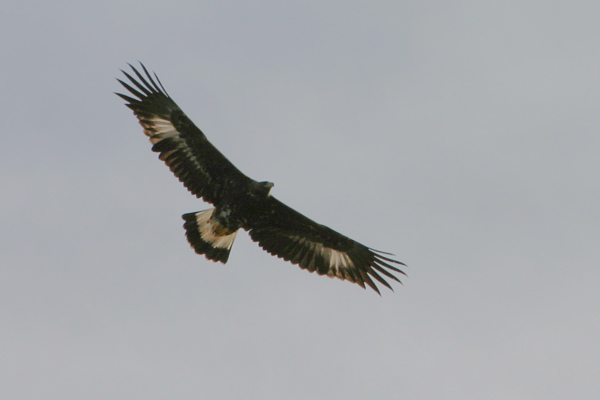
Short-toed Eagle

Other than Lesser Kestrels and hundreds of Black Kites we saw disappointingly few raptors but at least one Short-toed Eagle allowed close approach.

Mid-June would not be our recommended time to visit Doñana but if you can put up with temperatures of 40ºC and higher, it still offers some good birding.  Better, though, to go in April or early May when more birds are singing and there’s the prospect of seeing some migrants.


Sunday, 18 December 2016

Our birding week

There's been some fairly mixed weather this week but that’s what we expect at this time of the year.  We’ve had warm sunshine, we’ve had storms with strong winds and torrential rain and one morning we had to change our plans because of thick fog.  At least it hasn’t been too cold.

We helped out with the monthly count of wetland birds at Castro Marim on Monday.  In addition to the Cerro do Bufo area and Sinexpral, we also covered the Esteiro da Carrasqueira with the whole count taking four of us almost four hours.  Cerro do Bufo is a huge area which held close to 3,000 birds.  Counting them without disturbing them is a challenge and on this occasion we weren’t help by the presence of a couple of Marsh Harriers, an Osprey and a Peregrine Falcon that caused panic among the ducks and waders whenever they appeared.  The Shelducks were particularly flighty and we have to admit that our total count of 364 might not be the most accurate.

Osprey

Greater Flamingos (700) were the most numerous species; there were 18 wader species, seven duck species; 112 Cormorants and 70 Black-necked Grebes.  A single Great Egret was the nearest we came to seeing anything unusual.

Black-necked Grebes

At Sinexpral we found around 1,300 birds more than half of which were Dunlins; there were about a dozen Curlew Sandpipers amongst them.  In fact there were more than ten times more Dunlin here than there had been at Cerro do Bufo and lots more Ringed & Kentish Plovers, a pattern we have seen before.

Easily the most numerous species of the day were the Eurasian Coots on the Carrasqueira, about 900 of them.  On another day we might have searched through them for a Red-knobbed bird but we have to be in the right mood for that sort of thing and this wasn’t the time.  About a dozen each of Great Crested & Little Grebes were with them plus just a handful of ducks and gulls.

Great Crested Grebe

As well as Marsh Harriers and Peregrine Falcon we saw an Osprey, a Sparrowhawk, a Common Buzzard and a Common Kestrel – a six raptor day!  The following day at Quinta do Ludo we beat this with seven raptor species.  These included a Black-winged Kite, a Hen Harrier and no fewer than ten Booted Eagles.

Black-winged Kite

We always enjoy Ludo but for some reason on Tuesday it wasn’t at its best.  There was a marked lack of waders on the saltpans and an almost complete lack of ducks on the Ribeira de São Lourenço.

Thankfully, when we reached the lagoa de São Lourenço it was a different story - there were lots of birds to sort through and to photograph in the really nice afternoon light.   On the way there, we saw a Water Pipit, which wasn’t unexpected and a Woodcock, a species we see only rarely which was certainly a surprise!  Unfortunately, the Woodcock was dead by the roadside, probably hit by a car.

Eurasian Wigeon

Lagoa de São Lourenço is well-known as a place to see Little Bitterns and although this is a species that is considered to be a trans-Saharan migrant, it’s usually possible to find them here through the winter.  Today we saw three different birds.
 
Of course, this is one of the best sites in the Algarve to get close to and to photograph various common duck species and also Western Swamp-hens (a name, incidentally, we are still struggling to get used to).  Glossy Ibis and Black-headed Weaver are species that we expect to find here and in recent times we have regularly seen Water Rails.

Western Swamp-hen

Hoopoes are fewer here in winter but can usually be found on the neighbouring golf course, which is also the favoured feeding area for Mistle Thrushes.

 Hoopoe

Mistle Thrush

We got our required wader fix first of all in the Ria Formosa at Praia de Faro and later, on the way home, at saltpans near Olhão.  We often find a few Knots here and on this occasion were able to more or less walk up to one for a photograph.  This is also a regular place to find Slender-billed Gulls and we weren’t disappointed.

 Olhão saltpans

Red Knot

We finished the week with a trip west to Sagres and this turned out to be another six raptor day with Short-toed Eagle and Red Kite amongst them bringing the total of raptor species for the week up to eleven.

Short-toed Eagle

This was planned to be mainly a photography day and we hoped to find Alpine Accentors, Rock Pipits, Ring Ouzels and Purple Sandpipers.  As it was we had to settle for Cormorants, Black Redstarts, Thekla Larks and other more common species but had an enjoyable day in spite of that.

 Great Cormorant

Black Redstart

In fact we had a very pleasant week, dodging the worst of the weather and enjoying a great variety of birds.

Monday, 26 September 2016

Back in the Algarve at last!

We’ve been back in the Algarve for just a week now and seem to have timed our return quite well.  The weather is very pleasant but no longer uncomfortably hot, children have returned to school and birds are migrating!

 Short-toed Eagle

Already we have been to Castro Marim, Ludo, Quinta do Lago, Parque Ambiental de Vilamoura, Lagoa dos Salgados (twice) and Sagres (twice) and seen more than 120 species.

Castro Marim, usually one of our favourite reserves, proved to be something of a disappointment.  There are plenty of birds there, particularly in the Cerro do Bufo sector but with access to the site restricted it is difficult to get close to many of them.  Highlights were Black-necked Grebes, Audouin’s & Slender-billed Gulls and of course there are hundreds of waders and Greater Flamingos but a telescope was definitely a necessity.  The salt harvest is in progress and it looks to have been a productive season.

 Salt harvest and Black-tailed Godwits

 Juvenile Greater Flamingo

Dunlin

There was also much salt-related activity at Ludo.  As so often, it was raptors there that proved most popular with five Booted Eagles putting on a show and a single female Marsh Harrier quartering the reedbed.

Booted Eagle

At Quinta do Lago, Little Bitterns were the stars.  We saw seven or maybe eight different birds.  A Water Rail showed well; a juvenile Black-crowned Night-Heron and a Whiskered Tern were unexpected treats.  We lost count of the number of Western Swamphens but nine of them were together, completely in the open on the golf course; two Glossy Ibises took off and left before we had much chance to look at them.  Five species of gulls were on the lagoa de São Lourenço and two or three Kingfishers were chasing each other about.

Lagoa de São Lourenço from the hide

The Parque Ambiental de Vilamoura has become a favourite place at this time of the year and it didn’t disappoint – it was full of birds!  Most numerous were Willow Warblers and Chiffchaffs and Yellow Wagtails with one or two Northern Wheatears and Pied Flycatchers but we know from past experience that all sorts of rarities can and do turn up here at this time of year.  We will be back for another look very soon.  A Black-winged Kite here was reasonably approachable.

Northern Wheatear

The water level at Lagoa dos Salgados was lower than we would have liked but still there were impressive numbers of birds.  Notable were a Marsh Harrier, an Osprey, a Black-winged Kite, at least four different Bluethroats, a Little Bittern, several Western Swamphens and what appeared to be a thunbergi-type Yellow Wagtail.  Waders included Little Stint, Bar-tailed & Black-tailed Godwits, Common Snipe and Wood Sandpiper.  We searched through hundreds of gulls without finding anything other than fuscus, michahellis and ridibundus.  Glossy Ibises were especially numerous and on our first visit we estimated that there might have been as many as 1,000.  We managed to read colour-rings on several of them, which identified their origins as breeding sites near Sevilla and Huelva in Andalucia.  Two colour-ringed Spoonbills had travelled further – one from France and one from the Netherlands.

 Common Snipe

 Lagoa dos Salgados

Glossy Ibis

Both of our trips to Sagres produced reasonable numbers of raptors and importantly there were good, close views of many of them.  Most numerous were Black Kites (31 on the first visit, slightly fewer the second time).  Also seen were Egyptian Vultures, Short-toed Eagles, Booted Eagles, Honey-buzzards, Common Kestrels, a Sparrowhawk, a Goshawk and a Peregrine Falcon.  Two Black Storks came close overhead.  We saw just a single Little Bustard and a couple of Red-billed Choughs, while migrants included a Wryneck, several juvenile Woodchat Shrikes, Common Redstarts, both Pied & Spotted Flycatchers, Whinchats and Northern Wheatears.

 Egyptian Vulture

 Black Stork

Little Bustard

So, not a bad start (for us) to the autumn migration period and still more than enough places to visit. 
 

Sunday, 20 September 2015

Last week's birding

We're now settled back into our routine here in the Algarve and we've just  enjoyed an excellent week of birding. Migrants are on the move, it's been a particularly good week to see eagles and there's been much more besides.

Spanish Imperial Eagle

Our two visits to the Castro Verde area in the Baixo Alentejo gave us multiple sightings of Short-toed, Bonelli's, Golden & Spanish Imperial Eagles - enough to make anyone's day!  It would have been nice to have come across the Steppe Eagle that has recently been reported but maybe that was too much to ask for.  Other raptors we did see up there included Black-winged Kites, Griffon Vultures and Eurasian Black Vultures so there were no complaints.

 Short-toed Eagle

As usual at this time of the year, Great Bustards were relatively few and we failed to find any Little Bustards at all.  In an area where hundreds of them nest, there wasn't a White Stork to be seen but we watched a party of seven Black Storks over São Marcos da Ataboeira.  Most of the summer visitors such as Golden Orioles, Collared Pratincoles, Bee-eaters and Rollers have left but a couple of Black-eared Wheatears remained.

After a scorching hot summer the plains are baked dry and for many birds food must be scarce.  Most of the rivers and streams are now dry but there are quite a number of ponds and small reservoirs that still contain some water.  Green Sandpipers and Common Snipe winter around these reservoirs and both species are already in residence. A few passage waders also occur at these waters and we found Dunlin, Common Sandpiper, Greenshank and Ringed Plover.  We also saw Greater Flamingos and Spoonbills which somehow seem a little out of place here away from the coastal wetlands.

 Spoonbills

The eagles we saw in the Algarve were of course Booted Eagles, several of them at a regular site with two Black-winged Kites roosting nearby.  At Quinta do Lago, Little Bitterns, Glossy Ibises and Purple Swamp-hens were easy to see and a Water Rail made a brief appearance.  At Santa Luzia a juvenile Red-necked Phalarope brought to 25 the number of wader species recorded during the week; Audouin's & Slender-billed Gulls were also there.  At Olhão there were Mediterranean Gulls plus Caspian, Little, Common & Sandwich Terns and near Tavira we found what is presumed to be a hybrid Little x Western Reef Egret, a bird that has been in the area for several weeks.

  Booted Eagle

 Audouin's Gull

Red-necked Phalarope

Presumed hybrid Little x Western Reef Egret

An adult Spanish Imperial Eagle was our main reward for making the long trip to the Doñana area in neighbouring Spain.  There were also several Booted Eagles.  Again here it was a matter of finding some water in order to find a few birds as the whole place was parched dry and unrecognisable compared to how we see it in the spring and early summer. A few Black Storks, Great Egrets and Night Herons were seen as well as numerous Grey Herons, Cattle & Little Egrets but apart from Green Sandpipers and Black-winged Stilts there few waders and the day was generally disappointing.


Spanish Imperial Eagle

Everywhere we have been there have been at least a few passerine migrants, including Common Whitethroat, Northern Wheatears, Whinchats, Tawny Pipits, Pied  & Spotted Flycatchers, Chiffchaffs, Willow & Subalpine Warblers and Common Redstarts and we can expect more of the same during the coming weeks.  Maybe this will be the year for another North American passerine - we can but hope!

 Tawny Pipit

Whinchat

Saturday, 30 June 2012

Castro Marim

We’ve spent three mornings this week at and around the Reserva Natural do Sapal de Castro Marim e Vila Real de Santo António, which not surprisingly we tend to refer to simply as Castro Marim.  Not only is this one of the most productive birding sites in the Algarve but it also has the attraction for us that it is reasonably close to our base in Tavira and can be reached fairly quickly without incurring road tolls.

It’s getting to be quite warm here now with temperatures rising to 30ºC and higher by mid-morning, so early starts have become an essential part of our routine.  Breakfast has been accompanied by the ‘cut-ock, cut-ock’ song of Red-necked Nightjars and the calls of Little Owls, two birds that get the day list off to a good start before leaving home.


Castro Marim is primarily a wetland area and we have mentioned before that we recently counted almost 1,600 Greater Flamingos there.  We haven’t counted them this week but have no reason to think that there are any fewer than that number.  There is more to the reserve than just saltpans but they are a major attraction and already many Spoonbills and waders are returning, birds that have been north to breed or perhaps have suffered a failed breeding attempt.  Most numerous of these are Black-tailed Godwits but Dunlins, Grey Plovers and Ruddy Turnstones have also been seen and we were particularly pleased to see and hear the return of our favourite, Greenshanks and Green Sandpipers.


The local breeding waders, Kentish Plovers, Avocets, Black-winged Stilts and Stone-curlews all have young, some of them now well-grown.  A month or so ago, we saw a pair of Little Ringed Plovers with young on the reserve and it seems likely that Common Redshank have also nested in the area.


Gulls seen this week have been just the usual Yellow-legged, Slender-billed and Audouin’s.  Little Terns are numerous but it seems that they may not have had much breeding success.  Up to three non-breeding Caspian Terns have remained in the area and a flock of 18 Black Terns passed through on Tuesday.  Sightings of Collared Pratincoles have been popular and several pairs are assumed to be breeding.


We read somewhere in one of the guide books to the Algarve that there are few raptors here other than those seen at Sagres during the autumn period and that seeing anything other than a Common Buzzard or a Common Kestrel could be considered a bonus.  Well, we must have been very lucky this week with seven species seen just at Castro Marim!  A Black-winged Kite near Tavira made eight species.


We are still finding one or two Glossy Ibises in unexpected places and Castro Marim is no exception.  Several Purple Herons are being seen around the reserve which may also be birds displaced from Doñana.

Other highlights of the week at Castro Marim have been a pair of Purple Swamp-hens, singing Golden Orioles, a pair of Spectacled Warblers feeding young, Bee-eaters going backwards and forwards in and out of nest holes, several pairs of White Storks with young, Woodchat Shrikes, Southern Grey Shrikes, Little Bustards and what appeared to be a family party of four Common Ravens.


It is disappointing that ICNB have found it necessary to stop access to the Cerro do Bufo sector of the reserve and we miss doing the circular walk there that was part of our weekly routine.  Still, we have adapted to the change and we hope that visiting birders will also respect the restrictions – there are plenty of birds to be seen without the need to trespass!  

Sunday, 25 March 2012

Castro Verde, Castro Marim and more

March is a month when we expect to spend a lot of time in the Castro Verde area and we’ve had two more trips up there this week, making three visits in the past eight days. The number of species recorded on each visit has averaged 76 but these days in the Alentejo are more about quality than quantity. During these trips we have not just seen but had really great views of 16 species of raptors with Golden Eagle, Bonelli’s Eagle, Peregrine Falcon, Common Buzzard, Griffon Vulture and Black Vulture now added to the list that was included in our last report. We’ve watched countless Great Bustards displaying, almost seeming to turn themselves inside out and looking like big white powder puffs; some Little Bustards are also displaying now but many still seem to be in flocks. Other popular species have been Calandra Larks and Great Spotted Cuckoos, Black Stork and the numerous nesting White Storks.

Golden Eagle

Short-toed Eagle

Of course, we’ve also visited several of our favourite sites in the Algarve. At Quinta do Lago, we were pleased to get good views of a Purple Heron and a Little Bittern and once again a couple of Sacred Ibises were seen alongside the more familiar Glossy Ibises. At Ludo, we expected to find Booted Eagles and we weren’t disappointed.

Little Bittern

At Castro Marim, we had several encounters with noisy Great Spotted Cuckoos and at Aldeia Nova there was a Common Cuckoo. Last year we sponsored ‘Chris’, one of the Common Cuckoos that the BTO tagged and have been tracking by satellite throughout the winter months. It’s interesting that we have Cuckoos returning here now to the Algarve but ‘Chris’ and the other BTO Cuckoos, that are presumably going to return to the UK, are still in West Africa.

Great Spotted Cuckoo

Yesterday, during the high tide period, we were at Castro Marim again to carry out a count of the waders and other birds, mostly Greater Flamingos and Spoonbills, on the saltpans there. Avocets, Dunlins, Grey Plovers and Ringed Plovers were the most numerous species but the job wasn’t made any easier by a male Montagu’s Harrier that spooked the birds on a couple of occasions. Normally we love to see Montagu’s Harriers but when we’re half way through counting a flock of several hundred birds and they all take off in panic…well that does tend to change our views! It recalled occasions at Belvide Reservoir years ago when a Peregrine Falcon would often be the culprit that disrupted wildfowl counts.

Meanwhile, here in Tavira we’re starting to see a few more migrants. This morning we came across several Woodchat Shrikes, Greater Short-toed Larks and a Subalpine Warbler and heard the familiar calls of Bee-eaters. Our ‘bird of the morning’, however, was probably a lovely Black-necked Grebe in fine summer plumage. We have still been seeing Bluethroats this week but they will soon be on their way north. The Slender-billed Gulls that have wintered here will also soon be leaving; there are currently 14 of them. Only three years ago this species was classified as a rarity in Portugal but in the south-east of the country we go out most of the year almost expecting to see them and maybe it won’t be long before they join Audouin’s Gulls and breed here.

Woodchat Shrike

Bluethroat

Slender-billed Gull