Showing posts with label Little Crake. Show all posts

Tuesday, 11 April 2017

Bitterns & Crakes

Peter writes:
I’ve just returned to the Algarve after almost four weeks away which included leading another Avian Adventures tour in Northern Tanzania.  I say ‘another tour’ because this was my sixth time in Tanzania, but this wasn’t just another tour this was to see the wonderful Serengeti, the marvellous Ngorongoro Crater, Lake Manyara, Tarangire and Arusha National Parks.  It may be an itinerary that has become familiar to me over the past few years but this is undoubtedly one of the world’s great wildlife destinations and one I always look forward to visiting.

Having said that, it’s almost inevitable that while I’m away, at least one or two interesting birds turn up in the Algarve and this time was no exception.  I was only a couple of days into my trip when a Eurasian Bittern was reported from Parque Ambiental de Vilamoura.  There have been only a handful of records here of this species and it’s one that June and I have never seen in Portugal.  June went with Ray Tipper to look for it and although they didn’t see it they had more than a little consolation when instead they found a female Little Crake.  Then the next day a male Little Crake was found at Quinta do Lago.  I was slightly miffed even before I reached Tanzania!

In recent years there have been several records here of Little Crake, most of them at Quinta do Lago and usually following periods of easterly winds.  We have seen them a number of times, most recently in 2015 when we blogged here.

Yesterday we went to Parque Ambiental de Vilamoura optimistically thinking that the Great Bittern might still be there and to Quinta do Lago hoping to see a Little Crake.  We did at least have partial success.  We failed to see a Eurasian Bittern but I was pleased that the Little Crake remains at Quinta do Lago after three weeks even if it seemed to do everything possible to avoid being photographed.


There has been speculation in the past about Little Crakes possibly breeding here.  They can be such difficult birds to detect and previous records include a juvenile in September 2009.  Although we are not aware of any female being seen this time at Quinta do Lago, the present long-staying bird does put in mind the same thought.  And what about the Eurasian Bittern?  Is that a species that might breed here?  Vilamoura would certainly be the place for them.

I will be away again during the first half of May – that should be a good time for more rarities to show up!          

Saturday, 21 March 2015

Déja vu (again)!

Although they are still regarded as very rare birds in Portugal, the appearance last Thursday of two Little Crakes at Quinta do Lago could hardly be called a surprise.  In fact, their arrival was somewhat predictable given the pattern of occurrences of this species in recent years.  We wrote about it here at this time last year.


Now, once again, we have a male and a female being seen close to the hide that overlooks Lagoa de São Lourenço.  We were there yesterday for about two and a half hours and during that time were able to watch the birds for several minutes and even photograph them, although from quite a distance and in very poor light.


We arrived at the hide half thinking that it might be full of twitchers but then remembered where we were!  As it was, while we were waiting for the Little Crakes to show, we spoke to half a dozen or more people who came into the hide but none of them was even aware that these rarities had been reported.  They certainly showed interest when we told them the story but they all seemed just as keen to see Bluethroat, Glossy Ibis, Little Bittern, Common Snipe, Yellow Wagtail, Purple Swamp-hen, Black-headed Weaver, Cetti’s Warbler and several other species that were frequently visible only a few metres away.  And why not - and what a great place that hide is from which to see such a variety of species so well.  Perhaps the Little Crakes will attract more attention over the weekend but there are plenty of other birds to see while you’re waiting!


Anyway, what we would like to know is this.  Are these Little Crakes the same individuals that have occurred in exactly the same location and circumstances in previous years; where have they come from and where do they breed?  Any suggestions?


Interestingly, there has been a belated report of another Little Crake in the Algarve, at Paúl de Lagos on 5th March, and another was seen yesterday much further north near Óbidos.  If only they weren’t so secretive and such difficult birds to see maybe there would be a few more records not only in Portugal but elsewhere in Western Europe.

Sunday, 23 March 2014

Déja vu!

Once again there are Little Crakes (Porzana parva) at Quinta do Lago.  One was first seen on 14th March and subsequently two birds have been seen, a male and a female.

We blogged here about the occurrence of Little Crakes at Quinta do Lago in March / April 2012.  Those birds were extremely difficult to see and, in fact, we don't know whether it was ever established for sure whether there were two of them or whether one might have been a Baillon’s Crake (P. pusilla).

Unfortunately, but unsurprisingly, the current birds are so far proving even more elusive with one observer yesterday claiming that he had seen one or other of them for a total of only about a minute during the ten hours that he was there watching for them!

Before the 2012 bird(s), there were only two previous records of Little Crake in Portugal, both of them juveniles.  Can you guess where they were?  The first was a long-staying bird from 9th August to 11th September 2008 and the other was seen on 20th September 2009; both were at Quinta do Lago!

So now we have records from this one site of juveniles in 2008 and 2009 and adults in 2012 and 2014.  Do we see a pattern emerging?  Of course, there is no suggestion that Little Crake has bred at Quinta do Lago, although there is thought to be a small population of these secretive birds not so far from here, in Doñana.  No, presumably, like so many other birds in the Algarve, these are simply migrants that are passing through on their way to and from West Africa; the pattern is just that they have all been seen from what is the most regularly used birdwatching hide in the country.  How many other Little Crakes there might be passing through here undetected in less popular localities, one can only imagine!

If you have the patience, there should still be time to go to Quinta do Lago to try and see the birds.  As far as we know, at least one of the 2012 birds remained there until at least 8th April.  However, be prepared to spend a few hours!  Of course, as always, there are plenty of other birds to see; Little Bitterns and Purple Swamp-hens are very active and Black-headed Weavers are building nests but don’t let yourself be distracted by them - you will need to concentrate hard if you want to see a Little Crake!

 Purple Swamp-hen - part of the distracting sideshow!

Sunday, 1 April 2012

Crakes at Quinta do Lago

We were finally able to get to Quinta do Lago this morning to look for the Baillon’s/Little Crake(s) that have been reported there recently.

Little Bittern - part of this morning's sideshow

The Baillon’s Crake (Porzana pusilla) reported on 22nd March is a very rare species in Portugal with only three previous records, all of them back in the 1990s. There have been no further sightings of it as far as we know but at the same site on 27th and 28th March an equally rare Little Crake (P. parva) was seen and photographed.

Little Grebe

Since then there has been no further news but plenty of debate! Was the first bird misidentified? Could two rare crakes have arrived at Quinta do Lago in the same week? It does sound unlikely and although the recent spell of weather predominated by easterly winds certainly makes it possible, most people seemed to be think that a mistake had been made. The fact that a Moustached Warbler (Acrocephalus melanopogon) was reported by the same observer at the same time as the Baillon’s, a time when several Sedge Warblers (A. schoenobaenus) were also present, was another factor that seemed to put doubt in people’s minds. Moustached Warbler is also an extreme rarity here.

Red-crested Pochard

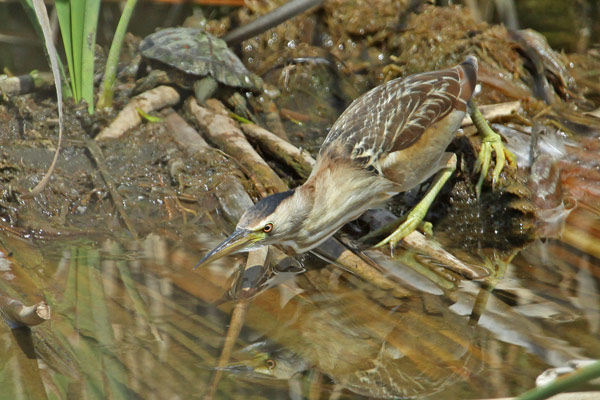
This morning was our first opportunity to go and see for ourselves. We arrived at Quinta Lago at about 7.45am and stayed there just about five hours. It would have been nice to include here lots of images of one or more crakes but that wasn’t to be and photographing Little Bitterns, Little Grebes, Red-crested Pochard and Purple Swamp-hens was all we managed. However, we did see crakes…

Purple Swamp-hen

At the edge of the reeds in the western corner of the lake we had multiple but very brief views of what we believe was a Little Crake. However, the time that elapsed between observations was such that we couldn't say with absolute certainty that only one bird was involved although we are inclined to think that was the case. We were unable to detect any barring on the bird that would have suggested identification as P. pusilla.

Little Bittern - again!

When we walked to the hide, about 100 metres away, we quickly had better views of what was definitely a Little Crake. We had several further views of this bird until it was last seen disappearing into vegetation straight out in front of the hide. Then, after an hour without seeing it again, we gave up and left.

Little Bittern - hard to resist

We consider the morning to have been only a qualified success. One the one hand, we confirmed the presence of at least two birds but unfortunately we weren’t able to verify the record of a Baillon’s Crake which would have been a ‘lifer’ for June. We can’t, however, rule out the possibility of a Baillon’s having been there or indeed still being there and we hope other people will go and look - we will certainly be there again as soon as we can!