Showing posts with label Common Kestrel. Show all posts

Friday, 6 October 2017

Algarve autumn

After spending much of the summer in the UK in order to avoid the extreme heat of the Algarve we returned here in September to find that it was still pretty warm.  And so it continues with the temperature rising to 30º C again yesterday and there’s continuing, wall to wall sunshine forecast for at least another week.  Not that we’re complaining, of course, but it isn’t ideal weather for long birding days and it isn’t weather that’s been bringing in many of the scarce or rare migrants that we hope for at this time of year.

Having said all that, we’ve been birding most days since our return and it’s been great.  Mostly we’ve been in the Ria Formosa but there have been days around Castro Verde to see the specialities of that area and we have had a couple of trips to Sagres where raptors and seabirds are the main attractions; we also spent some time with the team from Brewood Ringers who had another very successful visit to the Parque Ambiental de Vilamoura.
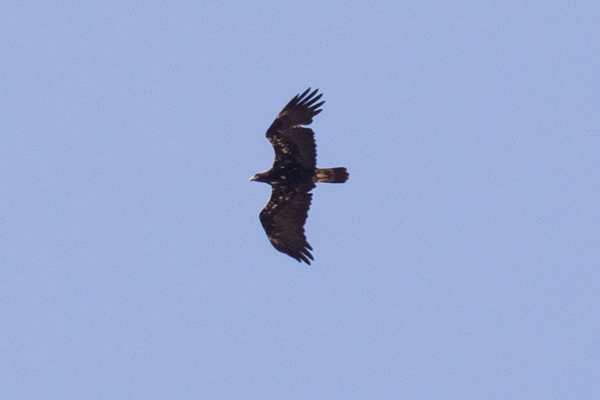
Spanish Imperial Eagle

As always, there’s been lots to see in the Ria Formosa.  It isn’t difficult to find 20 or more shorebird species in a morning around the tidal areas and saltpans and it’s usually possible to see six gull species without too much difficulty.  There was a Pectoral Sandpiper last month and a Red-necked Phalarope but so far nothing more exotic than those.  It’s fair to say that not everyone we take birding shares our enthusiasm for waders and gulls and still we find that Little Bitterns, Black-winged Kites, Western Swamp-hens and Bluethroats are the biggest ‘crowd-pleasers’.

One or two Yellow-browed Warblers have appeared in recent days but rare passerines have otherwise been missing.  In former years the ringers have produced the goods – we remember a Common Yellowthroat, Common Rosefinches, a Paddyfield Warbler and an Aquatic Warbler turning up in mist-nets at Vilamoura in the recent past but this year their success was simply in the actual number of birds they caught and ringed rather than finding rarities – 1903 birds of 56 varieties!  Their efforts once again underline the importance of the Parque Ambiental to a wide selection of migrant species.

 Iberian Green Woodpecker

Common Kestrel

At Sagres we managed to see a reasonable number of raptors but to be honest it would have been nice to view them at closer range.  Some days they come closer to Cabranosa than others and we just haven’t been lucky.  Highlights there so far (and there’s plenty of time left for more) have been two Rüppell’s Vultures and a Lesser Spotted Eagle.  We did get a distant view of the eagle, coincidentally on the same date that we saw a much closer one in 2015.

Highlights among the seabirds have been two Brown Boobies and a Yelkouan Shearwater, both seen from Cape St Vincent.  Whilst there is a nice photograph of the Brown Booby, the shearwater record may not have such an easy passage through the hands of the Rarities Committee.  We went out to sea about nine miles with Mar Ilimitado and on a fairly calm day saw Cory’s, Balearic & Great Shearwaters, European & Wilson’s Storm-petrels, Northern Gannets and just one Great Skua.  Maybe it wasn’t the most productive trip we’ve ever done but it was certainly memorable.  There were close encounters with a Fin Whale, several Striped Dolphins and far more Common Dolphins than we have ever seen before.

 Fin Whale

Common Dolphin

European Storm-petrel

Cory's Shearwater

Five Cory's and one Balearic Shearwater

We continue to read and report inscriptions from colour-rings.  These include the regular rings on Spoonbills and Greater Flamingos but more interestingly we have seen recently a nine year-old Glossy Ibis that was ringed in the Doñana area and which has returned to more or less the exact spot that we saw it in 2010 and 2012.  Also a Slender-billed Gull is back in the same saltpan where we first saw it at this time last year.

Spoonbill (ringed in The Netherlands)

Monday, 21 December 2015

Fuerteventura - 2

During our week on Fuerteventura we were based at Caleta de Fuste, a tourist resort situated only about 10km from the airport and no more than an hour’s drive from any of the birding sites we planned to visit.  It proved to be a good choice.

We had prepared for the trip by reading various tour reports published on the internet and by talking to friends who had been to the island.  We took with us Finding Birds in The Canaries by Dave Gosney and A Birdwatchers' Guide to the Canary Islands by David Collins and Tony Clarke both of which proved helpful.

We particularly wanted to see ten species that would be new for us: Fuerteventura Chat, Houbara Bustard, Plain Swift, Barbary Falcon, Barbary Partridge, African Blue Tit, Berthelot’s Pipit, Canary Islands Chiffchaff, Trumpeter Finch and Atlantic Canary.  In the event, we managed to find nine of them.  Some sources suggest that the Canary doesn’t even occur on Fuerteventura and we might now be inclined to agree with that!

We also wanted to try and photograph Cream-coloured Courser, Black-bellied Sandgrouse and Lesser Short-toed Lark.

 Cream-coloured Courser

 Black-bellied Sandgrouse

Lesser Short-toed Lark - subspecies polatzeki

We went twice to the reservoir at Los Molinos, where Ruddy Shelducks outnumbered all other birds put together!  We counted about 200 of them.  Unfortunately, the high water level resulted in very little shoreline for waders but this was one of the places we saw Fuerteventura Chat and Egyptian Vulture and we also had good views of the dacotiae race of Common Kestrel and the insularum race of Common Buzzard.

 Los Molinos Reservoir

 Ruddy Shelducks

Common Kestrel - subspecies dacotiae

Egyptian Vultures - subspecies majorensis

We made two visits to the plains around Tindaya and La Oliva.  On the first occasion we saw Houbara Bustard, Cream-coloured Courser and Black-bellied Sandgrouse.  They all took a bit of finding and the birding was ‘hard work’ but we enjoyed it so much that we went back there on our last day simply for a second helping!

Houbara Bustard - subspecies fuertaventurae

The water level at the Las Peñitas reservoir was also very high and it was hardly worth going there.  However, on the walk along the mainly dry river bed we did see a Grey Wagtail and our first African Blue Tit.  Nearby we spent some time in the attractive little town of Betancuria.  Founded in 1404 this was the original capital of the Kingdom of the Canary Islands and while there we slipped into ‘tourist mode’ for a short while.  It was also there that we had our best views of African Blue Tit and we also saw Canary Islands Chiffchaff and Monarch butterflies.

 Iglesia Catedral de Santa Maria de Betancuria

 African Blue Tit - subspecies degener

 Monarch Butterfly

More from us about Fuerteventura to come shortly...

Sunday, 25 September 2011

Ringing at Vilamoura

As well as visiting Ludo and Quinta do Lago and keeping an eye on the local Tavira and Santa Luzia area, this last week has twice seen us spending time at the Parque Ambiental de Vilamoura. For the fifth successive year a group of ringers from the UK has been visiting there and although there’s obviously a serious purpose to their visit, it’s also fun to see what they’re up to, what they catch and how they go about it all.

Catching a juvenile Booted Eagle and three juvenile Common Kestrels was certainly a surprise.

It’s instructive, too, and seeing how difficult it can be to age and sex birds in the hand definitely makes us more cautious about making these calls in the field. Also, of course, we remember that these same ringers, when they were here last year, trapped a Common Yellowthroat and two Common Rosefinches, birds that otherwise would surely have gone undetected. What might they turn up this time?

It was good to have the identification of a Greenland Wheatear confirmed by reference to biometrics rather than just “that looks big and chunky”.


As always, it was interesting to see familiar birds such as Bluethroats and Kingfishers in the hand and a Little Bittern at close range emphasised the fact that this is a bird that is all legs, neck and beak with quite a small body.

This year’s ringing session was earlier than any of the previous ones and almost a whole month earlier than in 2010. This in itself probably reduced the chances of trapping any major rarity but at the same time it was thought that it might increase the diversity of species ringed. Whatever, having already seen in the past few days without the aid of a mist net migrants including Wryneck, Woodchat Shrike, Tawny Pipit, Northern Wheatear, European Reed Warbler, Common Whitethroat, Greater Short-toed Lark and Whinchat, we knew there would be plenty to see.

Whereas in October, Chiffchaffs and Blackcaps have tended to be the most numerous species caught, this time there were relatively few of either of these. Instead, Red-rumped Swallow and European Reed Warbler seem to have topped the chart. No doubt, we will receive a full report with all the ringing totals in due course. Possibly one of the most surprising birds caught was a Spectacled Warbler found in what we would consider atypical grassland habitat.

Sorting out the races of Yellow Wagtails was easier when adult males were involved!

Willow Warbler and Chiffchaff, but which is which?

Red-rumped Swallow - hundreds roosting in the reed beds.

An unusual bird that wasn’t trapped was a Great Egret, one of only a handful of this species that we have seen in the Algarve. It flew over our heads and dropped into the neighbouring water treatment works (in Portuguese, the ETAR). The ETAR is usually full of birds at this time, particularly gulls, and it would be great to have access to the site or even a hide from which we could more easily view them.

As we have said before, the Parque Ambiental is a great site for birds and also for dragonflies and butterflies. It is one of the best places in the Algarve to see Monarch butterflies and this time we were also lucky enough to see a Plain Tiger, the so-called African Monarch, something of a rarity.

Parque Ambiental de Vilamoura

+++++++++++++++++++++++++

The occurrence in the UK of remarkable numbers of Nearctic vagrants on the back of Hurricanes Irene and Katia has to some extent been mirrored here in Portugal. So far this month six species of American shorebirds have been reported in mainland Portugal. Next door, in Spain there have also been multiple occurrences of transatlantic shorebirds. Unfortunately, here in the Algarve, we’ve had none at all or at least none have so far been reported. Surely there must be a Buff-breasted Sandpiper or a Pectoral Sandpiper here somewhere! Or, more difficult to find, perhaps a Semipalmated Sandpiper is lurking in one of the local saltpans. We must keep looking!

Wednesday, 19 January 2011

Kestrels & Owls

It may have something to do with how much time we have to spare or perhaps how poorly we plan ahead; maybe the outrageous cost of petrol is a factor. Whatever the reason, it’s a fact that these days our cross-border excursions for birding in Spain are few are far between.Certainly it’s a measure of how good the birding is here in the Algarve that we are tempted so infrequently to venture ‘abroad’. Our base in Tavira is less than a two-hour drive from Doñana (also known as Doñana National Park and Coto Doñana), considered one of the most important wetlands in Europe and yet we probably head off in that direction no more than two or three times a year.

We were actually in Doñana just a few days ago but it proved to be a rather disappointing day. The problem was simply the weather. We picked a day when the forecast promised wall to wall sunshine but when we got there what we had instead was fog! Visibility was really poor until early afternoon and, of course, there was little or no light for photography which was the main purpose of the trip. During the day we recorded about 70 bird species and came away with a few useable images so it wasn't a total waste of time by any means but the morning was more than a little frustrating.

We managed to photograph one or two Common (Eurasian) Kestrels, easily the most numerous of the raptors present. Our previous experience of Kestrels has been that they don’t sit still very long to pose for photographs but this time a couple of birds did oblige, one when the light was still quite poor, the other later after the sun broke through. What they had in common was that they both chose really unattractive perches!


No such problems with the weather back here in Tavira where we have again been out trying to photograph Short-eared Owls. There are now three birds regularly hunting over the local saltpans but getting near them requires time and patience plus more than a bit of luck. As the afternoon light fades and the ISO value has to be increased, so the birds seem more inclined to come within range! Today we watched for more than an hour without even pointing the camera at an owl but earlier in the week we did get a few more reasonable images.

Short-eared Owls feed predominantly on small mammals and their presence, hunting over the saltpans provokes very little reaction from the hundreds of waders that are present. In contrast to this, a male Hen Harrier that has been regularly quartering the same area sends Redshanks, Black-tailed Godwits, Avocets and others flying in panic in all directions even though smaller birds are probably its more realistic targets.


The owls are clearly defending feeding territories and we have seen and heard several mid-air skirmishes. They are fun to watch and we hope they stay around for a while.

Sunday, 21 December 2008

Sevilla

We’re just back from Spain. We were there with five representatives of other birding tour companies (two Brits, three Dutch) and a Spanish photo-journalist for a four-night stay at the invitation of Turismo de Doñana. From our point of view the object of the trip was to see parts of Sevilla province that we hadn’t visited previously and to find out more about those areas with which we are already reasonably familiar and perhaps learn about some new birding sites.

After spending the first night in El Pedroso, north of Sevilla, we spent much of the first day touring the Parque Natural de la Sierra Norte de Sevilla, a pleasant enough area of smooth, rounded hills with woods of stone pines and oaks and crossed by several rivers. Although we did see an immature Spanish Imperial Eagle, the truth is that we didn’t have a great day’s birding, spending too much time in the minivan as we tried to cover a huge amount of countryside. However, the bird list we were given suggests that it might be a very worthwhile area to explore in the spring and summer when Booted and Short-toed Eagles, Black, Griffon and Egyptian Vultures, Montagu’s Harriers, Black-shouldered Kites and Black Storks are all possible.

Our second day was spent in two areas to the south and east of Sevilla. We began by driving to Coripe where on a really cold and frosty morning began a walk of 6km along the Via Verde, a disused railway track that actually took us just a short way out of Sevilla province into Cádiz province. In spite of the temperature this was a most enjoyable walk that produced plenty of birds, including Hawfinch and Cirl Bunting before we reached Peñón de Zaframagón Interpretation Centre and Ornithological Observatory. Here is one of the largest colonies of Griffon Vultures in Europe. Apart from the vultures themselves, the main feature here is a remotely-sited digital video camera with a 300mm lens that allows real-time images of the birds and their nests to be seen on a screen inside the Centre. Bonelli’s Eagles also breed here and we were able to watch some wonderful footage taken earlier in the year of a pair of eagles bathing. No Bonelli’s Eagles to be seen now, unfortunately.

From here we went north to La Lantejuela where on the extensive plains that surround the village we were taken to see a flock of about 30 Great Bustards. Also in the same area we saw Stone Curlews and several of the common raptor species. At the edge of the village itself we had a brief visit in rapidly fading light to a complex of sewage and water treatment lagoons. There were Little and Black-necked Grebes here and a selection of the common duck species but it looked like a place that could be very productive at another time of the year. White-headed Ducks are said to breed here.

Our last full day was spent around the eastern side of Doñana National Park, including a stop at the Jose Antonio Valverde Visitor Centre. This was mostly familiar territory for us and it came as no surprise to see Greater Flamingos, Spoonbills, White-headed Ducks, Red-knobbed Coots, Purple Swamp-hen, Little Bustard, Common Cranes, Black-crowned Night Herons and countless raptors. A gathering of about 2000 White Storks was quite a sight and with them were Glossy Ibises, Wood Sandpipers and about a dozen Yellow Wagtails. We spent the last hour or so of the day in the Aznalcázar pinewoods in the hope if not with any real expectation of seeing a Spanish Lynx. Our consolation was standing in the dark listening to Tawny, Long-eared and Eagle Owls, all calling at the same time. This just after actually seeing a Little Owl!

Common Kestrel

On Saturday morning, after a short return visit to the pinewoods, we were taken to the FIBES Exhibition Centre in Sevilla to visit Sevilla Son Sus Pueblos, an event promoting tourism in Sevilla province. Sometimes the more formal segments of trips like this, when we have to leave our binoculars behind, can be a bit of a chore but this was definitely an exception. There was a workshop and an opportunity to discuss some of the issues involved in attracting birdwatching tourism to Sevilla; afterwards we enjoyed looking at the many stands on which the small towns and villages surrounding the city displayed their individual attractions.

All in all it was an excellent opportunity to see quite a few places that we might not otherwise have visited. We also renewed existing friendships and enjoyed great hospitality in some very nice hotels and restaurants. Many thanks to all at Turismo de Doñana and especially to Sergio and Manolo, our driver/guides.