Friday, 20 September 2013

Travels Up North - 1

When we came to Portugal it was our plan to spend most of our time here in the Algarve but also to use Tavira as a base from which to explore the rest of the country and also some of the nearer parts of Spain.  For a variety of reasons this hasn’t really happened.  We have got to know parts of the Baixo Alentejo very well but trips further north have been few and far between.  We have been birding around the Tejo Estuary and we have been to Lisbon but that’s been about it - until last weekend!

We have just returned from a very enjoyable four day visit to Porto and Northern Portugal where we were hosted by the local Tourism Board and the Porto Convention Bureau.  We were accompanied throughout by José Aragão from Turismo de Portugal, local guide Monica and driver, Ricardo.

Our lunchtime flight from Faro to Porto with Ryanair was very convenient and a perfectly satisfactory experience.  We arrived in the country’s second-largest city with time for just a short tour around the old and narrow streets.  Porto (sometimes seen referred to as Oporto) is a city with tremendous historical interest; it was designated a UNESCO World Heritage Site in 1996.  We will have to go back to fully appreciate it and do it justice.

Porto and the Douro River

One feature that we did get to see was the historic São Bento Railway Station, well known for its tile (azulejo) panels depicting scenes of the history of Portugal.  The tiles are said to number 20,000 and date from 1905–1916.

São Bento Railway Station

After the city tour we went to the Cálem port wine cellars where we saw and heard about the production of tawny and ruby ports, LBVs, Colheitas, etc.  We also got to sample a couple of them, something that became a recurring theme of the trip!
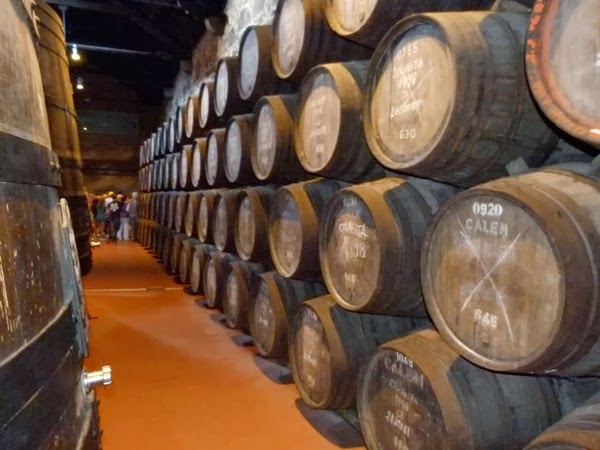
Cálem port wine cellar

Dinner was enjoyed at the D. Tonho Restaurant where our outside table overlooked the Douro River and the famous Dom Luis Bridge.
 
Dom Luis Bridge

We very soon heard about the nickname given to the people of Porto: tripeiros, people who eat tripe!  This refers to a period in history when higher-quality cuts of meat were shipped from Porto with their sailors, while off-cuts and by-products, such as tripe, were left behind for the local citizens.  Although tripe is still a popular dish, neither of us was tempted to try it, probably having been put off by what we have seen on sale in butchers’ shops in the UK.

We stayed overnight at the Vila Galé Porto which is located within easy walking distance of the city’s main shopping area.

The following morning we travelled north by minibus to the Peneda-Gerês National Park, which is the only national park in Portugal and actually straddles the border with Spain.  We met with Paulo and Isobel, guides from Portugal Green Walks, in the town of Ponte de Lima and after stopping off to look at the historic espigueiros in the village of Soajo and a very pleasant lunch, we walked part of the Glacier and Alto Vez trail.  There were 24 espigueiros looking almost like a small cemetery; they are grain stores, constructed from local granite, some dating back to the 18th Century and still in use today for storing and drying maize.  An interesting feature of the walking trail was the grooves that had been worn in the rocks by years of use by heavy ox-carts.

Espigueiros

 Peneda-Gerês National Park...


Did we see any birds?  Well, yes we did see quite a number but of the species that we hoped to find in the north of the country, i.e. those that don’t normally occur in the Algarve, we caught just a glimpse of a Coal Tit!

We spent the night at the beautifully located Aquafalls Hotel in S. Miguel da Caniçada, about 30km from Braga.  As so often on these trips, there wasn’t time to sample its many facilities and we even went out to dinner, to the Pousada Santa Maria do Bouro, a 12th Century Cistercian monastery, which was well worth the drive not just for the food but for the ambience and the whole experience.

More to follow...

Friday, 13 September 2013

Dotterels

Dotterels are scarce birds here in the Algarve.  They seem to occur most years in September or October but only in very small numbers, sometimes just single birds, but they’re not guaranteed to stay around for more than a few days.  The regular site for them is the Vale Santo, near Cabo de São Vicente at the extreme south-west of the country and that’s where we were yesterday.

We had seen reports that four or even five Dotterels had been seen earlier in the week and realising that we hadn’t managed to see one here since 2007, we decided to give them a try.  We set off early from Tavira, along with Ray Tipper, hoping that the birds would still be there - it would be a long way to go and not see them!


It turned out to be a bright, sunny day (no surprise there!) but it was also quite windy and although we did eventually find three Dotterels it took us some time as they were hunkered down, getting what shelter they could in the sparse vegetation.  Even from just a few metres away they remained almost invisible and we might easily have given up.  But that’s the nice thing about Dotterels, as well as being really lovely birds, they’re also very confiding and with patience they can be approached quite closely.


But we weren’t just there for the Dotterels.  The Sagres peninsula is particularly well known for raptor migration at this time of the year and so we also spent some time at the popular watch point, Cabranosa.  It wasn’t a vintage day by any means but we did see a Short-toed Eagle, two Ospreys, a Goshawk, one or two Montagu’s Harriers and Peregrine Falcons and several Honey Buzzards - a nice variety even if the numbers were small and even if we did miss seeing an Eleanora's Falcon.


Among the passerine migrants in the area were Tawny Pipits, Whinchats, Spotted & Pied Flycatchers, Northern Wheatears, Yellow Wagtails, Short-toed Larks, Woodchat Shrikes, Willow Warblers and Chiffchaffs, all contributing to a most enjoyable day that was well worth the long drive. 

Saturday, 7 September 2013

Lesser Flamingo!

Our first day back in the Algarve and already a rarity!  Not for the first time our reward for helping out with the monthly wetland bird count at Castro Marim was seeing something unusual.

A few weeks ago we received news that a pair of Lesser Flamingos was breeding among the many thousands of Greater Flamingos at Laguna Fuente de Piedra in the Málaga province of Spain.  We know from colour-ringing that many of the Greater Flamingos we see in the Algarve originate from there so maybe then it shouldn’t have been such a surprise this afternoon to see a Lesser Flamingo among the many Greaters at Castro Marim.


Of course, today’s bird could be from somewhere else completely but it’s nice to think that it might have come from Laguna Fuente de Piedra and that it might stay in our area into the winter.  Even among the many hundreds of Greaters it should be easy enough to locate from its smaller size, all dark bill and generally pinker appearance.

We have only once before seen a Lesser Flamingo at Castro Marim; that was on 1st July 2007.  All records of this species are, of course, subject to scrutiny by the Portuguese Rarities Committee and even when accepted they are usually accompanied by a comment about the possibility of escape from captivity.  The breeding birds in Spain may well be from a wildfowl collection somewhere - who knows?

Lesser Flamingos are birds that we are more used to seeing in Africa mainly in the Rift Valley lakes of Ethiopia and Tanzania.

Wednesday, 4 September 2013

Autumn approaches

Where does the time go?  As our stay in the UK nears its end, we realise that we haven’t managed to do anything like as much birding here as we had hoped and intended.  However, as already reported, we have visited a number of the reserves that were previously our regular stamping grounds and in the process it has been good to meet up with quite a number of old friends.  Bittell Reservoirs have recently been added to the list of local sites visited and we also managed a few hours at Lakenheath Fen RSPB Reserve on our way back from a trip to the Norwich area.

Peter was born within walking distance of Upper Bittell Reservoir and Sunday afternoon visits there were regular long before he owned any binoculars.  In fact, his earliest visits, across the fields from what used to be known as ‘Groveley Corner’, probably involved him being carried by his parents!  Access to the reservoirs is rather more restricted now than it was in those days and although there are public footpaths that allow some views, it would certainly be necessary now to obtain permission from the owners, Barnt Green Waters Ltd, to cover the area thoroughly.  Without such permission our visit was a bit frustrating.

The website of Barnt Green Sailing Club has an interesting section on the history of the reservoirs, which owe their existence to the Worcester & Birmingham Canal, completed in 1815.  Apparently there was intense opposition to the building of the canal and the necessary Act of Parliament was not passed until the third attempt in 1791!  Who in those days could possibly have foreseen the importance that the reservoirs now have as habitat for birds and other wildlife - not to mention the sailing and fishing!

At Lakenheath Fen we managed to see a couple of Common Cranes, a Little Egret, an Osprey and a Marsh Harrier but few other birds of note.  However, as we have been pleased to find elsewhere, there were plenty of butterflies, particularly Small Tortoiseshells, which have been relatively scarce in recent years.  Our favourite bird organisation, the BTO, currently has a page on its website detailing records of Small Tortoiseshells provided by participants in BTO Garden BirdWatch.  These records show that numbers increased dramatically with the hot, dry weather of early July.  A number of possible reasons, including the weather, are suggested for the annual fluctuation in numbers of this most familiar of our butterflies.  For several weeks the Buddleias in our garden have been attracting them (along with lots of Large Whites), we now have one that seems already to be hibernating in our office and there seem to be others looking to find a way in!

 Lakenheath Fen (above & below)


Small Tortoiseshell

If you do go to the BTO website, also take a look at the latest news of the satellite-tagged Common Cuckoos.  Back in 2011 we chose well when we decided to sponsor ‘Chris’ which is now the only Cuckoo known to survive from the five that were tagged that year.  The latest signal received from ‘Chris’ was on 2nd September.  He arrived in Chad on 24th July and has remained there throughout August but based on his movements during the past two migrations, he can be expected to head soon for the Central African Republic and then on to the Congo Rainforest.  We will be following his progress and hoping that he makes it back to Thetford Forest in 2014.

Here in Stafford "barred clouds bloom the soft-dying day, and touch the stubble-plains with rosy hue" but Keats made no mention of those hundreds of Canada Geese that pass over the house each morning and evening!

Join us for a seabird trip!

Very soon we'll be back in the Algarve and we're very much looking forward to the autumn migration period when we'll hope to see a rarity or two appear among the regular species.  Raptor passage, best experienced in the Sagres / Cabo de São Vicente, is a particular feature during September and October and we will also hope to spend some time with the ringing group from the UK who will be at Vilamoura for a week.  Remember last year they caught an Aquatic Warbler and the highlights of their previous years' mist-netting sessions have included Common Yellowthroat and Common Rosefinch.  Around the Ria Formosa or at Castro Marim, another North American wader would be nice, maybe a Least Sandpiper or a Solitary Sandpiper!

Cory's Shearwater

Autumn is also the time for seabird passage and we have arranged a boat trip from Fuseta for Friday, 4th October.  We plan to be out for about 2½ - 3 hours and we'll hope to see Shearwaters (Cory's, Great, Balearic and maybe Manx or Sooty), Skuas (Great, Pomarine and maybe more), European Storm-petrel, Gannets, various gulls and terns, etc.  Based on previous experience of similar trips and assuming good weather, there should be good opportunities for photography.  If you're interested in joining us, please contact us via our website for further details.

Monday, 19 August 2013

Birdfair 2013

We‘re just back from an exhausting but very enjoyable weekend at the Birdfair held as usual at Rutland Water Nature Reserve.  The organisers describe it as the international wildlife event of the year and who would argue?  This year Birdfair was celebrating its 25th anniversary and with almost 350 exhibitors and four simultaneous lecture programmes it has grown well beyond anything that could possibly have been imagined back in 1989 when Tim Appleton and Martin Davies organised the first modest birdwatchers’ fair on behalf of the RSPB and the Leicestershire and Rutland Wildlife Trust.


Right from the start, profits from the Birdfair have been donated to conservation projects with the total amount raised now standing at more than £3 million.  Currently Birdfair is supporting BirdLife International’s Global Flyways Programme, funding projects to study and help migratory species.  This year it is grassland-dependent migrants in the Americas that are the focus, species such as Upland Sandpiper, Buff-breasted Sandpiper, Swainson’s Hawk and Bobolink that rely on the effective management of grasslands throughout the Americas flyway where the remnants of native grasslands are fast disappearing under grain, oil-seed and other commodity crops.  A Birdfair-funded project will co-ordinate work at grassland Important Bird Areas in Mexico, Colombia, Bolivia and Argentina. 

Buff-breasted Sandpiper - this one was in the Algarve

We travelled to Rutland Water on Thursday to help put up the Avian Adventures stand and then spent most of Friday, Saturday and Sunday talking.  We talked about birds and we talked about travel.  We talked a great deal about the Algarve and we talked about many other places we have been and others that we would like to visit.  We talked to friends from countries in Africa, North, South and Central America and various parts of Europe and we talked to friends from the West Midlands.  We talked to people who have been with us on Avian Adventures tours and to many whom we have guided in the Algarve.  We talked to an encouraging number of you who are regular readers of our blog.  In short - we talked!

 The Avian Adventures stand before the Birdfair opened - all neat and tidy!

Marquee 3 - there were 10 marquees this year

Birdfair is undoubtedly one of the highlights of our year.  We always come away disappointed by how quickly three days have passed and because in that time we haven’t been able to get round the whole site and see everything and everybody.  Already next year’s event is in our diary - it’ll be on 15th, 16th & 17th August 2014.  

Wednesday, 14 August 2013

Time to Stop the Shooting!

We applaud the Portuguese Liga para a Protecção da Natureza (LPN) which has today called for a two-year moratorium on the shooting of Turtle Doves. Tomorrow sees the start of the hunting season but it surely makes no sense whatsoever to continue killing a species that is clearly in serious trouble with a population that continues to decline at an alarming rate. As an example, the British population is reported to have reduced by 90% since the 1960s.


Major changes in farming methods and adverse conditions in their wintering areas in Africa may well be the main causes of the decline in Turtle Doves and competition with Collared Doves could also be a factor. However, the scale of the slaughter of these birds in Italy, Spain, Greece, Cyprus, Malta, Portugal and elsewhere in Europe cannot be sustainable. And then, outside the European Union, there’s Morocco, Egypt and other countries in North Africa where large numbers are also shot, many of them by ‘tourist’ hunters from Europe!

While resources are being devoted to research and conservation programmes in the UK and elsewhere and there is a long-term Management Plan in place with the objective of halting the species’ decline, it makes very little sense to allow up to an estimated 3 million or more of these birds to be legally killed actually in the EU. In fact, it’s complete madness!


The LPN press release calls for the Portuguese Government to act now to protect the Turtle Dove before it is too late and the population reaches the point of no return. The plight of the Turtle Dove in Europe is unsettlingly similar to that of the Passenger Pigeon in North America, which was also once a common and widespread bird but driven to extinction as a result of hunting pressure and habitat loss. Nineteenth century Americans may have had some sort of excuse in their ignorance of what was happening to the Passenger Pigeon but there can be no such excuse for Europeans if we allow the Turtle Dove to continue its slide to oblivion.