Showing posts with label Yellow Wagtail. Show all posts

Thursday, 12 June 2014

Hot Summer Days

We don’t expect to have much rain at this time of the year.  The average amount for the month of June here in Tavira is only about 8mm.  There was a brief shower a few nights ago but any trace of it was gone by morning and many people won’t even have noticed it.

Recently, temperatures have been rising to around 25ºC most days but the forecast shows an expected high at the weekend of a toasty 32º.  Everywhere the land looks baked and parched, a situation that is unlikely to change until well into September at the earliest.


If you’re a House Martin wanting mud for your nest, it’s definitely not much fun!  Mud is in short supply!  Of course, the breeding season for House Martins started early here; many birds were back in February and some didn’t leave at all, managing to find enough insect food in the Algarve through the ‘winter months’.  By now most will have raised at least one brood if not two.  But still there are birds that are busy collecting mud.  Probably they are repairing nests rather than building new ones from scratch, but who knows?


We always enjoy watching and photographing birds that are attracted to fresh water, whether they are collecting mud or just drinking and bathing.  Migration seasons give more chance for something unusual to show up but even now there can be a good selection of species.  The common seed-eating finches, Serins, Goldfinches, Greenfinches and Linnets, are the most regular but, as well as the House Martins and an occasional Barn Swallow, we have had Spotless Starlings, Blackbirds, House Sparrows, Collared Doves, Azure-winged Magpies and Yellow Wagtails.


It’s been both enjoyable and frustrating to sit watching these birds and at the same time listen to Nightingale, Blackcap, Cetti’s Warbler, Reed Warbler and Common Waxbill, all of them just a few metres away but none showing any inclination to come out for a bath and a photo session!


We haven’t been spending all our time cooped up in the car taking photographs - for one thing, it’s far too hot!  We’ve also spent time in the Castro Verde area watching Rollers, Lesser Kestrels, Collared Pratincoles and more, many of them feeding young.  And yesterday we helped with the monthly count of the birds on the Castro Marim Reserve, where the highlights as far as numbers are concerned were 1,200 Greater Flamingos, 780 Black-tailed Godwits, 147 Slender-billed Gulls, 116 Shelducks, 212 Black-winged Stilts and 175 Avocets.  As well as counting, we managed to read quite a number of colour-rings, mostly on Spoonbills and Audouin’s Gulls.

Thursday, 28 March 2013

Water, Water, Everywhere...

Any concerns there might have been earlier in the year about an impending water shortage here in the Algarve can certainly be forgotten now as after several weeks with scarcely a dry day the reservoirs are full to overflowing and there’s water lying everywhere.

Quite a lot of the bird photography we do here is at ponds and puddles.  We’ve tried to attract birds by offering them food but had no success at all; they just haven’t caught on to the idea of a free meal.  However, they do love fresh water for drinking and bathing and we’ve spent more hours than we care to think about sitting by pools of water.

Obviously, this strategy works best when there isn’t much fresh water around.  Last autumn, when everywhere was parched, a burst pipe at Castro Marim resulted in a small pond forming and we were regular visitors there to photograph Green Sandpiper, Spotted Redshank, Stonechat, Southern Grey Shrike and others.  In mid-February, just before the deluge started, we spent several hours at a puddle near Sagres that attracted 21 species during the time we were there.  On that occasion we were particularly pleased to photograph Ring Ouzels and Redwings.

Ring Ouzel

Right now with so much water available we wouldn’t normally consider devoting a lot of time to a single pond but yesterday we came across a Water Pipit that was feeding around the edge of a temporary pool where we have regularly had success in the past.  We couldn’t resist it!

Two hours later we came away with reasonable photographs of Yellow Wagtails and a Little Ringed Plover but less than satisfactory ones of the pipit, which just wouldn’t come close enough.  A Corn Bunting and a Meadow Pipit also popped in briefly but five species was a poor return for the time we put in.

 Little Ringed Plover

Meadow Pipit

Undeterred, we were back there this afternoon (it is only a short distance away) and after an hour or so of watching a White Wagtail and a Meadow Pipit, several Yellow Wagtails chasing each other about and the same Little Ringed Plover as yesterday, the Water Pipit finally showed up.  This time we got the photo but only just in time as the bird was spooked by a noisy Black-winged Stilt and flew into the distance – the joys of bird photography!

 Water Pipit

Yellow Wagtail

Barn Swallows and House Martins have been here in good numbers for several weeks now and there are reasonable numbers of Yellow Wagtails around but otherwise migrants seem quite slow to arrive.  Woodchat Shrikes, Pallid Swifts, Spectacled Warblers, Bee-eaters, Common Cuckoos, Nightingales and Subalpine Warblers are here but not yet in the numbers we might expect.  Maybe the Easter weekend will bring some more. 

Woodchat Shrike

Saturday, 29 September 2012

Our birding week

On Tuesday we headed west to Sagres and Cabo de São Vicente, a journey that we are inclined to make less frequently these days as the price of fuel increases and with tolls now having to be paid on the A22 motorway.  We also know that the long day out to the west, although it promises much in the way of raptor migration and more, can sometimes prove to be a disappointing anticlimax.  The good days at Sagres can be really good but, of course, there are no guarantees other than the cost!

As it turned out and in spite of cloudy conditions and a fair amount of rain we had a reasonable morning’s birding.  Passerine migrants included several of the expected species such as Spotted & Pied Flycatchers, Northern Wheatears and Chiffchaffs and we also found a single Bonelli’s Warbler.  Out over the sea an occasional Balearic Shearwater was seen amongst the numerous Northern Gannets and Cory’s Shearwaters and we might have had further reward had we stayed longer on the cliff top.  However, raptors were our priority and during a brief spell when the weather threatened to clear up, we did see a couple of Egyptian Vultures, four Booted Eagles, possibly three different Short-toed Eagles and a Peregrine Falcon over Cabranosa.  Raptors elsewhere during the morning were a Black-winged Kite, at least one other Peregrine Falcon, several Common Buzzards and Common Kestrels and a Sparrowhawk.

On the way back we spent a couple of hours at Lagoa dos Salgados where there was an impressive number of gulls, White Storks and Greater Flamingos and a nice selection of waders that included the Pectoral Sandpiper that was first seen on 16th September.  A single Glossy Ibis, a Marsh Harrier, one or two Purple Swamp-hens and a Bluethroat were the other highlights.  The gulls were mostly Lesser Black-backs but also included at least a couple of Audouin’s.


It was disappointing that we spoke to several people at Salgados who were enthusing about the birds and the lagoon but who, in spite of all the publicity, still had no idea of the threat that the site currently faces or the online petition that has now attracted almost 16,500 signatures.

On Wednesday morning we went a much shorter distance in the opposite direction, east to Castro Marim, still our favourite birding area in the Algarve even though there is no longer public access to a major part of the reserve.  It’s hard to pick out highlights among the 60 or so species recorded as none were very surprising but we enjoyed seeing the hundreds of Audouin’s Gulls, a dozen or more Black-necked Grebes, a Peregrine Falcon, a Caspian Tern, about 20 Stone-curlews and a flock of 15 Little Bustards.  We were left to wonder what else there might have been in areas that we couldn’t see from the public track.

In the afternoon, we visited a small lagoon close to Castro Marim where three Ferruginous Ducks, eight Red-crested Pochards, a Purple Swamp-hen and a Kingfisher made the short diversion well worthwhile.  Later, back in Tavira, it didn’t take more than a few minutes to locate four Slender-billed Gulls, one of which had been colour-ringed in Spain.

Thursday was more or less a day off from birding but around Tavira we did see the hybrid “Grey Egret” and a Slender-billed Gull at Forte do Rato and there were 25 or more Greater Short-toed Larks at two different sites either side of town.  Unfortunately, the larks and the Yellow Wagtails with them proved rather skittish and difficult to photograph.


Yesterday we were in the Castro Verde area.  It was a mostly cloudy and dull day but it wasn’t until the drive home that there was significant rain.  We were able to find several groups of Great Bustards, totalling 20 or more birds but once again Little Bustards eluded us.  We saw about 30 or more Black-bellied Sandgrouse, several Tawny Pipits, Calandra Larks and Stone-curlews but, not surprisingly, it was a very poor day for raptors with Common Buzzards sitting dejectedly on power poles and just nine Griffon Vultures and a Black Vulture being of any real note.

Sunday, 25 September 2011

Ringing at Vilamoura

As well as visiting Ludo and Quinta do Lago and keeping an eye on the local Tavira and Santa Luzia area, this last week has twice seen us spending time at the Parque Ambiental de Vilamoura. For the fifth successive year a group of ringers from the UK has been visiting there and although there’s obviously a serious purpose to their visit, it’s also fun to see what they’re up to, what they catch and how they go about it all.

Catching a juvenile Booted Eagle and three juvenile Common Kestrels was certainly a surprise.

It’s instructive, too, and seeing how difficult it can be to age and sex birds in the hand definitely makes us more cautious about making these calls in the field. Also, of course, we remember that these same ringers, when they were here last year, trapped a Common Yellowthroat and two Common Rosefinches, birds that otherwise would surely have gone undetected. What might they turn up this time?

It was good to have the identification of a Greenland Wheatear confirmed by reference to biometrics rather than just “that looks big and chunky”.


As always, it was interesting to see familiar birds such as Bluethroats and Kingfishers in the hand and a Little Bittern at close range emphasised the fact that this is a bird that is all legs, neck and beak with quite a small body.

This year’s ringing session was earlier than any of the previous ones and almost a whole month earlier than in 2010. This in itself probably reduced the chances of trapping any major rarity but at the same time it was thought that it might increase the diversity of species ringed. Whatever, having already seen in the past few days without the aid of a mist net migrants including Wryneck, Woodchat Shrike, Tawny Pipit, Northern Wheatear, European Reed Warbler, Common Whitethroat, Greater Short-toed Lark and Whinchat, we knew there would be plenty to see.

Whereas in October, Chiffchaffs and Blackcaps have tended to be the most numerous species caught, this time there were relatively few of either of these. Instead, Red-rumped Swallow and European Reed Warbler seem to have topped the chart. No doubt, we will receive a full report with all the ringing totals in due course. Possibly one of the most surprising birds caught was a Spectacled Warbler found in what we would consider atypical grassland habitat.

Sorting out the races of Yellow Wagtails was easier when adult males were involved!

Willow Warbler and Chiffchaff, but which is which?

Red-rumped Swallow - hundreds roosting in the reed beds.

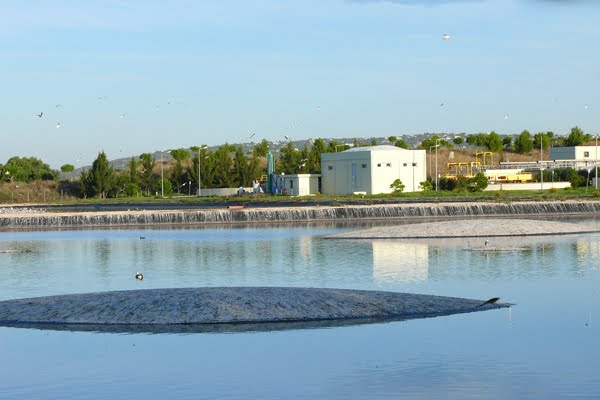
An unusual bird that wasn’t trapped was a Great Egret, one of only a handful of this species that we have seen in the Algarve. It flew over our heads and dropped into the neighbouring water treatment works (in Portuguese, the ETAR). The ETAR is usually full of birds at this time, particularly gulls, and it would be great to have access to the site or even a hide from which we could more easily view them.

As we have said before, the Parque Ambiental is a great site for birds and also for dragonflies and butterflies. It is one of the best places in the Algarve to see Monarch butterflies and this time we were also lucky enough to see a Plain Tiger, the so-called African Monarch, something of a rarity.

Parque Ambiental de Vilamoura

+++++++++++++++++++++++++

The occurrence in the UK of remarkable numbers of Nearctic vagrants on the back of Hurricanes Irene and Katia has to some extent been mirrored here in Portugal. So far this month six species of American shorebirds have been reported in mainland Portugal. Next door, in Spain there have also been multiple occurrences of transatlantic shorebirds. Unfortunately, here in the Algarve, we’ve had none at all or at least none have so far been reported. Surely there must be a Buff-breasted Sandpiper or a Pectoral Sandpiper here somewhere! Or, more difficult to find, perhaps a Semipalmated Sandpiper is lurking in one of the local saltpans. We must keep looking!

Wednesday, 23 March 2011

Avian Adventures and more

We've been busy with a week-long Avian Adventures tour here in the Algarve and with other guiding that has resulted in multiple visits to the Castro Verde area and the coastal hotspots, Quinta do Lago, Lagoa dos Salgados, Tavira/Santa Luzia and Cabo de São Vicente.

The weather has been mixed with some thunderstorms and strong winds but now seems to have settled down and currently we have a cloudless sky and a comfortable 17° C.

Here are a few recent photographs:

We managed to see 11 species of raptors during the second of our days in the Baixo Alentejo, including lots of Lesser Kestrels. It was also a day that produced more than 100 Great Bustards and a nice flock of 40 Black-bellied Sandgrouse. On our earlier visit we saw the last three Common Cranes of the winter.

We are now seeing three races of Yellow Wagtails arriving: flava, flavissima and this one, iberiae.

Also creeping about in the grass, we found a couple of newly-arrived Greater Short-toed Larks.

On the local saltpans, Black-winged Stilts, Avocets and Kentish Plovers are now in pairs and preparing to nest.

Among the many Ringed Plovers on the saltpans, we are still seeing a few Little Ringed Plovers. 'Lurps', as we call them, are already occupying breeding sites inland.

Amongst the many Common Redshanks was this one, the first colour-ringed individual of this species we have seen in the Algarve. It was ringed in the Netherlands in May 2010. We have also seen a Dutch-ringed Spoonbill and a Spanish-ringed Greater Flamingo this week.

We have seldom seen more Red-crested Pochards at Quinta do Lago than there were yesterday. Red-billed Pochard would surely have been a more sensible name!

The Avian Adventures group included some keen botanists, so we have also been looking at orchids. This one is Sawfly Orchid, photographed near Sagres where we were entertained by a flock of 40 Red-billed Choughs, saw a few lingering Ring Ousels and found Spectacled Warblers.

Hoopoe - the Avian Adventures logo and, for photographers, hard to resist.

So many birds, so little time...

Tuesday, 15 March 2011

Changeover time

What a busy time for us and the birds - plenty to see and to show to people! We've had some pretty poor weather these last couple of weeks but at last, today, the sun is out again!

Lots of migrants are arriving now. A few Barn Swallows and House Martins were with us throughout the winter and we even saw the odd Red-rumped Swallow in December. Now they're all here in large numbers and Sand Martins are also passing through. Two Pallid Swifts we saw on 14th February were, it seems, the earliest on record in the Algarve. They have since been followed by Yellow Wagtails, Woodchat Shrikes, Northern Wheatears, Common Cuckoos, European Reed Warblers and more. No matter how many times we've experienced the annual return of these birds in the spring, it's an exciting time and we want to be out there welcoming them back no matter what the weather.

Yellow Wagtail

At the same time, we are seeing waders such as Black-tailed Godwits starting to acquire their colourful breeding plumage while for some resident species the breeding season is already well underway. Some already have young in the nest.

Black-tailed Godwit

Lesser Spotted Woodpecker

Many of our winter visitors are still here: we are still seeing Short-eared Owls, for instance, and there are still plenty of Chiffchaffs around and Bluethroats are still occupying their winter territories.

Short-eared Owl

The saltpans still have lots of waders and those that have wintered here are being joined by more that are on their way back having ventured further south. All too soon there will be a mass exodus as all these birds fly north to their breeding grounds. Our consolation is that we will have Bee-eaters, Golden Orioles, Nightingales and others to replace them!

Ruff

Saturday, 30 October 2010

A Quieter Week

Well, we've had the relaxed week we promised ourselves but have still seen plenty of birds during single visits to Castro Marim, Parque Ambiental de Vilamoura and Quinta do Lago and several local excursions around Tavira and Santa Luzia. The weather has remained mostly warm and sunny, although Friday was cloudy and we had our first rain for a while.


Two unusual views of the ETAR at Vilamoura - a hide here overlooking the water treatment works would be popular
.
The very familiar view from the hide at Quinta do Lago.

After all last week’s excitement, a Common Gull reported from the Ria Formosa and a Pied Wagtail near Tavira have been the nearest we’ve had to rarities in the Algarve or at least that’s all we’ve heard about. However, remembering that November last year produced Whooper Swan, Red-breasted Flycatcher and White-rumped Sandpiper, there is still plenty of time to be looking for the unusual.

Meanwhile, we are seeing some of the scarcer wintering species settling in to familiar places. Black-necked Grebes, Squacco Heron, Little Bittern, a hybrid ‘Grey Egret’, Slender-billed Gulls, Glossy Ibis, Penduline Tit, Booted Eagles and Black-winged Kite have all been found in the last few days exactly where they were last winter. Some of the commoner winter species don’t yet seem to be here in the numbers we would expect, notably Song Thrushes and Chaffinches, and although we saw our first Bluethroat as long ago as 11th September, there still don’t seem to be many around Tavira at least. Late migrants in the last few days have included Turtle Dove, Pied Flycatcher, Yellow Wagtails and a Red-necked Nightjar.

Presumed garzetta x gularis hybrid egret.

Booted Eagle

Yellow Wagtail

Yesterday, we saw our first ‘kitchen window’ Eurasian Griffon of the autumn and no doubt there will be more during the coming weeks as the birds that have congregated at Sagres start to make their way east looking for a shorter crossing to North Africa.

It's heading straight for us!!

And, of course, we've been looking for a yellowlegs (or two?) around the local saltpans...

Common Greenshank