Showing posts with label Parque Ambiental. Show all posts

Monday, 26 September 2016

Back in the Algarve at last!

We’ve been back in the Algarve for just a week now and seem to have timed our return quite well.  The weather is very pleasant but no longer uncomfortably hot, children have returned to school and birds are migrating!

 Short-toed Eagle

Already we have been to Castro Marim, Ludo, Quinta do Lago, Parque Ambiental de Vilamoura, Lagoa dos Salgados (twice) and Sagres (twice) and seen more than 120 species.

Castro Marim, usually one of our favourite reserves, proved to be something of a disappointment.  There are plenty of birds there, particularly in the Cerro do Bufo sector but with access to the site restricted it is difficult to get close to many of them.  Highlights were Black-necked Grebes, Audouin’s & Slender-billed Gulls and of course there are hundreds of waders and Greater Flamingos but a telescope was definitely a necessity.  The salt harvest is in progress and it looks to have been a productive season.

 Salt harvest and Black-tailed Godwits

 Juvenile Greater Flamingo

Dunlin

There was also much salt-related activity at Ludo.  As so often, it was raptors there that proved most popular with five Booted Eagles putting on a show and a single female Marsh Harrier quartering the reedbed.

Booted Eagle

At Quinta do Lago, Little Bitterns were the stars.  We saw seven or maybe eight different birds.  A Water Rail showed well; a juvenile Black-crowned Night-Heron and a Whiskered Tern were unexpected treats.  We lost count of the number of Western Swamphens but nine of them were together, completely in the open on the golf course; two Glossy Ibises took off and left before we had much chance to look at them.  Five species of gulls were on the lagoa de São Lourenço and two or three Kingfishers were chasing each other about.

Lagoa de São Lourenço from the hide

The Parque Ambiental de Vilamoura has become a favourite place at this time of the year and it didn’t disappoint – it was full of birds!  Most numerous were Willow Warblers and Chiffchaffs and Yellow Wagtails with one or two Northern Wheatears and Pied Flycatchers but we know from past experience that all sorts of rarities can and do turn up here at this time of year.  We will be back for another look very soon.  A Black-winged Kite here was reasonably approachable.

Northern Wheatear

The water level at Lagoa dos Salgados was lower than we would have liked but still there were impressive numbers of birds.  Notable were a Marsh Harrier, an Osprey, a Black-winged Kite, at least four different Bluethroats, a Little Bittern, several Western Swamphens and what appeared to be a thunbergi-type Yellow Wagtail.  Waders included Little Stint, Bar-tailed & Black-tailed Godwits, Common Snipe and Wood Sandpiper.  We searched through hundreds of gulls without finding anything other than fuscus, michahellis and ridibundus.  Glossy Ibises were especially numerous and on our first visit we estimated that there might have been as many as 1,000.  We managed to read colour-rings on several of them, which identified their origins as breeding sites near Sevilla and Huelva in Andalucia.  Two colour-ringed Spoonbills had travelled further – one from France and one from the Netherlands.

 Common Snipe

 Lagoa dos Salgados

Glossy Ibis

Both of our trips to Sagres produced reasonable numbers of raptors and importantly there were good, close views of many of them.  Most numerous were Black Kites (31 on the first visit, slightly fewer the second time).  Also seen were Egyptian Vultures, Short-toed Eagles, Booted Eagles, Honey-buzzards, Common Kestrels, a Sparrowhawk, a Goshawk and a Peregrine Falcon.  Two Black Storks came close overhead.  We saw just a single Little Bustard and a couple of Red-billed Choughs, while migrants included a Wryneck, several juvenile Woodchat Shrikes, Common Redstarts, both Pied & Spotted Flycatchers, Whinchats and Northern Wheatears.

 Egyptian Vulture

 Black Stork

Little Bustard

So, not a bad start (for us) to the autumn migration period and still more than enough places to visit. 
 

Sunday, 2 January 2011

New Year's Day


Once again we spent New Year’s Day trying to find as many bird species as possible – a ‘Big Day’. It’s just a bit of fun and the only competition involved is with ourselves – our record to beat was 106, set in 2009 and a total that we managed to equal last year.

In past years we have spent the morning in the Ludo/Quinta do Lago area, the afternoon at Castro Marim and then used up the remaining hour or so of daylight around Tavira. Unfortunately, as there is no longer any access to the best (Cerro do Bufo) section of the Castro Marim reserve, yesterday this plan had to be revised. We decided, based on our visit there last Monday, to go instead to the Parque Ambiental de Vilamoura but this proved to be something of a tactical mistake.

We set off from Tavira at about 7.00am, not easy after a late night watching the New Year’s Eve firework display! The weather forecast referred to just a 20% chance of rain all day, which often means no rain at all, so there would be no excuses on that score.

At Ludo, we started the day with the expected Booted Eagles and Black-winged Kites but it was a sign of things to come that there was no Osprey or Hen Harrier to be seen, birds that we have found there on a number of recent visits. However, after continuing to Quinta do Lago, we saw most of the other expected species and when after about five hours we left the area, our running total was 84. We would have liked it to be at least 90!

Glossy Ibis at Quinta do Lago - No: 78 for the day

Opting to visit Vilamoura meant that we were driving further than we really wanted to, using up valuable birding time, but we were seduced by the prospect of Southern Grey Shrike, Penduline Tit, Barn Swallow, Red-rumped Swallow, House Martin and Black-necked Grebe, species that we had seen there only a few days ago most of which we were unlikely to see elsewhere. We also had this fantasy about finding a Jack Snipe there! In the event, Vilamoura let us down badly. We saw none of those anticipated species. In fact we left there having added only five species to the total and four of those we could probably have found around Tavira. The exception was Black-headed Weaver which we had somehow contrived to miss at Quinta do Lago. In the context of the day it was a long drive for effectively that one species.

We now had very little time left to cover our home area around Tavira and virtually no chance of getting anywhere near a record total. Even then, in an area we know so well, some birds that we were confident of seeing let us down. The flock of Knots that on any other day would have been feeding at Quatro Águas were nowhere to be seen! We simply didn’t have time to go and look for the local Blue Rock Thrush.

At about 5.00pm we were feeling a bit dejected and ready to pack up and return home. In the fading light we had found Stone-curlews and Golden Plovers but were more than a little disappointed that they were only numbers 94 and 95 on our list, way short of our target.

At this point, the last bird of the day put in a very welcome appearance and what a change there was in our mood. It was a Short-eared Owl! We may have been 10 species short but this bird was completely unexpected and it saved our day. There seem to have been more reports than usual of Short-eared Owls this winter but this was our first and we’ll be hoping it stays around so that we can see it again.

So, a total of only 96 species. Next year there will definitely have to be a re-think about the day's schedule and, of course, we will hope for more co-operation from the birds!

Friday, 31 December 2010

Avian Adventures in Portugal

We've just spent a week leading the Avian Adventures Christmas tour. In past years we have taken groups to Arizona & New Mexico, Texas, Cuba, Costa Rica and South Africa for Christmas birding but this year we had the people come to us in Portugal and we joined them, staying six nights in the excellent Vila Galé Albacora, located close to Tavira and just five minutes drive from home.

Hotel Vila Galé Albacora

The weather was kind to us more or less throughout. Although it was pouring with rain in Tavira on the morning of Christmas Day, we were able to change our plans and by driving out to Cape St Vincent managed to stay dry. Otherwise, it was a mixture of 'partly sunny' and 'partly cloudy' with a generally pleasant temperature.

Our programme for the week took us to all our favourite birding sites in the Algarve plus, of course, there was a trip into the Castro Verde area of the Baixo Alentejo.

Star birds of the week for us were the two Barnacle Geese seen less than a kilometre from the hotel on the Tavira saltpans. It seems that this was the first record of this species in the Algarve! Unfortunately, they were very skittish and quickly flew out of sight before there was any possibility of a photograph.

Also around Tavira we were able to find at least two Slender-billed Gulls, a male Hen Harrier, a Peregrine Falcon, almost 100 Stone-curlews and the usual selection of waders. The hybrid egret ('Hollywood Egret') at Santa Luzia performed well and we were also pleased to note the return of the similar garzetta x gularis hybrid at Forte do Rato, a bird we haven't seen for a while.

Forte do Rato - dates back to the 16th Century

Slender-billed Gull

Kentish Plover

We had an excellent day in the Ludo/Quinta do Lago area where Booted Eagles, Black-winged Kites, Marsh Harriers, an Osprey and a Hen Harrier all appeared on cue and we had little difficulty in seeing Little Bittern, Glossy Ibis and Purple Swamp-hen. A Black-crowned Night Heron and two Sacred Ibises were seen in flight.

Amongst the most popular birds of the week were the Penduline Tits seen at Parque Ambiental de Vilamoura. There were also Booted Eagle, Marsh Harrier and Purple Swamp-hen there and all four hirundine species were feeding together over one of the lagoons - Barn Swallow, Red-rumped Swallow, Crag Martin and House Martin. The trees and bushes were full of Blackcaps, Robins, Blackbirds and Song Thrushes; there were Siskins and Serins feeding together in the conifers and two Black-necked Grebes on the ETAR.

Penduline Tit

Parque Ambiental de Vilamoura

Our trip to Cape St Vincent produced one major surprise, a Great Bustard, the first we have seen in the Algarve. More to be expected here were Red-billed Choughs, Blue Rock Thrush, Rock Doves and Shag. Little Bustards were seen only in flight and at some distance.

At Lagoa dos Salgados there was relatively little water but plenty of birds - a nice selection of waders and ducks, plus Spoonbills, Purple Swamp-hen, hundreds of Black-headed Gulls and a couple of Bluethroats.

Castro Marim proved a little disappointing - the closing to birdwatchers of the Cerro do Bufo section of the reserve is undoubtedly a major blow to those of us who have been regular visitors there. However, we did get reasonable views of about 20 Little Bustards. Nearby, at the mouth of the Guadiana, we were able to find at least four Little Terns.

Our day around the Castro Verde area produced few surprises. We saw around 70 Great Bustards, mostly in flocks of about 15 or 20, there were lots of Red Kites, we found one good-sized flock of Calandra Larks, Cranes and Little Bustards were few but there were plenty of Black-bellied Sandgrouse. The highlight was seeing an adult Spanish Imperial Eagle on the ground with what appeared to be four immature birds of the same species.

All in all it was a satisfactory and very enjoyable week and hopefully we have sent 12 more people back to the UK to spread the word about how good the birding can be in the Algarve.

Hoopoe - always a crowd-pleaser

Saturday, 30 October 2010

A Quieter Week

Well, we've had the relaxed week we promised ourselves but have still seen plenty of birds during single visits to Castro Marim, Parque Ambiental de Vilamoura and Quinta do Lago and several local excursions around Tavira and Santa Luzia. The weather has remained mostly warm and sunny, although Friday was cloudy and we had our first rain for a while.


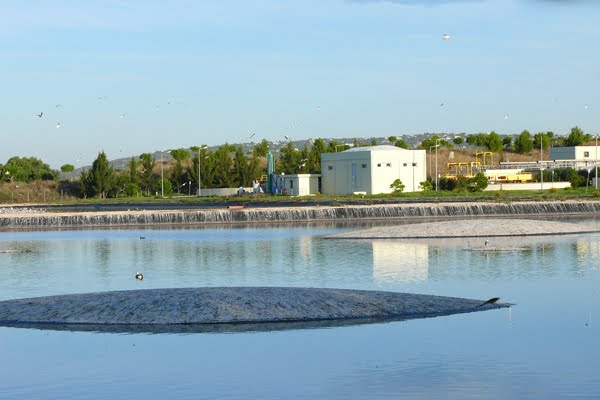
Two unusual views of the ETAR at Vilamoura - a hide here overlooking the water treatment works would be popular
.
The very familiar view from the hide at Quinta do Lago.

After all last week’s excitement, a Common Gull reported from the Ria Formosa and a Pied Wagtail near Tavira have been the nearest we’ve had to rarities in the Algarve or at least that’s all we’ve heard about. However, remembering that November last year produced Whooper Swan, Red-breasted Flycatcher and White-rumped Sandpiper, there is still plenty of time to be looking for the unusual.

Meanwhile, we are seeing some of the scarcer wintering species settling in to familiar places. Black-necked Grebes, Squacco Heron, Little Bittern, a hybrid ‘Grey Egret’, Slender-billed Gulls, Glossy Ibis, Penduline Tit, Booted Eagles and Black-winged Kite have all been found in the last few days exactly where they were last winter. Some of the commoner winter species don’t yet seem to be here in the numbers we would expect, notably Song Thrushes and Chaffinches, and although we saw our first Bluethroat as long ago as 11th September, there still don’t seem to be many around Tavira at least. Late migrants in the last few days have included Turtle Dove, Pied Flycatcher, Yellow Wagtails and a Red-necked Nightjar.

Presumed garzetta x gularis hybrid egret.

Booted Eagle

Yellow Wagtail

Yesterday, we saw our first ‘kitchen window’ Eurasian Griffon of the autumn and no doubt there will be more during the coming weeks as the birds that have congregated at Sagres start to make their way east looking for a shorter crossing to North Africa.

It's heading straight for us!!

And, of course, we've been looking for a yellowlegs (or two?) around the local saltpans...

Common Greenshank

Tuesday, 19 October 2010

Common Yellowthroat!!

It was just a week ago that we said it: "Surely it can only be a matter of time now before we get a passerine from across the Atlantic!"

Well it turned out to be less than a week as yesterday a Common Yellowthroat (Geothlypis trichas) was trapped and ringed at the Parque Ambiental in Vilamoura. The bird was found in a mist-net late in the afternoon by John Hodson, part of a team of British ringers led by Fergus Henderson who had arrived in Portugal only that day.


Common Yellowthroat is a common enough bird in North America, breeding in most of the USA and southern Canada; birds from the north of its range are migratory, most spending the winter in Mexico and Central America south as far as Panama. This one, a hatch-year male, has the distinction of being the first passerine from across the Atlantic to be found in mainland Portugal.

Marshes and other wet areas with dense low vegetation are its favoured habitat and the Parque Ambiental is absolutely ideal. Maybe it will be seen again...