Showing posts with label Common Greenshank. Show all posts

Monday, 23 November 2015

Birding mostly around Tavira

For much of the last week or so our birding has been restricted to our local patch - the Tavira and Santa Luzia area.  With most of the time spent around the saltpans and along the edge of the Ria Formosa it’s not surprising that we have seen mainly wetland birds.

 Tavira saltpans

 Santa Luzia saltpans

Estrada das 4 Aguas - roadworks are still unfinished and
birding here will never be quite the same again

There are only relatively few Greater Flamingos here now and Spoonbill numbers have also dropped as birds have continued their migration south into Africa.  However, after a period of absence, White Storks are now quite numerous and there are plenty of Little Egrets and Grey Herons to be seen.

Little Egret

Wader numbers have also fallen but there continues to be a good variety of species although for some reason, Golden Plovers have been conspicuous by their absence.

Common Greenshank

Numbers of Stone-curlews seem to be fewer than in some previous years but at least 20 birds are regularly present.  Sadly, the area that they have usually favoured continues to be subject to disturbance and disruption.

Stone-curlew

It’s still easy enough to find six species of gulls in the area but the flock of 500 Mediterranean Gulls that we were seeing earlier in the month seem to have moved on.  However, we counted 50 Slender-billed on the 18th November, which is an increase.

Slender-billed Gull 

We expect to find Caspian Terns and Sandwich Terns at this time of year but a Little Tern has also been seen on a couple of occasions.  A few Little Terns usually spend the winter in the mouth of the Guadiana River but otherwise they are normally gone from the Algarve by the end of October.

Even more surprising was the Whiskered Tern that we found, also on the 18th and seen for at least the following two days.  This is easily our latest ever record and only our second in November.

Whiskered Tern

The low bushes around the saltpans provide insect food for numerous Chiffchaffs, Zitting Cisticolas, Sardinian Warblers; Stonechats are common and it’s not hard to find a Bluethroat or two.

Sardinian Warbler

Raptors seen in the last few days have been Black-winged Kite, Hen Harrier, Marsh Harrier and Common Kestrel. 

Yesterday, by way of a change, we spent a couple of hours in the morning at the wastewater lagoons near Faro, tempted by a report of a Terek Sandpiper being seen there the previous day.  A light northerly wind has dropped the temperature here in recent days (to a maximum of about 18ÂșC) but it was a very pleasant, sunny morning.

 Northen Pintail

 Peregrine Falcon

 Eurasian Wigeon

We didn’t find a Terek Sandpiper but can hardly say we came away disappointed when we saw Peregrine Falcon, Marsh Harrier, Glossy Ibis (20+), Spotted Redshank, Greenshank, Green Sandpiper, Common Snipe (c.6), Common Sandpiper (c.12), Black-winged Stilt (c.15), Spoonbills, Greater Flamingos, Water Pipit, Bluethroat and Audouin’s Gull, plus hundreds of Gadwall, Shoveler, Pintail and Wigeon and more than 50 Cormorants.  We particularly enjoyed watching the Peregrine as it flushed more and more ducks from unseen ponds in the surrounding area.   


Monday, 19 December 2011

Ethiopia - Part 3

South of Addis Ababa the main road passes through the Central Rift Valley and close to a succession of lakes that are of major importance for resident birds and for Palearctic and Afrotropical migrants.

Pied Kingfisher - common around most of the lakes.

Egyptian Geese - seen most days of the tour.

We were able to visit Lakes Cheleleka, Hora, Ziway, Langano and Awassa and made brief stops at others when we were travelling.

Although wetland birds were the main focus, the lakes are surrounded by bird-rich savannas and forest and the diversity of species was impressive.

Fields of vegetables at Lake Cheleleka come as a surprise to the first-time visitor expecting to find Ethiopia a country of famine and drought.

Fishing at Lake Awassa attracts pelicans, cormorants, egrets, gulls and terns.

Roosting Slender-tailed Nightjars were easy to find in the grounds of our hotel at Lake Langano.

One of several Greyish Eagle-Owls that we saw, this one was at Lake Langano.

This much bigger Verreaux's Eagle-Owl and its mate were being mobbed by Fan-tailed Ravens.

Greenshank, one of the many wader species wintering around the lakes.

African Pygmy-geese at Lake Ziway; they are attractive little birds but are they geese or ducks?

Western Reef Egrets are mainly coastal and this one at Lake Hora was the only one we saw. It had us thinking about those apparent hybrids we see around Tavira.

Superb Starling - common and widespread.

Masked Shrike, a species that we had seen before only in Lesvos. We saw 18 species of shrikes, bush-shrikes, boubous, etc in Ethiopia.

More from Ethiopia soon...

Thursday, 11 November 2010

The Week in Pictures

We've been busy around Tavira this week where there has been plenty to keep us occupied:

Eurasian Griffons passed over Tavira this week, presumably heading for Tarifa. About 150 were counted on Sunday.

At least three Water Pipits have been regular at Pedras d'el Rei.

Meadow Pipits are now very numerous - but still smart little birds and quite variable in plumage.

Always popular and, in spite of what some of the books say, still quite vocal in November.

Greater Flamingos - hard to ignore.

Bar-tailed Godwit - one of at least 21 wader species currently around Tavira.

Sometimes even long-legged Flamingos get out of their depth!

Common Greenshank - always one of our favourites!

When not chasing off Little Egrets, this hybrid Western Reef x Little Egret regularly poses for photographs - tight-rope walking a speciality!

Stone-curlews are not too hard to see - if you know where to look!

Six gull species are here now and can sometimes be seen all in one place. Just two on this photograph.

Lesser Black-backed Gull - one of the most common species around here in winter.

Saturday, 30 October 2010

A Quieter Week

Well, we've had the relaxed week we promised ourselves but have still seen plenty of birds during single visits to Castro Marim, Parque Ambiental de Vilamoura and Quinta do Lago and several local excursions around Tavira and Santa Luzia. The weather has remained mostly warm and sunny, although Friday was cloudy and we had our first rain for a while.


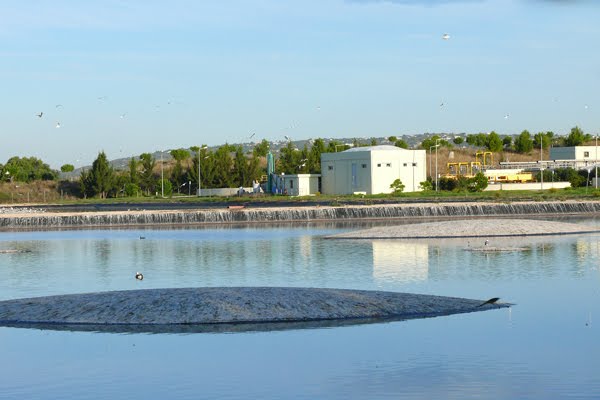
Two unusual views of the ETAR at Vilamoura - a hide here overlooking the water treatment works would be popular
.
The very familiar view from the hide at Quinta do Lago.

After all last week’s excitement, a Common Gull reported from the Ria Formosa and a Pied Wagtail near Tavira have been the nearest we’ve had to rarities in the Algarve or at least that’s all we’ve heard about. However, remembering that November last year produced Whooper Swan, Red-breasted Flycatcher and White-rumped Sandpiper, there is still plenty of time to be looking for the unusual.

Meanwhile, we are seeing some of the scarcer wintering species settling in to familiar places. Black-necked Grebes, Squacco Heron, Little Bittern, a hybrid ‘Grey Egret’, Slender-billed Gulls, Glossy Ibis, Penduline Tit, Booted Eagles and Black-winged Kite have all been found in the last few days exactly where they were last winter. Some of the commoner winter species don’t yet seem to be here in the numbers we would expect, notably Song Thrushes and Chaffinches, and although we saw our first Bluethroat as long ago as 11th September, there still don’t seem to be many around Tavira at least. Late migrants in the last few days have included Turtle Dove, Pied Flycatcher, Yellow Wagtails and a Red-necked Nightjar.

Presumed garzetta x gularis hybrid egret.

Booted Eagle

Yellow Wagtail

Yesterday, we saw our first ‘kitchen window’ Eurasian Griffon of the autumn and no doubt there will be more during the coming weeks as the birds that have congregated at Sagres start to make their way east looking for a shorter crossing to North Africa.

It's heading straight for us!!

And, of course, we've been looking for a yellowlegs (or two?) around the local saltpans...

Common Greenshank