Although they are still regarded as very rare birds in Portugal, the appearance last Thursday of two Little Crakes at Quinta do Lago could hardly be called a surprise. In fact, their arrival was somewhat predictable given the pattern of occurrences of this species in recent years. We wrote about it here at this time last year.
Now, once again, we have a male and a female being seen close to the hide that overlooks Lagoa de São Lourenço. We were there yesterday for about two and a half hours and during that time were able to watch the birds for several minutes and even photograph them, although from quite a distance and in very poor light.
We arrived at the hide half thinking that it might be full of twitchers but then remembered where we were! As it was, while we were waiting for the Little Crakes to show, we spoke to half a dozen or more people who came into the hide but none of them was even aware that these rarities had been reported. They certainly showed interest when we told them the story but they all seemed just as keen to see Bluethroat, Glossy Ibis, Little Bittern, Common Snipe, Yellow Wagtail, Purple Swamp-hen, Black-headed Weaver, Cetti’s Warbler and several other species that were frequently visible only a few metres away. And why not - and what a great place that hide is from which to see such a variety of species so well. Perhaps the Little Crakes will attract more attention over the weekend but there are plenty of other birds to see while you’re waiting!
Anyway, what we would like to know is this. Are these Little Crakes the same individuals that have occurred in exactly the same location and circumstances in previous years; where have they come from and where do they breed? Any suggestions?
Interestingly, there has been a belated report of another Little Crake in the Algarve, at Paúl de Lagos on 5th March, and another was seen yesterday much further north near Óbidos. If only they weren’t so secretive and such difficult birds to see maybe there would be a few more records not only in Portugal but elsewhere in Western Europe.
Showing posts with label Quinta do Lago. Show all posts
Saturday, 21 March 2015
Saturday, 14 April 2012
The Last Two Weeks
It’s the migration season, that time of the year when even more than usual we want to be out birding all day every day. So that’s what we’ve been doing and why it is there’s been no news from us for almost two weeks!
During that time, we’ve had two further visits to the Castro Verde area, a trip across the border to Doñana and multiple visits to the usual sites in the Algarve – Quinta do Lago, Ludo, Castro Marim, Tavira/Santa Luzia, Olhão and even Lagoa dos Salgados, somewhere that we don’t go all that frequently.
We’ve had no further luck with the crakes at Quinta do Lago and neither it seems has anyone else. There’s been one further report of a Little Crake there but no confirmation of the Baillon’s Crake reported on 22nd March. Interestingly, three further Baillon’s Crakes have been found further north in Portugal during the past couple of weeks and there’s been at least one in Spain. There was another Little Crake at Vilamoura on 2nd April and there have been at least three Spotted Crakes in the Algarve during the same period of easterly winds.
The weather that brought the crakes has also resulted in us having many more migrants than usual in the Algarve. Species such as Subalpine Warbler, Bonelli’s Warbler, Black-eared Wheatear, Common Redstart and Greater Short-toed Lark have all appeared in greater numbers than we normally expect and it has made for some exciting birding.
No further sightings of crakes at Quinta do Lago but it has been a great place to watch Little Bitterns. Black-headed Weavers have been busy building nests there and are always a talking point and Purple Swamp-hens can always be relied on for entertainment. Not far away, Glossy Ibis continue to be seen and we’ve heard a Savi’s Warbler singing on two or three occasions. The Barnacle Goose that we first saw back in October is still present and appears to be of the fulica race, making itself at home feeding on the golf course with the Coots!
When we’ve been to Quinta do Lago we’ve usually also spent time at nearby Ludo. The saltpans there haven’t been very productive but the raptors have been good with Booted Eagles, Black Kite, Montagu’s and Marsh Harriers, Common Buzzard, Peregrine Falcon and Osprey all seen there in the last week. A pair of Wrynecks (one of June’s favourites) also put on a good show for us one morning.
We still rate Castro Marim as the best birding site in the Algarve and spend quite a lot of time there. As well as regular birding there, we’re also helping with a survey of the breeding Lesser Short-toed Lark population. As usual with survey work, one of the side benefits has been that we have birded in areas that we don’t usually go to. Amongst the recent highlights at Castro Marim have been several pairs of Great Spotted Cuckoos, displaying Little Bustards, a Short-toed Eagle, Montagu’s Harriers, half a dozen Glossy Ibises, more than 50 Slender-billed Gulls and plenty of waders, including Spotted Redshanks and Curlew Sandpipers starting to show signs of breeding plumage and, yesterday, a Wood Sandpiper.
The woodland at Aldeia Nova is worth a quick visit when in the Castro Marim area and we have been rewarded there recently with Ferruginous Duck, Red-crested Pochards and Black-crowned Night Heron at the small pond and Bonelli’s Warbler in the pines.
The Castro Verde area has continued to provide us with excellent birding. Displaying Great Bustards and Little Bustards are the ‘crowd pleasers’ along with the Spanish Imperial Eagles and it’s great now to see so many Montagu’s Harriers and Lesser Kestrels. We’ve also enjoyed watching the song-flights of Calandra Larks. On our last visit we had great views of a flock of about 50 Black-bellied Sandgrouse, two Collared Pratincoles and the first Rollers of the year.
We also had good views of a Spanish Imperial Eagle when we were in Doñana but there the sandgrouse were of the Pin-tailed variety. Other highlights of our day there were 20+ Griffon Vultures, Short-toed Eagles, Purple Herons, Great Reed Warblers, Black-crowned Night Herons and countless Black Kites. It was disappointing to see how much the area seems to have suffered from the very dry winter; few egrets or Glossy Ibises appear to be nesting at the JAV Centre where they are usually such a feature.
The soundtrack to the last two weeks has been the songs of Corn Buntings, Cetti’s Warblers, Serins, Nightingales and Zitting Cisticolas and the calls of Bee-eaters. We’re looking forward to adding Golden Oriole to that list very soon and we’re also listening out now for the return of Red-necked Nightjars.
During that time, we’ve had two further visits to the Castro Verde area, a trip across the border to Doñana and multiple visits to the usual sites in the Algarve – Quinta do Lago, Ludo, Castro Marim, Tavira/Santa Luzia, Olhão and even Lagoa dos Salgados, somewhere that we don’t go all that frequently.
We’ve had no further luck with the crakes at Quinta do Lago and neither it seems has anyone else. There’s been one further report of a Little Crake there but no confirmation of the Baillon’s Crake reported on 22nd March. Interestingly, three further Baillon’s Crakes have been found further north in Portugal during the past couple of weeks and there’s been at least one in Spain. There was another Little Crake at Vilamoura on 2nd April and there have been at least three Spotted Crakes in the Algarve during the same period of easterly winds.
The weather that brought the crakes has also resulted in us having many more migrants than usual in the Algarve. Species such as Subalpine Warbler, Bonelli’s Warbler, Black-eared Wheatear, Common Redstart and Greater Short-toed Lark have all appeared in greater numbers than we normally expect and it has made for some exciting birding.
Greater Short-toed Lark
No further sightings of crakes at Quinta do Lago but it has been a great place to watch Little Bitterns. Black-headed Weavers have been busy building nests there and are always a talking point and Purple Swamp-hens can always be relied on for entertainment. Not far away, Glossy Ibis continue to be seen and we’ve heard a Savi’s Warbler singing on two or three occasions. The Barnacle Goose that we first saw back in October is still present and appears to be of the fulica race, making itself at home feeding on the golf course with the Coots!
Glossy Ibis
When we’ve been to Quinta do Lago we’ve usually also spent time at nearby Ludo. The saltpans there haven’t been very productive but the raptors have been good with Booted Eagles, Black Kite, Montagu’s and Marsh Harriers, Common Buzzard, Peregrine Falcon and Osprey all seen there in the last week. A pair of Wrynecks (one of June’s favourites) also put on a good show for us one morning.
We still rate Castro Marim as the best birding site in the Algarve and spend quite a lot of time there. As well as regular birding there, we’re also helping with a survey of the breeding Lesser Short-toed Lark population. As usual with survey work, one of the side benefits has been that we have birded in areas that we don’t usually go to. Amongst the recent highlights at Castro Marim have been several pairs of Great Spotted Cuckoos, displaying Little Bustards, a Short-toed Eagle, Montagu’s Harriers, half a dozen Glossy Ibises, more than 50 Slender-billed Gulls and plenty of waders, including Spotted Redshanks and Curlew Sandpipers starting to show signs of breeding plumage and, yesterday, a Wood Sandpiper.
Slender-billed Gull
The woodland at Aldeia Nova is worth a quick visit when in the Castro Marim area and we have been rewarded there recently with Ferruginous Duck, Red-crested Pochards and Black-crowned Night Heron at the small pond and Bonelli’s Warbler in the pines.
The Castro Verde area has continued to provide us with excellent birding. Displaying Great Bustards and Little Bustards are the ‘crowd pleasers’ along with the Spanish Imperial Eagles and it’s great now to see so many Montagu’s Harriers and Lesser Kestrels. We’ve also enjoyed watching the song-flights of Calandra Larks. On our last visit we had great views of a flock of about 50 Black-bellied Sandgrouse, two Collared Pratincoles and the first Rollers of the year.
Montagu's Harrier
We also had good views of a Spanish Imperial Eagle when we were in Doñana but there the sandgrouse were of the Pin-tailed variety. Other highlights of our day there were 20+ Griffon Vultures, Short-toed Eagles, Purple Herons, Great Reed Warblers, Black-crowned Night Herons and countless Black Kites. It was disappointing to see how much the area seems to have suffered from the very dry winter; few egrets or Glossy Ibises appear to be nesting at the JAV Centre where they are usually such a feature.
Black Kite
The soundtrack to the last two weeks has been the songs of Corn Buntings, Cetti’s Warblers, Serins, Nightingales and Zitting Cisticolas and the calls of Bee-eaters. We’re looking forward to adding Golden Oriole to that list very soon and we’re also listening out now for the return of Red-necked Nightjars.
European Bee-eater
Saturday, 10 September 2011
The Birding Week
Two trips to the Castro Verde area this past week have demonstrated again how much more difficult it can be at this time of year to find even those species which we think of as reasonably common there. Sure we’ve seen Great and Little Bustards, Black-bellied Sandgrouse, Griffon Vultures, Short-toed Eagles, Calandra Larks, Lesser Kestrels and plenty more but for some of them we’ve really had to work hard! On one visit we had great views of a juvenile Black Vulture but our best bird was probably a Rüppell’s Vulture. We say ‘probably’ because, in all honesty, we couldn’t be 100% sure of the identification; we both saw it briefly and came to the same conclusion but the bird quickly got mixed up in a flock of about 50 Griffons and was soon no more than a silhouette disappearing into the distance.
We’ve also spent a day around Ludo and Quinta do Lago where Little Bitterns, Purple Swamp-hens and Black-crowned Night Herons continue to be among the most popular birds. We had so many sightings of Little Bitterns it was difficult to come to any conclusion about the actual number of individuals that were present. We were also pleased to see both a Black-winged Kite and a Booted Eagle in an area where we have regularly seen them in the past and where we hope they will now remain through the autumn and winter.
Around the Tavira area, we have been keeping an eye on the saltpans and adjacent areas. As well as Greater Flamingos, Spoonbills and increasing numbers of gulls and waders, there are now a few passerine migrants to be found, including Spotted and Pied Flycatchers, Northern Wheatears, Chiffchaffs and Tawny Pipits. There are many Red-rumped Swallows and House Martins in evidence currently and we are seeing plenty of Kingfishers. The increasing number of Stone-curlews probably explains why we couldn’t find any in the Alentejo!
Today, for a change, we crossed the border into Spain and met up with friends, Stephen and Julie, for a look around the Marismas de Isla Cristina. The birds there were much the same selection that we would probably have seen here in the Algarve but it was nice to have a change of scene. We also looked in at El Pintado Mill Ecomuseum, one of more than a hundred tidal mills that were constructed in Spain and Portugal in the second half of the 13th century and were an early example of the use of renewal energy. It’s definitely worth a look if you’re in the area.
We’ve also spent a day around Ludo and Quinta do Lago where Little Bitterns, Purple Swamp-hens and Black-crowned Night Herons continue to be among the most popular birds. We had so many sightings of Little Bitterns it was difficult to come to any conclusion about the actual number of individuals that were present. We were also pleased to see both a Black-winged Kite and a Booted Eagle in an area where we have regularly seen them in the past and where we hope they will now remain through the autumn and winter.
Around the Tavira area, we have been keeping an eye on the saltpans and adjacent areas. As well as Greater Flamingos, Spoonbills and increasing numbers of gulls and waders, there are now a few passerine migrants to be found, including Spotted and Pied Flycatchers, Northern Wheatears, Chiffchaffs and Tawny Pipits. There are many Red-rumped Swallows and House Martins in evidence currently and we are seeing plenty of Kingfishers. The increasing number of Stone-curlews probably explains why we couldn’t find any in the Alentejo!
Today, for a change, we crossed the border into Spain and met up with friends, Stephen and Julie, for a look around the Marismas de Isla Cristina. The birds there were much the same selection that we would probably have seen here in the Algarve but it was nice to have a change of scene. We also looked in at El Pintado Mill Ecomuseum, one of more than a hundred tidal mills that were constructed in Spain and Portugal in the second half of the 13th century and were an early example of the use of renewal energy. It’s definitely worth a look if you’re in the area.
Saturday, 30 October 2010
A Quieter Week
Well, we've had the relaxed week we promised ourselves but have still seen plenty of birds during single visits to Castro Marim, Parque Ambiental de Vilamoura and Quinta do Lago and several local excursions around Tavira and Santa Luzia. The weather has remained mostly warm and sunny, although Friday was cloudy and we had our first rain for a while.

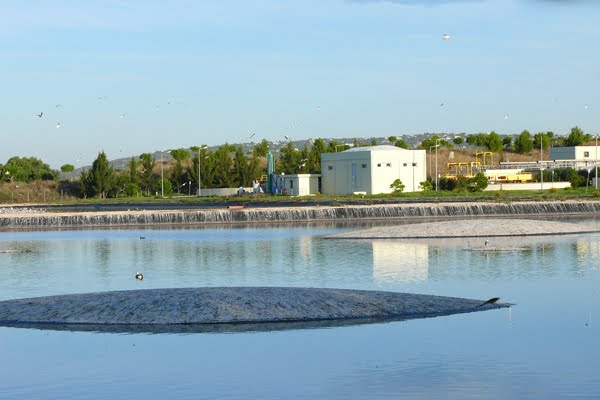
Two unusual views of the ETAR at Vilamoura - a hide here overlooking the water treatment works would be popular
.
After all last week’s excitement, a Common Gull reported from the Ria Formosa and a Pied Wagtail near Tavira have been the nearest we’ve had to rarities in the Algarve or at least that’s all we’ve heard about. However, remembering that November last year produced Whooper Swan, Red-breasted Flycatcher and White-rumped Sandpiper, there is still plenty of time to be looking for the unusual.
Meanwhile, we are seeing some of the scarcer wintering species settling in to familiar places. Black-necked Grebes, Squacco Heron, Little Bittern, a hybrid ‘Grey Egret’, Slender-billed Gulls, Glossy Ibis, Penduline Tit, Booted Eagles and Black-winged Kite have all been found in the last few days exactly where they were last winter. Some of the commoner winter species don’t yet seem to be here in the numbers we would expect, notably Song Thrushes and Chaffinches, and although we saw our first Bluethroat as long ago as 11th September, there still don’t seem to be many around Tavira at least. Late migrants in the last few days have included Turtle Dove, Pied Flycatcher, Yellow Wagtails and a Red-necked Nightjar.
Yesterday, we saw our first ‘kitchen window’ Eurasian Griffon of the autumn and no doubt there will be more during the coming weeks as the birds that have congregated at Sagres start to make their way east looking for a shorter crossing to North Africa.
It's heading straight for us!!

Two unusual views of the ETAR at Vilamoura - a hide here overlooking the water treatment works would be popularAfter all last week’s excitement, a Common Gull reported from the Ria Formosa and a Pied Wagtail near Tavira have been the nearest we’ve had to rarities in the Algarve or at least that’s all we’ve heard about. However, remembering that November last year produced Whooper Swan, Red-breasted Flycatcher and White-rumped Sandpiper, there is still plenty of time to be looking for the unusual.
Meanwhile, we are seeing some of the scarcer wintering species settling in to familiar places. Black-necked Grebes, Squacco Heron, Little Bittern, a hybrid ‘Grey Egret’, Slender-billed Gulls, Glossy Ibis, Penduline Tit, Booted Eagles and Black-winged Kite have all been found in the last few days exactly where they were last winter. Some of the commoner winter species don’t yet seem to be here in the numbers we would expect, notably Song Thrushes and Chaffinches, and although we saw our first Bluethroat as long ago as 11th September, there still don’t seem to be many around Tavira at least. Late migrants in the last few days have included Turtle Dove, Pied Flycatcher, Yellow Wagtails and a Red-necked Nightjar.
Yesterday, we saw our first ‘kitchen window’ Eurasian Griffon of the autumn and no doubt there will be more during the coming weeks as the birds that have congregated at Sagres start to make their way east looking for a shorter crossing to North Africa.
It's heading straight for us!!And, of course, we've been looking for a yellowlegs (or two?) around the local saltpans...
Tuesday, 21 September 2010
Around the local hotspots
We were at Castro Marim this morning, our first visit for a little over a week. The number of birds there continues to be impressive and although long-legged species (Greater Flamingos, European Spoonbills, Little Egrets, Grey Herons, White Storks, Pied Avocets, Black-winged Stilts and Black-tailed Godwits) predominate there are now several pans that are muddy or have just enough shallow water to make them attractive to the smaller sandpipers and plovers. Dunlin, Curlew Sandpipers, Ringed Plovers and Kentish Plovers were particularly numerous; we managed to find a single Little Ringed Plover and, of course, it was a pleasure to see our favourite Tringas.
Yesterday morning we visited Quinta do Lago where the numbers of ducks and gulls are increasing, particularly Gadwall, Shoveler and Lesser Black-backs. Migrant passerines included Pied Flycatchers, Garden Warbler and Sedge Warbler; among the 'expected species' were Black-crowned Night-Heron, Little Bittern, Red-crested Pochard, Booted Eagle and Purple Swamp-hen but it's always fun to experience these through the eyes of people who are seeing them for the first time. "Just look at the size of its feet!" was the immediate reaction to the Swamp-hen. The tidal lagoon here is a great place to photograph Whimbrel, Ruddy Turnstone and Bar-tailed Godwit; if only the Oystercatchers were so easy!
At Quinta do Lago we were already half way to Lagoa dos Salgados so in the afternoon we decided to go and look for the juvenile Buff-breasted Sandpiper that was seen there at the end of last week. Remarkably, this bird showed up on almost the same date as the one that was at Salgados last year. In the event we didn't find it - there were plenty of waders to choose from but most were in an area of the lagoon that has now been rendered inaccessible by various means presumably designed to protect breeding birds. As a result they were quite a long way off and difficult to sort out through the heat haze. It was a bit frustrating. We did get good views of Little Stints, Curlew Sandpipers, Dunlin, Green Sandpiper and Whimbrel so no real complaints. A Northern Wheatear posed for photographs - this is currently the most numerous of the passerine migrant species here.
Locally, in Tavira and Santa Luzia, there are increasing numbers of Spoonbills and Greater Flamingos. We have already had news that a colour-ringed Flamingo which we reported on Friday from Santa Luzia was ringed in France in 1996 at Etg. du Fangassier - Bouches-du-Rhône. It has apparently been reported several times over the years from Castro Marim and Marismas del Odiel and in January 2009 it was seen in Tavira. There are lots more colour-rings out there for us to look at when we have some time on our own. For example, many of the Audouin's Gulls now gathering here are colour-ringed and although most originate from the Ebro Delta we have had the odd one from Mallorca.
Yesterday morning we visited Quinta do Lago where the numbers of ducks and gulls are increasing, particularly Gadwall, Shoveler and Lesser Black-backs. Migrant passerines included Pied Flycatchers, Garden Warbler and Sedge Warbler; among the 'expected species' were Black-crowned Night-Heron, Little Bittern, Red-crested Pochard, Booted Eagle and Purple Swamp-hen but it's always fun to experience these through the eyes of people who are seeing them for the first time. "Just look at the size of its feet!" was the immediate reaction to the Swamp-hen. The tidal lagoon here is a great place to photograph Whimbrel, Ruddy Turnstone and Bar-tailed Godwit; if only the Oystercatchers were so easy!
At Quinta do Lago we were already half way to Lagoa dos Salgados so in the afternoon we decided to go and look for the juvenile Buff-breasted Sandpiper that was seen there at the end of last week. Remarkably, this bird showed up on almost the same date as the one that was at Salgados last year. In the event we didn't find it - there were plenty of waders to choose from but most were in an area of the lagoon that has now been rendered inaccessible by various means presumably designed to protect breeding birds. As a result they were quite a long way off and difficult to sort out through the heat haze. It was a bit frustrating. We did get good views of Little Stints, Curlew Sandpipers, Dunlin, Green Sandpiper and Whimbrel so no real complaints. A Northern Wheatear posed for photographs - this is currently the most numerous of the passerine migrant species here.
Locally, in Tavira and Santa Luzia, there are increasing numbers of Spoonbills and Greater Flamingos. We have already had news that a colour-ringed Flamingo which we reported on Friday from Santa Luzia was ringed in France in 1996 at Etg. du Fangassier - Bouches-du-Rhône. It has apparently been reported several times over the years from Castro Marim and Marismas del Odiel and in January 2009 it was seen in Tavira. There are lots more colour-rings out there for us to look at when we have some time on our own. For example, many of the Audouin's Gulls now gathering here are colour-ringed and although most originate from the Ebro Delta we have had the odd one from Mallorca.
Monday, 12 July 2010
Quinta do Lago
Yesterday's visit to Quinta do Lago was for no other reason than we hadn't been there for quite a while. As it was, the morning's bird list contained few surprises but the chance to photograph Little Bitterns made the trip worthwhile even if the results weren't great in the very harsh sunlight.


It was difficult to resist also pointing the camera at the Black-headed Weavers, a species that surprises and often puzzles first-time visitors here. An African species introduced to Portugal and now a well-established breeding bird, Ploceus melanocephalus is also referred to by some authors (e.g. Stevenson & Fanshawe, Field Guide to the Birds of East Africa) as Yellow-backed Weaver. The fact that the name Black-headed Weaver is also sometimes given to Ploceus cucullatus, better known as Village Weaver, adds to the confusion!

Some time ago we had a long debate in the hide at Quinta do Lago with a visiting 'expert' who knew for certain these birds couldn't be weavers of any sort because they were definitely Black-headed Buntings which he 'was very familiar with' after seeing them on his trip to Lesvos! Nothing we could say would persuade him...
The lagoon held the usual species: Purple Swamp-hens, Common & Red-crested Pochards, Little Grebes, Great Reed Warblers, etc. On the the tidal mud there were a few returning (or perhaps never departed) waders: Grey Plover, Whimbrel, Curlew, Redshank, Avocet; also good numbers of Black-headed & Yellow-legged Gulls with just a few Lesser Black-backs and Mediterranean Gulls and a single Audouin's. (On Saturday, we counted 85 Audouin's Gulls at Santa Luzia saltpans.)
If there was any sort of surprise for us yesterday it was the flock of 26 Glossy Ibises that flew over, following the coast. Perhaps they'll end up at Lagoa dos Salgados or maybe some inland ricefields.
At 10.00am, with the temperature approaching 30 degrees, we figured it was time to head for some shade!


It was difficult to resist also pointing the camera at the Black-headed Weavers, a species that surprises and often puzzles first-time visitors here. An African species introduced to Portugal and now a well-established breeding bird, Ploceus melanocephalus is also referred to by some authors (e.g. Stevenson & Fanshawe, Field Guide to the Birds of East Africa) as Yellow-backed Weaver. The fact that the name Black-headed Weaver is also sometimes given to Ploceus cucullatus, better known as Village Weaver, adds to the confusion!

Some time ago we had a long debate in the hide at Quinta do Lago with a visiting 'expert' who knew for certain these birds couldn't be weavers of any sort because they were definitely Black-headed Buntings which he 'was very familiar with' after seeing them on his trip to Lesvos! Nothing we could say would persuade him...
The lagoon held the usual species: Purple Swamp-hens, Common & Red-crested Pochards, Little Grebes, Great Reed Warblers, etc. On the the tidal mud there were a few returning (or perhaps never departed) waders: Grey Plover, Whimbrel, Curlew, Redshank, Avocet; also good numbers of Black-headed & Yellow-legged Gulls with just a few Lesser Black-backs and Mediterranean Gulls and a single Audouin's. (On Saturday, we counted 85 Audouin's Gulls at Santa Luzia saltpans.)
If there was any sort of surprise for us yesterday it was the flock of 26 Glossy Ibises that flew over, following the coast. Perhaps they'll end up at Lagoa dos Salgados or maybe some inland ricefields.
At 10.00am, with the temperature approaching 30 degrees, we figured it was time to head for some shade!
Sunday, 4 April 2010
Tavira update
It's been a busy few weeks for me while Pete has been away leading an Avian Adventures tour in Costa Rica. I've visited most of our favourite sites - Tavira saltpans, Castro Marim, Ludo and Quinta do Lago and the Baixo Alentejo - most of them more than once! The weather is taking longer to settle this year and some of my birding has been in pretty wet conditions. Migration has really picked up though with Northern and Black-eared Wheatears, Woodchat Shrikes, Great Spotted and Common Cuckoos and European Bee-eaters all here in reasonable numbers now.
I saw my first of the season Collared Pratincoles at Castro Marim on the 22nd March but the Black-tailed Godwits, which a couple of weeks ago were looking very smart in their brick-red plumage, seem now to have headed north to their breeding grounds. I'm sure the Dunlins that are now showing smart black bellies will follow very soon.
On the 29th whilst visiting Cerro do Bufo I watched a pair of Great Spotted Cuckoos in their courtship routine. I first saw the male, sitting on a fence post with a huge caterpillar in its beak. The bird then flew to another post and called whilst still holding its prey. This brought the female in and the male quickly mounted her, at the same time presenting her with the caterpillar. Mating is invariably preceded by courtship feeding but the whole episode was over in a matter of a few seconds.
Male Great Bustards in the Alentejo are in fine plumage and their leks have been fascinating to watch as they throw back their heads, fluff up their feathers and throw their wings forward - almost turning themselves inside out!!
Along the Mértola to Castro Verde road, White Storks are nesting in good numbers, although some of them have had to build new nests. Last year some of them returned to find that their nests had ‘disappeared’ - some of the power poles that support the nests had been replaced as part of the road improvement scheme. Platforms have been provided to help the re-building project and all seems to be going well – let’s hope they have a successful year.
At Quinta do Lago the Purple Swamp-hens, Great Crested Grebes and Red-crested Pochards don't seem to mind that the reeds were very severely cut back earlier in the year - they seem to have other things on their mind!
A Slender-billed Gull that was hanging out on saltpans near the Hotel Vila Galé here in town seems now to have moved on. Not very far from there I have twice recently seen Black-crowned Night-Herons which was something of a surprise. On the first occasion, there were two birds and on the second there appeared to be two adults and a sub-adult bird. We saw a couple of Night-Herons locally before Christmas but these latest birds are presumably migrants.
I saw my first of the season Collared Pratincoles at Castro Marim on the 22nd March but the Black-tailed Godwits, which a couple of weeks ago were looking very smart in their brick-red plumage, seem now to have headed north to their breeding grounds. I'm sure the Dunlins that are now showing smart black bellies will follow very soon.
On the 29th whilst visiting Cerro do Bufo I watched a pair of Great Spotted Cuckoos in their courtship routine. I first saw the male, sitting on a fence post with a huge caterpillar in its beak. The bird then flew to another post and called whilst still holding its prey. This brought the female in and the male quickly mounted her, at the same time presenting her with the caterpillar. Mating is invariably preceded by courtship feeding but the whole episode was over in a matter of a few seconds.
Male Great Bustards in the Alentejo are in fine plumage and their leks have been fascinating to watch as they throw back their heads, fluff up their feathers and throw their wings forward - almost turning themselves inside out!!
Along the Mértola to Castro Verde road, White Storks are nesting in good numbers, although some of them have had to build new nests. Last year some of them returned to find that their nests had ‘disappeared’ - some of the power poles that support the nests had been replaced as part of the road improvement scheme. Platforms have been provided to help the re-building project and all seems to be going well – let’s hope they have a successful year.
At Quinta do Lago the Purple Swamp-hens, Great Crested Grebes and Red-crested Pochards don't seem to mind that the reeds were very severely cut back earlier in the year - they seem to have other things on their mind!
A Slender-billed Gull that was hanging out on saltpans near the Hotel Vila Galé here in town seems now to have moved on. Not very far from there I have twice recently seen Black-crowned Night-Herons which was something of a surprise. On the first occasion, there were two birds and on the second there appeared to be two adults and a sub-adult bird. We saw a couple of Night-Herons locally before Christmas but these latest birds are presumably migrants.
Saturday, 13 February 2010
Last Week
A week of very mixed weather - some days warm and spring-like, others almost monsoon-like! Clive Viney's description, “gloriously unpredictable”, seems just about right!
Last Saturday I had a full day out, birding most of the daylight hours, visiting Ludo/Quinta do Lago and Castro Marim as well as several sites around Tavira. Although a long list wasn’t the object of the exercise, over 90 species were noted, including some, like Water Rail, that were only heard. Highlights at Ludo were six Booted Eagles, an Osprey, two Black-winged Kites and three Siskins, a species that we don’t see much in the Eastern Algarve. At Castro Marim, it was nice to see ten Ruff.
On Monday I went to Olhão and Fuseta and on Thursday to Castro Marim again, but otherwise activity has centred on Tavira where there are plenty of birds, particularly waders, to look at and photograph.

The number of gulls here has fallen significantly now. There are still lots of Lesser Black-backs and Black-headeds but nowhere near as many as there were a month ago. Most of the Meds seem to have gone, I’ve seen no more than ten Audouin’s all week and the single Slender-billed near Forte do Rato was the first I’d seen in a while. Amongst the Lesser Black-backs at Fuseta was another one that had been colour-ringed at Gloucester in the UK.
An Osprey was seen again at Santa Luzia saltpans; it was on the same post where we saw it three weeks ago. I wonder where else it gets to. A Black-winged Kite was at the edge of Tavira, not far in fact from the Gran-Plaza shopping centre (of which the least said the better). Barn Swallows and House Martins are quite numerous now, as of course are Crag Martins but Red-rumped Swallows don‘t seem to be back yet.
June is now about half way through her tour in Uganda. There has been little news other than confirmation that the 'must-see' species, Shoebill, has indeed been seen! That’s always a relief!
Last Saturday I had a full day out, birding most of the daylight hours, visiting Ludo/Quinta do Lago and Castro Marim as well as several sites around Tavira. Although a long list wasn’t the object of the exercise, over 90 species were noted, including some, like Water Rail, that were only heard. Highlights at Ludo were six Booted Eagles, an Osprey, two Black-winged Kites and three Siskins, a species that we don’t see much in the Eastern Algarve. At Castro Marim, it was nice to see ten Ruff.
On Monday I went to Olhão and Fuseta and on Thursday to Castro Marim again, but otherwise activity has centred on Tavira where there are plenty of birds, particularly waders, to look at and photograph.

Common Greenshank
The number of gulls here has fallen significantly now. There are still lots of Lesser Black-backs and Black-headeds but nowhere near as many as there were a month ago. Most of the Meds seem to have gone, I’ve seen no more than ten Audouin’s all week and the single Slender-billed near Forte do Rato was the first I’d seen in a while. Amongst the Lesser Black-backs at Fuseta was another one that had been colour-ringed at Gloucester in the UK.
An Osprey was seen again at Santa Luzia saltpans; it was on the same post where we saw it three weeks ago. I wonder where else it gets to. A Black-winged Kite was at the edge of Tavira, not far in fact from the Gran-Plaza shopping centre (of which the least said the better). Barn Swallows and House Martins are quite numerous now, as of course are Crag Martins but Red-rumped Swallows don‘t seem to be back yet.
June is now about half way through her tour in Uganda. There has been little news other than confirmation that the 'must-see' species, Shoebill, has indeed been seen! That’s always a relief!
Saturday, 2 January 2010
Big Day

How many species did you see on 1st January? Like lots of birders all over the world, we were out yesterday engaged in what Americans call a 'Big Day', an attempt to find as many species as possible in a day to get the New Year off to a good start. Last year we found 106 species on the first day - could we do better in 2010?
It was no surprise to start the year off with several Little Owls calling. We can look out of the window here most days and see a Little Owl and probably have three pairs within earshot. Like us, they were up early although at 6.30am it was still dark and we couldn't actually see them. No matter, as we include in our total birds that are only heard, Little Owl was first on the list.
We decided to follow a similar route to last year and so we spent most of the morning in the Ludo Farm/Quinta do Lago area. The diversity of habitats here means that a good range of species can be guaranteed and last year we came away having seen 86 by mid-day. This time we got off to an excellent start with Booted Eagle, Osprey, Black-shouldered Kite, Firecrest, Green Woodpecker, Crested Tit and Short-toed Treecreeper among the first birds seen. Cetti's Warblers were singing and a Great Spotted Woodpecker drummed briefly as we headed past the saltpans towards Lago do São Lourenço. The walk to the lake and back took about four hours and produced most of the expected waders and wildfowl. There were few surprises although Barn Swallows and House Martins were not birds that we had counted on seeing. Disappointing was the absence of Glossy Ibis and Little Bittern, two that we were hoping for. There was no sign either of a Yellow-backed Weaver or Red-crested Pochard. By the time we got back to the car our total had reached 81, slightly fewer than we had hoped.
Next we headed back to Tavira where Blue Rock Thrush was our main target but where we also made sure of Stone-curlew and picked up several common species including Kestrel. We also had our biggest surprise of the day - an unseasonal Short-toed Eagle.
Then we were off to Castro Marim where Greylag Geese, Black-necked Grebes, Slender-billed Gulls, a Bluethroat, a Marsh Harrier and a Caspian Tern were thankfully all more or less where we expected them to be. We were also pleased to see a flock of about 300 Golden Plovers and then three Spotted Redshanks brought the day's total of wader species to 23 and the over all total to 104.
By now it was late afternoon. There were several species that we knew we could still find if sufficient daylight remained but with so little time available we decided that a return to Tavira for Audouin's Gull, Common Waxbill and Oystercatcher was our best bet. Unfortunately, when we got there, only two of these three targets obliged, Oystercatchers having disappeared to their high tide roost. As darkness fell, we waited along the river for a Night Heron to appear so that we might beat last year's total but it wasn't to be.
So, at the end of the Big Day our total of species recorded was the same as last year at 106...except that we're going to count an extra 1/2 for the 'grey egret' seen in Tavira so that we can claim to be just slightly better birders than we were in 2009!
Subscribe to:
Posts (Atom)