Showing posts with label Red-crested Pochard. Show all posts

Sunday, 22 July 2012

What's in a name?

If you could change the English name of just one bird, which one would it be and what new name would you choose?

There are plenty to pick from aren’t there?  Lots of birds seem to be stuck with names that are inappropriate in some way.  What about Black-headed Gull Chroicocephalus ridibundus -  a bird that never has a black head and has a name designed to confuse, a name that is simply wrong?  Obvious possible alternative names would be Brown-headed Gull or Brown-hooded Gull but those already belong to C. brunnicephalus and C. maculipennis, so we would have to think of something else.  Why not Chocolate-headed Gull?


Continuing to think of birds that have names that describe them inaccurately, what about Red-crested Pochard Netta rufina?  That’s one that we find particularly irritating!  Orange-headed maybe, but never in your wildest imagination is it Red-crested!  The most obvious and striking feature of the drake is its coral-red bill – so why not Red-billed Pochard?  Maybe for some that’s too similar to Rosy-billed Pochard N. peposaca but at least it’s accurate.


Lots of birds have names that include reference to features that may be real but which aren’t easily seen in the field or they’re features that aren’t the most obvious.  We’re thinking, for instance, of Orange-crowned Warbler, Sharp-shinned Hawk, Hairy Woodpecker and several that apparently have short toes.  And what about Ring-necked Duck?  And what about those species that have inappropriate geographical references in their names, such as Kentish Plover, Nashville Warbler, Connecticut Warbler, Sandwich Tern and others.


We could go on in this vein for quite a while – there are so many candidates for a name change!  However, when the International Ornithological Congress set about compiling a list of recommended English names for all the world’s birds one of their starting principles was that existing names should prevail.  In other words, long-established names would not be changed just to correct a perceived inaccuracy or wrong description.  They even quoted the examples of Dartford Warbler and Philadelphia Vireo that they had no intention of interfering with. 


It was against this background that we were more than a little surprised recently to see a formal proposal being made to the American Ornithologists’ Union Committee on Classification and Nomenclature for the name of Columbina inca to be changed from Inca Dove to Aztec Dove.  This was based on the fact that the Inca Empire was centred on the Andes in South America whereas the range of the Inca Dove doesn’t extend beyond North and Central America.  Yes, on that basis, the name is clearly wrong but we weren’t aware of many people being offended by it and, as we have noted above, it’s only one of many candidates for re-naming and hardly a priority.  It really did sound like the proposal for change was made by someone with too much time on his hands and thankfully we’ve just heard that it was defeated.

At the same time as opting to retain the name Inca Dove, the AOU Committee also decreed that there must be more changes to the taxonomic order in which we list our birds.  In these days of DNA analysis there are bound to be such changes.  However, some of us who have spent years using field guides that start with divers and grebes and end with buntings and sparrows find all these changes a bit irritating!  If you’re still struggling to find your way around a list that now starts with swans and geese, watch out, there’s more trouble on the way!  The latest changes result from recent genetic studies that have found that falcons are much more closely related to songbirds than they are to other “hawks”!  You might want to read that last sentence again.  Yes, according to this new research, falcons' closest relatives are a group consisting of the parrots and the songbirds.  As a result, the new AOU check list sequence inserts the falcons and the parrots between the woodpeckers and the passerines.  Whatever next?  Can we expect the BOU to go along with this?  Probably.


Another decision of the AOU Committee was to split what they call Gray Hawk, but which according to the IOC is really Grey Hawk, into two separate species.  These are Grey Hawk, now re-named Buteo plagiatus, which is the bird you might have seen in Arizona or Texas or as far south as the Gulf of Nicoya in Costa Rica and Grey-lined Hawk B. nitidus which is resident from southern Costa Rica south through much of South America.  For Peter this represents an ‘armchair tick’, an addition to his life list without leaving home, based on birds seen when leading more than a dozen Avian Adventures tours in Costa Rica and during an October 2004 trip to Suriname.

Sunday, 1 April 2012

Crakes at Quinta do Lago

We were finally able to get to Quinta do Lago this morning to look for the Baillon’s/Little Crake(s) that have been reported there recently.

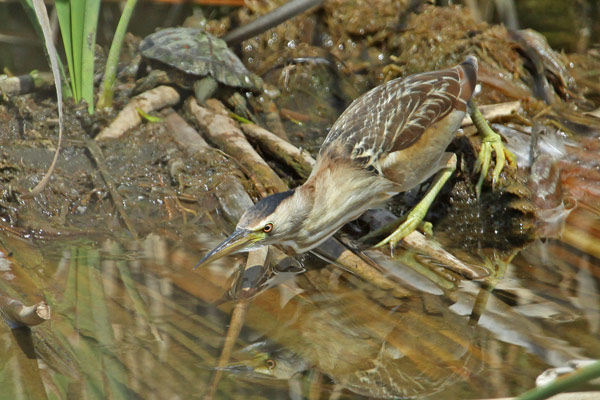
Little Bittern - part of this morning's sideshow

The Baillon’s Crake (Porzana pusilla) reported on 22nd March is a very rare species in Portugal with only three previous records, all of them back in the 1990s. There have been no further sightings of it as far as we know but at the same site on 27th and 28th March an equally rare Little Crake (P. parva) was seen and photographed.

Little Grebe

Since then there has been no further news but plenty of debate! Was the first bird misidentified? Could two rare crakes have arrived at Quinta do Lago in the same week? It does sound unlikely and although the recent spell of weather predominated by easterly winds certainly makes it possible, most people seemed to be think that a mistake had been made. The fact that a Moustached Warbler (Acrocephalus melanopogon) was reported by the same observer at the same time as the Baillon’s, a time when several Sedge Warblers (A. schoenobaenus) were also present, was another factor that seemed to put doubt in people’s minds. Moustached Warbler is also an extreme rarity here.

Red-crested Pochard

This morning was our first opportunity to go and see for ourselves. We arrived at Quinta Lago at about 7.45am and stayed there just about five hours. It would have been nice to include here lots of images of one or more crakes but that wasn’t to be and photographing Little Bitterns, Little Grebes, Red-crested Pochard and Purple Swamp-hens was all we managed. However, we did see crakes…

Purple Swamp-hen

At the edge of the reeds in the western corner of the lake we had multiple but very brief views of what we believe was a Little Crake. However, the time that elapsed between observations was such that we couldn't say with absolute certainty that only one bird was involved although we are inclined to think that was the case. We were unable to detect any barring on the bird that would have suggested identification as P. pusilla.

Little Bittern - again!

When we walked to the hide, about 100 metres away, we quickly had better views of what was definitely a Little Crake. We had several further views of this bird until it was last seen disappearing into vegetation straight out in front of the hide. Then, after an hour without seeing it again, we gave up and left.

Little Bittern - hard to resist

We consider the morning to have been only a qualified success. One the one hand, we confirmed the presence of at least two birds but unfortunately we weren’t able to verify the record of a Baillon’s Crake which would have been a ‘lifer’ for June. We can’t, however, rule out the possibility of a Baillon’s having been there or indeed still being there and we hope other people will go and look - we will certainly be there again as soon as we can!

Wednesday, 23 March 2011

Avian Adventures and more

We've been busy with a week-long Avian Adventures tour here in the Algarve and with other guiding that has resulted in multiple visits to the Castro Verde area and the coastal hotspots, Quinta do Lago, Lagoa dos Salgados, Tavira/Santa Luzia and Cabo de São Vicente.

The weather has been mixed with some thunderstorms and strong winds but now seems to have settled down and currently we have a cloudless sky and a comfortable 17° C.

Here are a few recent photographs:

We managed to see 11 species of raptors during the second of our days in the Baixo Alentejo, including lots of Lesser Kestrels. It was also a day that produced more than 100 Great Bustards and a nice flock of 40 Black-bellied Sandgrouse. On our earlier visit we saw the last three Common Cranes of the winter.

We are now seeing three races of Yellow Wagtails arriving: flava, flavissima and this one, iberiae.

Also creeping about in the grass, we found a couple of newly-arrived Greater Short-toed Larks.

On the local saltpans, Black-winged Stilts, Avocets and Kentish Plovers are now in pairs and preparing to nest.

Among the many Ringed Plovers on the saltpans, we are still seeing a few Little Ringed Plovers. 'Lurps', as we call them, are already occupying breeding sites inland.

Amongst the many Common Redshanks was this one, the first colour-ringed individual of this species we have seen in the Algarve. It was ringed in the Netherlands in May 2010. We have also seen a Dutch-ringed Spoonbill and a Spanish-ringed Greater Flamingo this week.

We have seldom seen more Red-crested Pochards at Quinta do Lago than there were yesterday. Red-billed Pochard would surely have been a more sensible name!

The Avian Adventures group included some keen botanists, so we have also been looking at orchids. This one is Sawfly Orchid, photographed near Sagres where we were entertained by a flock of 40 Red-billed Choughs, saw a few lingering Ring Ousels and found Spectacled Warblers.

Hoopoe - the Avian Adventures logo and, for photographers, hard to resist.

So many birds, so little time...

Friday, 9 April 2010

No Longer Jynxed!

It was a cool morning with quite a stiff breeze but the sun was shining. By way of a change, our given target today was Wryneck. To look for one we went to Ludo and Quinta do Lago.

As usual we started the day with a nice selection of raptors. An Osprey, two Marsh Harriers, three or more Booted Eagles, a Common Buzzard and a Black Kite were all seen soon after we arrived.

It was an excellent morning for migrants; Whinchats, Northern Wheatears, Common Redstarts, Chiffchaff, Willow Warbler, Garden Warbler, Turtle Dove, Common Cuckoo and flava Yellow Wagtail were all seen.

Dunlin, Kentish Plovers, Ringed Plovers and Sanderlings were the most numerous waders but there were also Greenshanks, Curlew Sandpipers, Little Stints and a Spotted Redshank, some of which were beginning to show really nice breeding plumage.

There weren't too many opportunities for photography but the Purple Swamp-hens, White Storks and Red-crested Pochards were hard to resist.

Red-crested Pochards

White Stork

Purple Swamp-hen

Wryneck? Yes, of course we found a Wryneck! And everyone went home happy.

Thursday, 2 April 2009

Breezy birding

We never tire of visiting Castro Marim. We were there again yesterday afternoon, just for an hour or so. Our targets were Little Bustard, Spectacled Warbler, Stone-curlew and Lesser Short-toed Lark and the first three were quickly and easily found. However, although it was bright and sunny, in a strong wind, the larks were more difficult and we really didn't get what might be described as a 'tickable view'. Consolation came in the form of a Great Spotted Cuckoo and there was also a fairly distant look at a Caspian Tern and a Marsh Harrier.

This morning we returned to Quinta do Lago but for a change from recent visits we walked in from the Faro side, past Ludo Farm. Again it was bright and sunny but with a stiff breeze blowing. It was no surprise that almost the first birds seen were two Booted Eagles - they are very regular here, even in winter.

Booted Eagle

A little further on we saw what might well have been the same Black Kite that was in the area on Monday but the highlight of our walk to Lago do São Lourenço was a Black Stork, seen first of all in flight and then perched in a tree. The explosive calls of Cetti's Warblers could be heard everywhere, several European Reed Warblers were singing and about a dozen noisy Bee-eaters were always just out of camera range.

At the lagoon a first-winter Little Gull was feeding over the water but otherwise there was little change from earlier in the week. As always, there were good opportunities to photograph several species and the Red-crested Pochards were difficult to resist. A Little Grebe was also reasonably obliging.
Red-crested Pochard

Little Grebe

As we returned to the car, this Yellow Wagtail allowed close approach. The wind was so strong that it was probably frightened to let go of the power cable!

Yellow Wagtail (iberiae)