Showing posts with label Purple Swamp-hen. Show all posts

Sunday, 15 November 2015

St Martin's summer

A severe storm on 1st November brought torrential rain to the Algarve and was followed by more rain the next morning.  The area between Quarteira and Portimão was reported to be the worst affected and there was severe flooding in the popular resort of Albufeira where sadly one person died as a result.  For some of the coverage see here and here (which includes some aerial footage taken over Lagoa dos Salgados).

Since then we have been enjoying a St Martin’s summer - for almost two weeks we have had sunshine, mostly cloudless skies and temperatures reaching a comfortable 23°C or even higher.
During this time we have mostly been visiting our usual haunts along the coast of the Eastern Algarve but there have also been longer excursions to Sagres and Cape St Vincent and inland to the Castro Verde area.

Part of the Castro Verde / Mértola plains

 The coast at Cape St Vincent

In the Baixo Alentejo, Common Cranes have arrived to spend the winter and both Great & Little Bustards are now much easier to find than they were before the rains.  Red Kites and Hen Harriers have now replaced the Black Kites and Montagu’s Harriers that were here for the breeding season.  On one trip up there we were surprised to find four Mute Swans on a reservoir where just a couple of weeks earlier we had seen two of these unexpected visitors.  We were almost as surprised to find four Great Egrets at another lake nearby but at least we could think that they were truly wild birds.

Little Bustard

Inevitably, we have made multiple visits to Quinta do Lago where Purple Swamphens and Little Bitterns are so easy to see and sometimes to photograph and there are also opportunities, if you are lucky, to photograph Common Snipe and Kingfisher.  While waiting for these birds to appear, it’s hard to resist filling up the memory card with a variety of duck species!

 Common Snipe

 Northern Pintail

 Purple Swamphen

 Eurasian Teal

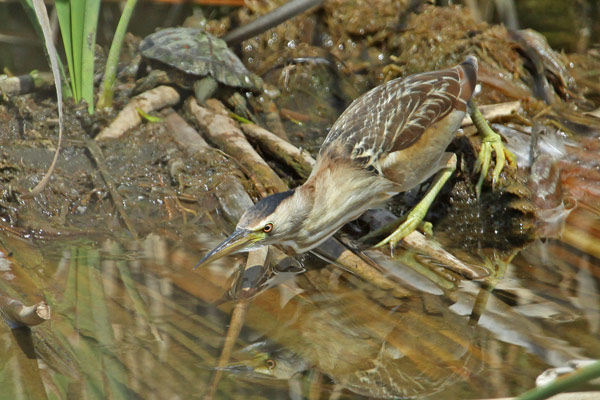
Little Bittern

Nearby at Ludo we have been seeing Booted Eagles and Black-winged Kites and this is one of several places we’ve seen Firecrests.

 Booted Eagle

Firecrest

We also had a morning at Rocha da Pena where a long uphill walk to the summit at Talefe (479m) provided marvellous views over the surrounding countryside and a modest selection of birds that included a single Ring Ouzel, which was our main reason for being there.  Ring Ouzels are regular autumn and winter visitors here and Rocha da Pena is always a good bet when it comes to finding them.

 Rocha da Pena

As to be expected, rarities have been fewer but there were several reports of Grey Phalaropes after the storm and a drake Long-tailed Duck near Faro was a good find (by Thijs Valkenburg).  We wonder whether it was the same bird that was briefly at the same site in February.

Long-tailed Duck

In Tavira we have been reading colour-rings, mostly those on Mediterranean Gulls but also on Audouin’s, Lesser Black-backed & Slender-billed Gulls.  There have been as many as 500 Meds on the saltpans by the Estrada das 4 Águas and they have come from Belgium, Holland, France, Germany, Spain, Poland and Hungary.  Some of them are birds that we have seen here in previous years.  There have been Lesser Black-backs from Belgium, Iceland and Alderney while the Audouin’s have been from Spain (Ebro Delta and Mallorca) and from the local colony on the Ilha da Barreta in the Ria Formosa.

Mediterranean Gull

 Marsh Harrier ready to be released

Finally, we should mention the visit we made to our friends Fábia and Thijs at RIAS (the Centro de Recuperação e Investigação de Animais Selvagens) at Quinta de Marim.  It is the season for them to be taking into care any Griffon Vultures that are too weak and hungry to continue their migration but we were there to be involved in a happy outcome, the release back to the wild of a Marsh Harrier.  Fortunately, this bird had not been badly injured and was fully recovered after just a short stay.

Monday, 6 April 2015

Easter birding in the Algarve

This last week our birding time has been spent mostly around Castro Marim and in the Ludo / Quinta do Lago area.  Both have been full of interest and some days it has been difficult to decide in which direction we should set off! 

 Castro Marim Reserve

Quinta do Lago

In a week which saw temperatures rise to almost 30º and a change in the wind direction, it has been great to see a variety of migrants at last arriving in numbers including Common Cuckoos, Bee-eaters, Nightingales, Northern Wheatears, Purple Herons, Woodchat Shrikes and Reed Warblers as well as the first Golden Orioles and Collared Pratincoles.  There have been Garganeys at several sites and among the Yellow Wagtails birds of the flava and flavissima races have joined the earlier arriving iberiaes.

 Woodchat Shrike

 European Bee-eater

Garganeys

The main attractions currently at Castro Marim have been the Little Bustards, which are now displaying and easy to see.  Spectacled Warblers and Great Spotted Cuckoos have also been popular and there has been a nice selection of passage waders that has included Spotted Redshank, Ruff, Black-tailed Godwits and Greenshank.  On Good Friday we saw a Short-toed Eagle there and the wintering Osprey with the red ring on its left leg seems reluctant to leave.  Marsh Harriers are also displaying and from time to time a pair of Ravens appear.

Spectacled Warbler

Although we have found Little Bitterns, Glossy Ibises, Red-crested Pochards and Purple Swamp-hens around Castro Marim in the last few days, these are species that are definitely easier to see In the Ludo / Quinta do Lago area.  Black-headed Weavers are now busy building nests and are also fun to watch in front of the hide that overlooks the Lagoa de São Lourenço.  The long-staying Red-breasted Flycatcher seems to have left and the Little Crakes didn’t stay very long but we have seen Wryneck, Booted Eagles, Osprey, Black Kite and Black-winged Kite as well as a few Mediterranean & Audouin’s Gulls.

Little Bittern

Purple Swamp-hen

Of course, we have also managed to visit the wonderful Castro Verde / Mértola area where Great Bustards are now displaying and easy to see.  One morning we stood and watched about a dozen of them at the same time as there were also in view two Spanish Imperial Eagles, a Black Vulture, 30 Black-bellied Sandgrouse and several Calandra Larks.  It was hard to decide where to look first!  We saw 10 raptor species during the day, which really is the minimum number we would expect at this time of year.  The first Rollers are just arriving but our experience is that Black-eared Wheatears are so far slow making an appearance.

Great Bustards

 White Storks

Almost wherever we go but particularly numerous in the Baixo Alentejo there are White Storks nesting.  We rather take them for granted but their black, white and red colours seen against a clear blue sky make a fine sight and we love to hear them bill-clapping.  There’s a colour-ringed White Stork nesting near Aipo that was ringed as a nestling at nearby Navarro (Castro Verde) in 1999.  It has been using the same nest for several years which is typical of the species but has been seen feeding on rubbish dumps in Spain in the dry autumn months when frogs are hard to come by.

Saturday, 15 February 2014

Our birding week

There aren’t too many ‘rarities’ to see here at the moment but there are certainly plenty of birds and it’s good to see some migrants starting to return.

On Monday afternoon we spent a couple of hours at Cacela Velha and Fábrica looking mainly at gulls.  There had been a recent report from there of a Great Black-backed Gull but we were also hoping we might come across the colour-ringed Caspian Gull from Germany that has been seen at several sites along the coast in recent weeks.  In the event, we saw only the six regular species: Black-headed, Mediterranean, Slender-billed, Audouin’s, Yellow-legged and Lesser Black-backed.  Among them were six colour-ringed birds: four Audouin’s (three from Spain, one Portuguese) and two Lesser Black-backed (one from Norway and one from the UK).

Slender-billed Gull

Audouin's Gull

Lesser Black-backed Gull

Our enthusiasm for gulls continued on Tuesday.  In spite of it being a miserable, wet day, we went to Quarteira.  There have been a remarkable number of records of Glaucous Gulls in the Algarve this winter (mostly when we haven’t been here!) including one at Quarteira in January so it seemed a reasonable place to go and look for one.  Also, there have been reports of Great Black-backed Gulls from there, not quite so rare but still a very scarce bird in the Algarve.  Again we were unsuccessful, although we did find a colour-ringed Lesser Black-backed Gull from Belgium and a Yellow-legged Gull that had passed through the hands of Thijs Valkenburg at RIAS here in the Algarve.  In the harbour, the Eider was still in exactly the same place where we had seen it on 12th January.

Eider

We also went to Foz do Almargem and Trafal where quite a lot of Barn Swallows, House Martins and Crag Martins were feeding in spite of the weather.  Out at sea, a few Great Skuas passed by as well as the usual Gannets.

On Wednesday we had an opportunity to show off some of our local birds to visiting birders, taking them to Santa Luzia, Tavira, Castro Marim and to the Mata Nacional das Dunas de Vila Real de Santo António.  Among the most popular of about 85 species recorded during the day were Little Bustard, Great Spotted Cuckoo, Bluethroat, Black-winged Kite, Slender-billed Gull, Black-necked Grebe, Stone-curlew and Crested Tit, some of them because of the prolonged, close-range views we were able to enjoy.  Of course, we also found time to look for colour-rings, which included one on a Greater Flamingo that we had seen before in 2010 and 2012, a bird that was ringed in 2006 in the huge colony at Laguna de Fuente de Piedra in Spain.

Purple Swamp-hen

Friday was also a guiding day but this time we went a short way to the west of here, birding around Ludo, Quinta do Lago, Foz do Almargem and Trafal.  Again the species count for the day was about 85.  It was a remarkable day for raptors with Black-winged Kite, Osprey, Booted Eagle, Goshawk, Peregrine Falcon, Marsh Harrier, Common Buzzard and Common Kestrel all being seen before 10.00am!  Also notable were a first-winter Little Gull, probably the same bird that we saw at Foz do Almargem in January, and a flock of about 150 Common Scoters off Praia de Faro.  Again this is almost certainly the same flock of scoters that has been in that area for several weeks but we failed to find anything else among them.  As far as we know, there don’t seem to have been any recent reports of the Surf Scoter, Velvet Scoter and possible Black Scoter that we and many others saw with them a month ago.  Elsewhere, Purple Swamp-hens, Glossy Ibises and a Little Bittern all appeared on cue but it was a singing Short-toed Treecreeper that was named ‘bird of the day’ by one of our party, which just goes to show how we all view things differently.  It was certainly cute but for us the Goshawk was definitely the star, particularly as it was seen so well, perched for several minutes in full view.

If, like us, you have an interest in the gulls of the Algarve, you should take a look at Nelson Fonseca’s new blog, appropriately called ‘Gulls of Algarve’.


Sunday, 3 February 2013

Winter 'Big Day' in the Algarve

Which is the best time of the year to come birding in the Algarve?  It’s a question that we get asked from time to time but, of course, there’s no simple answer – it really depends on what you want to see.  If Bee-eaters, Golden Orioles and Collared Pratincoles are on your agenda, then you might be lucky in March but April, May and June would probably be the best months.  If raptor migration is what you’re hoping for, then September and October should be your choice and September would also be a good time to take a boat trip to look for shearwaters and storm-petrels.

Azure-winged Magpie

Surprisingly few birders come here during the winter months, which is a shame because they’re missing out on some really good birding.  We know that the weather can be an issue but it’s almost guaranteed to be better than it is in northern Europe.  Today it is cloudless and sunny with a forecast high temperature of 19ºC and that is typical of how it has been recently.  It’s very difficult to stay home and not go birding on days like this!

Black-necked Grebe

To demonstrate just how many bird species are here in the winter, we went out on 1st January 2009 and 2010 to see what we could find.  Anyone who has participated in such a ‘Big Day’ in the winter will know that it doesn’t always pay to travel long distances when daylight hours are relatively short.  Time spent in the car on the motorway is not likely to be very productive.  We restricted ourselves to visiting Ludo/Quinta do Lago, Castro Marim and Tavira/Santa Luzia and on each of those days we managed to find 106 species.  The following year we proved our point by also going to the Parque Ambiental de Vilamoura.  Only four days earlier we had seen four species of hirundines and some Penduline Tits there but on our ‘Big Day’ none of those birds were present and we simply wasted time by going there.  We finished the day having seen only 96 species.

Purple Swamp-hen

On 1st January 2012 we were in Arizona and this year we had already left the Algarve to start our trip to Colombia so we haven’t been able to continue the sequence.  However, we have just had quite a full day out, this one on 1st February.  This time we went only to Ludo/Quinta do Lago and to Tavira/Santa Luzia and the pace was quite relaxed; with the longer hours of daylight we easily managed to see 101 species.  There was time for us also to have gone to Castro Marim and had we done so it’s probable that we would have found at least another four or five species but on such days nothing is guaranteed; when we look at the final list there are always one or two species that it’s hard to imagine missing.  To illustrate the point, yesterday we saw Great Spotted Cuckoo, Short-eared Owl, Southern Grey Shrike, Lapwing, Mediterranean Gull and Pintail that we didn’t see the day before when we needed them!  And for some reason we haven’t been able to find a Linnet or a Jay for several days.

 Slender-billed Gull
Kentish Plover

In a week here at this time of year it should be possible to see around 140 species, maybe a few more with a day trip to the Castro Verde area included.  There are some that are only likely to be found at the far western end of the Algarve (European Shag, Red-billed Chough) and others that are only here in the east such as Slender-billed Gull, so some travelling is necessary if you want to see them all.

Little Owl

But it’s not just about the numbers of species; there are simply lots of birds here in the winter.  And if you’re a photographer, there is the promise of good lighting conditions.  

Monday, 22 October 2012

Recent highlights...

So what exactly constitutes a highlight?  Well, the Aquatic Warbler that was ringed at Vilamoura on 12th October was the first of that species in the Algarve since 2005, it was the first that either of us had seen in Portugal and it was the first that June had seen anywhere.  That was probably enough to make it the highlight of that day and possibly also the highlight of the month!

Aquatic Warbler

Very often at the end of a day’s birding one of us will ask the question: what was your bird of the day?  The answers are sometimes surprising but just as often there will be a standout candidate that we agree on.  Maybe it will be that we have witnessed some unusual behaviour.  Sometimes it will be a common bird that we have seen somewhere unexpected or out of season.  Occasionally it will be a single bird that has brightened an otherwise mundane day.  Frequently it will be a bird that has given particular pleasure to someone who has been with us, maybe a bird that we ourselves take for granted.

An example in the last few days would be the single female Great Bustard that we eventually found in the Castro Verde area at 5.30pm in the late afternoon after searching all day.  Great Bustards can be difficult to find at this time of the year and on a day when it seemed that every farmer in the Baixo Alentejo was out ploughing and there was disturbance everywhere, it seemed that our 100% record in finding this species was in serious danger.  The bird that saved our bacon was definitely a candidate for ‘bird of the day’.

If that Great Bustard was ‘bird of the day’, then ‘species of the day’ was definitely Spanish Imperial Eagle.  Never have we seen quite so many of them!  Although, to be fair, we don’t know how many different individuals we saw.  On at least five occasions during the day, we got out of the car and looked up to see two or sometimes even three of these magnificent birds.  We were often able to watch them for several minutes and on one occasion were close enough to hear the harsh, barking call of one.

Spanish Imperial Eagle

Recently we spent a day doing survey work for the Atlas of Wintering & Migratory Birds.  We always say that Atlas work gets us into areas where we probably wouldn’t otherwise go and that’s true.  Unfortunately, that’s not necessarily a good thing!  We were out all day, visited six widely separated tetrads and saw no more than about 35 species in total.  Eventually, we got to some water where we found as many as five Green Sandpipers.  After counting so many Corn Buntings and Azure-winged Magpies, Green Sandpipers were definitely that day’s highlight even if we do see them most days at this time of year.

Green Sandpiper

Purple Swamp-hens are common at several sites here and hard to miss at Quinta do Lago.  Finding them here in the Eastern Algarve is a different story!  We have about half a dozen sites east of Tavira where we have seen them but few are reliable and easily accessible.  So it’s been good these last couple of weeks to have one that has been easy to get to and co-operative.  When you rely on being able to show birds to people, these things are important!

Purple Swamp-hen

On several occasions, at the same site, we have also seen one or more Ferruginous Ducks, a species unusual enough in these parts to be a highlight some days, whereas it probably wouldn’t be if seen at one of the more regular sites such as the Parque Ambiental de Vilamoura.

Ferruginous Duck

Little Bittern is a species that we have seen in every month of the year at Quinta do Lago.  Sometimes they are hard to find, sometimes they are hard to miss but always they are popular.  This one posed for several minutes in front of the hide, illuminated by perfect late afternoon sunshine, and brought real pleasure to those few who were there to enjoy it.

Little Bittern

In the category of unusual behaviour, we recently watched a Black-winged Kite that was apparently ‘fly-catching’, making short flights from the top of a small dead tree presumably to take dragonflies or similar before returning each time to the same perch, much in the manner of a Spotted Flycatcher.  It continued like this for all of ten minutes.  We are seeing Black-winged Kites with increasing frequency but can’t recall seeing this feeding method before.

Currently we have a reasonably reliable Water Rail that we can sometimes to show to people and several Bluethroats are now established in winter territories around Tavira.  Any one of these birds that performs when required is potentially the day’s highlight!
 
Bluethroat

Sunday, 1 April 2012

Crakes at Quinta do Lago

We were finally able to get to Quinta do Lago this morning to look for the Baillon’s/Little Crake(s) that have been reported there recently.

Little Bittern - part of this morning's sideshow

The Baillon’s Crake (Porzana pusilla) reported on 22nd March is a very rare species in Portugal with only three previous records, all of them back in the 1990s. There have been no further sightings of it as far as we know but at the same site on 27th and 28th March an equally rare Little Crake (P. parva) was seen and photographed.

Little Grebe

Since then there has been no further news but plenty of debate! Was the first bird misidentified? Could two rare crakes have arrived at Quinta do Lago in the same week? It does sound unlikely and although the recent spell of weather predominated by easterly winds certainly makes it possible, most people seemed to be think that a mistake had been made. The fact that a Moustached Warbler (Acrocephalus melanopogon) was reported by the same observer at the same time as the Baillon’s, a time when several Sedge Warblers (A. schoenobaenus) were also present, was another factor that seemed to put doubt in people’s minds. Moustached Warbler is also an extreme rarity here.

Red-crested Pochard

This morning was our first opportunity to go and see for ourselves. We arrived at Quinta Lago at about 7.45am and stayed there just about five hours. It would have been nice to include here lots of images of one or more crakes but that wasn’t to be and photographing Little Bitterns, Little Grebes, Red-crested Pochard and Purple Swamp-hens was all we managed. However, we did see crakes…

Purple Swamp-hen

At the edge of the reeds in the western corner of the lake we had multiple but very brief views of what we believe was a Little Crake. However, the time that elapsed between observations was such that we couldn't say with absolute certainty that only one bird was involved although we are inclined to think that was the case. We were unable to detect any barring on the bird that would have suggested identification as P. pusilla.

Little Bittern - again!

When we walked to the hide, about 100 metres away, we quickly had better views of what was definitely a Little Crake. We had several further views of this bird until it was last seen disappearing into vegetation straight out in front of the hide. Then, after an hour without seeing it again, we gave up and left.

Little Bittern - hard to resist

We consider the morning to have been only a qualified success. One the one hand, we confirmed the presence of at least two birds but unfortunately we weren’t able to verify the record of a Baillon’s Crake which would have been a ‘lifer’ for June. We can’t, however, rule out the possibility of a Baillon’s having been there or indeed still being there and we hope other people will go and look - we will certainly be there again as soon as we can!

Friday, 18 November 2011

On Our Travels...

We’re in the UK for a few days, preparing for an Avian Adventures tour in Ethiopia. There were long range forecasts of freezing weather here, so it’s a relief that it’s actually quite mild currently with temperatures up to 12°C. It’s still a bit of a shock to the system, though, for 'southern European softies' like us and we’re definitely hoping for some African sun next week. At the same time, we’re packing plenty of warm clothes for our days in the mountains.

Earlier this week we enjoyed what will be our last day this year of birding and guiding in the Algarve. An excellent day was spent around Ludo, Quinta do Lago, Olhão, Santa Luzia and Tavira recording a total of more than 90 species.

Slender-billed Gull

Highlights included at least 7 Booted Eagles, 2 Black-winged Kites, an Osprey, a Bluethroat, Slender-billed & Audouin’s Gulls, 23 wader species, more than 60 Stone-curlews, 3 Caspian Terns, a Blue Rock Thrush, 3 Black-necked Grebes and, of course, the always popular Purple Swamp-hens. Also notable for us were a Pied Wagtail, a sub-species that isn’t particularly common in the Algarve, and a Spanish colour-ringed Spoonbill that we had seen before in exactly the same place two years ago.

Purple Swamp-hen

Black-tailed Godwit

Although we're obviously looking forward to our travels, it's been a bit of a wrench leaving the Algarve where the birding can be so good at any time of the year and where we really enjoy spending what passes for winter.

Audouin's Gulls

Green Sandpiper

Look out for some photographs from Ethiopia in about three weeks time!