Showing posts with label Little Grebe. Show all posts

Sunday, 1 April 2012

Crakes at Quinta do Lago

We were finally able to get to Quinta do Lago this morning to look for the Baillon’s/Little Crake(s) that have been reported there recently.

Little Bittern - part of this morning's sideshow

The Baillon’s Crake (Porzana pusilla) reported on 22nd March is a very rare species in Portugal with only three previous records, all of them back in the 1990s. There have been no further sightings of it as far as we know but at the same site on 27th and 28th March an equally rare Little Crake (P. parva) was seen and photographed.

Little Grebe

Since then there has been no further news but plenty of debate! Was the first bird misidentified? Could two rare crakes have arrived at Quinta do Lago in the same week? It does sound unlikely and although the recent spell of weather predominated by easterly winds certainly makes it possible, most people seemed to be think that a mistake had been made. The fact that a Moustached Warbler (Acrocephalus melanopogon) was reported by the same observer at the same time as the Baillon’s, a time when several Sedge Warblers (A. schoenobaenus) were also present, was another factor that seemed to put doubt in people’s minds. Moustached Warbler is also an extreme rarity here.

Red-crested Pochard

This morning was our first opportunity to go and see for ourselves. We arrived at Quinta Lago at about 7.45am and stayed there just about five hours. It would have been nice to include here lots of images of one or more crakes but that wasn’t to be and photographing Little Bitterns, Little Grebes, Red-crested Pochard and Purple Swamp-hens was all we managed. However, we did see crakes…

Purple Swamp-hen

At the edge of the reeds in the western corner of the lake we had multiple but very brief views of what we believe was a Little Crake. However, the time that elapsed between observations was such that we couldn't say with absolute certainty that only one bird was involved although we are inclined to think that was the case. We were unable to detect any barring on the bird that would have suggested identification as P. pusilla.
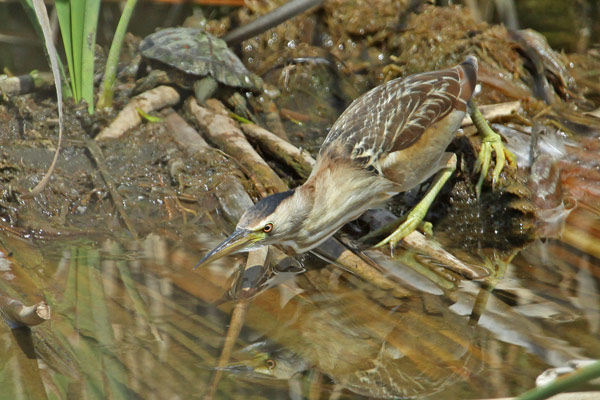
Little Bittern - again!

When we walked to the hide, about 100 metres away, we quickly had better views of what was definitely a Little Crake. We had several further views of this bird until it was last seen disappearing into vegetation straight out in front of the hide. Then, after an hour without seeing it again, we gave up and left.

Little Bittern - hard to resist

We consider the morning to have been only a qualified success. One the one hand, we confirmed the presence of at least two birds but unfortunately we weren’t able to verify the record of a Baillon’s Crake which would have been a ‘lifer’ for June. We can’t, however, rule out the possibility of a Baillon’s having been there or indeed still being there and we hope other people will go and look - we will certainly be there again as soon as we can!

Sunday, 11 October 2009

Quinta do Lago

We had an enjoyable visit to Quinta do Lago this morning but nothing very unusual to report. Duck numbers are increasing with Wigeon in particular quite vocal and we saw Booted Eagle and Osprey and a nice selection of waders on the saltpans as we walked through from Ludo farm. A highlight for June was one of her favourite Iberian Green Woodpeckers.

At Lago do São Lourenço Purple Swamp-hen, Kingfisher and Glossy Ibis were popular as ever but none gave really good views during our stay and the only Little Bittern that put in an appearance was at the far end of the lagoon. The photographs below are ones that were taken on our last visit on 2nd October.

As to be expected on a Sunday there were plenty of walkers, joggers and cyclists to contend with and with the temperature reaching the advertised 27°C or more, after lunch at Faro beach we decided to call it a day.

Glossy Ibis

Purple Swamp-hen

Northern Shoveler

Little Grebe

Sunday, 7 June 2009

Little Grebes

We were at Quinta do Lago this morning for the third time in a little over a week. Little Bitterns and Purple Swamp-hens continue to capture the limelight but for us this family of Little Grebes were the cutest birds on show.


Thursday, 2 April 2009

Breezy birding

We never tire of visiting Castro Marim. We were there again yesterday afternoon, just for an hour or so. Our targets were Little Bustard, Spectacled Warbler, Stone-curlew and Lesser Short-toed Lark and the first three were quickly and easily found. However, although it was bright and sunny, in a strong wind, the larks were more difficult and we really didn't get what might be described as a 'tickable view'. Consolation came in the form of a Great Spotted Cuckoo and there was also a fairly distant look at a Caspian Tern and a Marsh Harrier.

This morning we returned to Quinta do Lago but for a change from recent visits we walked in from the Faro side, past Ludo Farm. Again it was bright and sunny but with a stiff breeze blowing. It was no surprise that almost the first birds seen were two Booted Eagles - they are very regular here, even in winter.

Booted Eagle

A little further on we saw what might well have been the same Black Kite that was in the area on Monday but the highlight of our walk to Lago do São Lourenço was a Black Stork, seen first of all in flight and then perched in a tree. The explosive calls of Cetti's Warblers could be heard everywhere, several European Reed Warblers were singing and about a dozen noisy Bee-eaters were always just out of camera range.

At the lagoon a first-winter Little Gull was feeding over the water but otherwise there was little change from earlier in the week. As always, there were good opportunities to photograph several species and the Red-crested Pochards were difficult to resist. A Little Grebe was also reasonably obliging.
Red-crested Pochard

Little Grebe

As we returned to the car, this Yellow Wagtail allowed close approach. The wind was so strong that it was probably frightened to let go of the power cable!

Yellow Wagtail (iberiae)