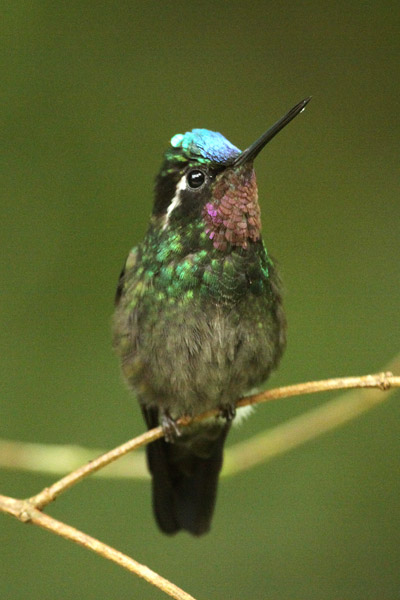
Violet Sabrewing
On this occasion we worked with local guide, Erick Castro, whom we have
known for many years and who was really good at sorting out the many confusion
species – we put our hands up and admit that Yellow-bellied, Yellowish,
Yellow-margined and Yellow-olive Flycatchers, Yellow, Yellow-bellied and
Yellow-crowned Tyrannulets can still sometimes be a bit of puzzle, particularly
if they are feeding high in the forest canopy!

Chestnut-mandibled Toucan

Silver-throated Tanager

Baltimore Oriole

Blue-grey Tanager

Montezuma Oropendola
After a night in San José on arrival we began the tour on
the Caribbean side of the country, staying at the excellent Selva Verde Lodge,
situated on the bank of the Rio Sarapiquí. From there we visited La Selva Biological Station,
one of the most important sites in the world for research on tropical
rain forest. For the first-time visitor
to Costa Rica, starting a tour here with such an array of tanagers, orioles,
toucans, woodcreepers, hummingbirds and flycatchers to contend with can be a
mind-boggling experience!

Rio Sarapiquí
Next we had two nights at Arenal Observatory Lodge, still on
the Caribbean slope and situated right next to the Arenal volcano. Arenal is 1,633 metres (5,358 ft.) high
and last erupted in 1968 but it is currently inactive. It seemed strange to see Great Curassows
visiting feeders here but in recent times this has been become their regular
daily habit whereas previously they were birds we simply hoped to get a quick
glimpse of in the forest.

Arenal

Great Curassow
On the Pacific side of the country we had two nights at La
Ensenada Lodge in the dry Guanacaste province.
The lodge is situated on the coast of the Gulf of Nicoya but as well as
coastal birds such as Brown Pelican and Magnificent Frigatebird it offers many
species of the surrounding dry tropical forest and there are also wetlands,
notably saltpans with hundreds of gulls, terns and waders. Birding the saltpans was like home from home
and several of the species seen were those familiar from Europe such as Ruddy
Turnstone and Grey Plover. There were
also Whimbrels and Sandwich Terns and we have blogged before here about these
possible splits.

La Ensenada Lodge

Hudsonian Whimbrel

White-necked Puffbird
From La Ensenada we visited Hacienda Solimar, primarily a
huge cattle ranch but also a wonderful wetland with thousands of birds. They were impossible to count but there must
have been at least 5,000 Black-bellied Whistling-Ducks and as many Cattle
Egrets as we have ever seen. The
highlights, however, were the much smaller numbers of Jabirus, Limpkins and
Snail Kites.

Hacienda Solimar

Jabiru
From La Ensenada we headed south, joining the Inter American
Highway for a while on our way to Hotel Villa Lapas. We stopped briefly in Puerto Caldera where we
searched through flocks of Laughing Gulls looking for a Franklin’s and were
surprised to find instead a first-winter Sabine’s Gull, possibly the least
expected bird of the whole tour. In the
same place were 100 or more Black Terns, migrants heading north to breed.
Hotel Villa Lapas is conveniently situated close to Carara
National Park and we made several visits there. Carara lies only about 90km
west of San José and because of that attracts many visitors, especially at
weekends. For the general tourist here
the American Crocodiles and the Scarlet Macaws are particular features and
easily seen but we were more intent on seeing Antthrushes, Quail-Doves,
Tinamous and Manakins along forest trails.

Scarlet Macaws
Also in this area we had an excellent afternoon boat trip on
the Rio Tárcoles,
looking for the specialist birds that occupy the mangroves and also seeking out
the elusive American Pygmy-kingfisher. River
boat trips are always popular and usually present really good opportunities for
photography.

(Mangrove) Yellow Warbler

American Pygmy-kingfisher

Boat-billed Heron
Next we moved to the mountains, to Savegre Hotel Nature Reserve &
Spa in the Cordillera de
Talamanca. Both at the hotel and at Paraíso
Quetzal Lodge, our lunch stop on the way there, hummingbird feeders were a main
attraction with Fiery-throated, Magnificent & Scintillant Hummingbirds,
White-throated Mountain-gem and Green Violetear among the species to been seen.

Fiery-throated Hummingbird

Birding above Savegre
A trip higher up the mountain to about 3,400m above sea level took us to
a habitat described as sub-alpine tropical rain paramo. It was obvious that one or two of our group
didn’t feel particularly happy at this altitude and this was also the only time
during the tour that we really experienced anything like serious rain. However, we stuck it out and it wasn’t long
before the sun re-appeared along with our target bird, the Volcano Junco.

Volcano Junco
The must-see bird in Costa Rica is the Resplendent Quetzal
and the male certainly lives up to its name with its iridescent green and red
plumage, extraordinarily long upper tail coverts, a helmet-like crest and a
yellow bill. We left it very late but we
did eventually see one in the San Gerardo Valley, near Savegre. It would have been hugely disappointing had
we not seen one but with close to 400 other bird species seen and a mammal list
that included Margay, Northern Tamandua, Hooded Skunk, Honduran White Bat,
Mantled Howler Monkey and two species of Sloths we don’t think anyone would
have returned home feeling anything but delighted by their Costa Rica
experience.


No new photos of Resplendent Quetzal - this one from 2006!