Showing posts with label Resplendent Quetzal. Show all posts

Tuesday, 19 March 2013

Guatemala Fam Trip - 3

Two nights at Las Nubes gave us just one full day’s birding there.  It began at 5.30am with a return up the same rough track that we had been on the previous evening to find the Fulvous Owl.  Our main target now, however, was Resplendent Quetzal, a species I have seen many times in Costa Rica but one which certainly lives up to its name and I was more than happy to see it again.  Those in our group seeing it for the first time were well impressed!  This is the national bird of Guatemala (Costa Rica for some reason chose the Clay-coloured Thrush - go figure!), it appears on the national flag and they even named their currency after it (currently 1 US Dollar = c. 8 Quetzales).

Resplendent Quetzal

Guatemalan national flag

The supporting cast included Mountain Trogon (lifer!), Elegant Euphonia, Flame-coloured Tanager and Crested Guan but by 10.00am the weather was just too miserable for us to stay out.  Although we tried again later, there was more rain and it turned out that we had had the best of the day’s birding in those first few hours.  The one exception was after dinner when a Mottled Owl at first gave us the run around but eventually allowed everyone with the necessary persistence to see it well.

Accommodation at Las Nubes

We heard Resplendent Quetzal the following morning but, like so many brightly coloured species, it's a bird that needs to be seen; its unmusical call has been likened to ‘a whimpering pup’.  One Mayan legend claims that it used to sing beautifully before the Spanish conquest but has been unable to do so since – an unlikely story but I understand their point!  With better weather there were plenty of birds but limited time before we had to leave.  An Azure-rumped Tanager was the highlight, not because it is a particularly striking bird in its appearance but because it has a restricted range (southern Mexico and south-western Guatemala) and is classified by BirdLife International as Endangered.   

Next on our itinerary was the Los Tarrales Reserve, located close to the Atitlán Volcano (last eruption in 1853) but again we were limited to a one-night stay where we might have wanted longer – such is the nature of these trips.  Los Tarrales stretches from the lowlands at 750m elevation to the top of the volcano at 3500m, an altitudinal range that has resulted in more than 340 bird species being recorded there.  We arrived in time to have lunch before spending the afternoon birding with local guide, Josué de León Lux, on a loop trail much of it through a shade coffee plantation.  Highlights were Scrub Euphonia, Prevost’s Ground-Sparrow, Yellow-winged Tanager and Grey-collared Becard (lifer!).

One of the high altitude attractions at Las Tarrales is the Horned Guan, more of which later… 

Tuesday, 13 April 2010

Costa Rica - Part 3

From Solimar we travelled next to Monteverde but, on the basis that you can never have too many opportunities to look at shorebirds, there were diversions on the way to the salinas at Colorado and a second visit to Punta Morales. Both sites had numerous Grey Plovers, Short-billed Dowitchers, Willets, Black-necked Stilts, Western and Least Sandpipers and more. At Punta Morales there were 20 Marbled Godwits, not a common species here, and a Franklin's Gull, my first ever in Costa Rica.

In past years the drive from sea level up to Monteverde, located at an elevation of about 4,500 feet, has been a slow, bumpy experience but much of the road has recently been surfaced and the journey is now much more enjoyable. As we gained height, there were spectacular views over the Gulf of Nicoya. By mid-afternoon we were at our new base, the excellent Trapp Family Lodge.

The modern town of Monteverde was founded in the 1950s by Quakers from the USA. It is now a major tourist destination with the main attraction being what we have come to know as the Monteverde Crowd Forest Reserve that is said to draw around 70,000 visitors annually.

We spent what remained of the day at the Hummingbird Gallery, essentially a shop with several hummingbird feeders outside that regularly attract seven or eight species of hummers and also Bananaquits. It's a great place to spend an hour or more but for the first-time visitor it's daunting to be faced with so many new birds. With males and females of some species looking completely different, it's quite a challenge.

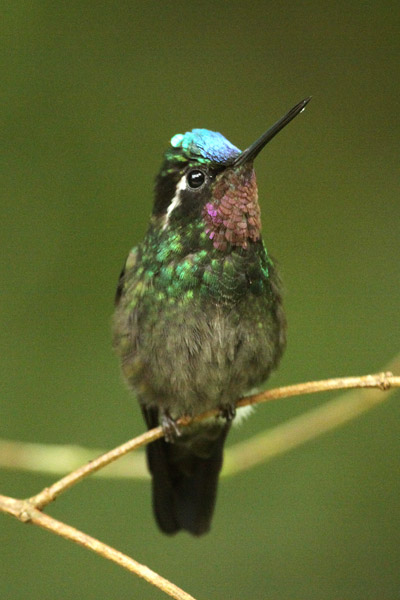
Purple-throated Mountain-gem

Green-crowned Brilliant

Green Violet-ear

Coppery-headed Emerald

Violet Sabrewing

The following morning we set off not to the Monteverde Reserve but to the nearby Santa Elena Cloud Forest Reserve. However, this too is becoming increasingly popular and it's fair to say that this whole area is not the place to be if you're seeking solitude! Having said that, the birding is excellent and the whole 'rainforest experience' truly wonderful with mosses, ferns, flowers and epiphytes growing on the trees and dangling roots and vines sweeping across the trails.

Cloud Forest

Without doubt the star birds for us were the Three-wattled Bellbird and the Resplendent Quetzal, but there was a strong supporting cast that included the exotic-sounding Brown-billed Scythebill, Spangle-cheeked Tanager, Streak-breasted Treehunter, Silvery-fronted Tapaculo and Prong-billed Barbet. We could hear the Bellbird and the Quetzal long before we saw them; in fact we spent quite a while searching for the Bellbird in the branches above our heads before finally it showed itself. Only a few minutes after that success, we located the Quetzal and truly resplendent it was, too!

Resplendent Quetzal

The other main site that we visited at Monteverde was what is now called Santuario Ecológico, formerly Finca Ecológica. This has always provided good birding with the emphasis very much on ground-dwelling species and true to form amongst a decent list of birds seen were White-eared Ground-Sparrow, Ovenbird, Black-breasted Wood-Quails and Chiriqui Quail-Dove, all of them on the forest floor.

Quite a lot of birding was also done along the roadsides where amongst the often-seen species were White-throated Robin, Blue-throated Toucanet, Slate-throated Redstart and Mountain Elaenia.

Slate-throated Redstart

Monteverde can be a wet (think rainforest) and windy place but on this occasion the weather was reasonably kind to us and the birding very good indeed.

Next: would we see the Arenal volcano or would it (as so often) have its head in the clouds?