Showing posts with label Purple Heron. Show all posts

Sunday, 11 February 2018

Thailand...again - 1

Our first visit to Thailand in January last year (see blogs here, here and here) was memorable in many ways, not least for the fact that we saw Spoon-billed Sandpiper for the first time.  However, the dreadful weather experienced during the first few days of the trip has also stayed long in the mind.  With January supposedly being in the ‘dry season’ we had been told not to expect rain but in the event a cyclone in the Bay of Bengal resulted in a continuous downpour (and consequent mud) that detracted greatly from our wader experience at Laem Pak Bia and Pak Thale.  We weren’t prepared for it and we were ill-equipped.

In spite of that it was a great trip and it wasn’t long after returning home that we decided we must go again to Thailand.  And so it was that a plan came together for another visit in January this year.  Again we went with friends, Chris & Graham Weston and our guide in Thailand was Neil Lawton.

When deciding the itinerary, a return to Pak Thale was essential in order to enjoy all those waders in better weather conditions but otherwise we set out to see different parts of the country from those we had been to in 2017. We also decided that two weeks wouldn’t be long enough this time and we arranged for 19 nights actually in Thailand.  We planned to start in the north of the country and then to work our way south by road, finishing with a couple of days around the Gulf of Thailand and another visit to the saltpans of Pak Thale...

We flew from Birmingham to Dubai and then from Dubai to Bangkok, both flights on the very comfortable Airbus A380, the world's largest passenger airliner. We had time for a snack in Suvarnabhumi Airport in Bangkok and got off to a great start there when we looked out of a window to see a Pallas’s Grasshopper Warbler on the grass below!  From Bangkok we took an internal flight to Chiang Rai where we were met by Neil, his wife, Pennapa and driver, Choom.

We spent our first two nights at the Viang Yanok Resort, only about an hour’s drive from Chiang Rai and located on the shores of Chiang Saen Lake.  We arrived late and very tired but we were up 5.30 a.m. the following morning for some local birding, the highlight of which was a boat trip on the lake.  This produced quite a number of familiar species such as Little Grebe, Grey & Purple Herons, Great Egret, Garganey and Ferruginous Duck but also Grey-headed Swamphen, Lesser Whistling Ducks, Indian Spot-billed Ducks, Chinese Pond Heron and Asian Openbill.

 Viang Yanok Resort

 Chiang Saen Lake

On the boat

 Grey-headed Swamphen

 Purple Heron

 Indian Spot-billed Ducks

Lesser Whistling Ducks

After lunch we headed to the nearby harrier roost at Wiam Nom Long, just in time for heavy rain to begin…talk about déjà vu!  Surely we weren’t in for a repeat of last year’s unseasonal weather.  We managed to find some shelter from the rain and soon found a male Western Marsh Harrier, a scarce winter visitor to Thailand, quartering the marsh. As the afternoon passed and the rain continued to fall, lots of harriers began to arrive at the roost including many fine male Pied Harriers.

We arrived back at the resort in a familiar damp and soggy state.  Several different weather forecasts were consulted.  We tried to remain optimistic but it seemed fairly clear that we were once again going to experience a rather wet ‘dry season’!

More to follow…

Saturday, 17 June 2017

A Day in Doñana

Regular readers of this blog and those who have visited the Algarve will know that our base in Tavira is only 30km or so from the border with Spain.  This allows us occasionally to make a day trip to Doñana, still regarded as one of the most important wetlands in Europe and an excellent location for all sorts of wildlife.  We were there just recently and although only a small part of the area can be seen in a single day, we had reasonable success visiting the Dehesa de Abajo and the José Antonio Valverde Visitor Centre.

There aren’t many bird species available in Doñana that don’t occur regularly in Portugal but notable exceptions are Marbled Duck and White-headed Duck, both of which are classified by BirdLife as Globally Threatened, and Red-knobbed Coot, which is widespread in Africa but scarce in Europe.  However, finding any of these in Doñana isn’t guaranteed and on this recent occasion we found only one of them: there were four White-headed Ducks at Dehesa de Abajo, three males and a female. It’s quite possible that there were Red-knobbed Coots present, too, but on this occasion there wasn’t much enthusiasm for standing in the blazing sun peering through a telescope trying to find them amongst hundreds of distant Eurasian Coots.
  
What Doñana does offer is better opportunities to see species such as Great Reed Warbler, Savi’s Warbler, Black-crowned Night Heron, Squacco Heron and Black Kite, which are not ‘every day’ birds in the Algarve and much greater numbers of European Reed Warblers, Purple Herons and Glossy Ibises.

 Glossy Ibis

Purple Heron

We have written before including  here, here and here about previous visits to Doñana.  One of the features of visits in the breeding season has been the spectacle of hundreds of nesting herons, egrets and Glossy Ibises at the José Antonio Valverde Visitor Centre so it was disappointing this time to find virtually none there at all.  Fortunately, it wasn’t long before we were able to at least find where they had re-located to but it is no longer possible to view them at such close range.  However, there were countless birds constantly flying to and fro and endless opportunities for flight photography.

 Squacco Heron

Black Kite

Short-toed Eagle

Other than Lesser Kestrels and hundreds of Black Kites we saw disappointingly few raptors but at least one Short-toed Eagle allowed close approach.

Mid-June would not be our recommended time to visit Doñana but if you can put up with temperatures of 40ºC and higher, it still offers some good birding.  Better, though, to go in April or early May when more birds are singing and there’s the prospect of seeing some migrants.


Friday, 10 February 2017

Thailand - 2

One of the highlights of our recent trip to Thailand was the three-hour boat trip we enjoyed at Bueng Boraphet, one of the country’s largest wetlands, located near the city of Nakhon Sawan, about 240km north of Bangkok.

We always like boat trips but especially ones that are on flat calm fresh water lakes like this one and on a stable boat with comfortable seating.  Add hundreds of birds, good light for photography and a boatman who could spot birds and identify them and we had a near-perfect morning.  As well as the birds, a fine array of water lilies and lotus flowers were quite a sight in themselves and made a very nice setting for many bird photos.


Most of the birds we saw were, of course, wetland species and several of them were familiar to us from Europe.  There were many Great & Little Egrets, Grey & Purple Herons, Black-crowned Night Herons, Glossy Ibises and Little Grebes.  However, lots were new including Bronze-winged & Pheasant-tailed Jacanas, Little & Indian Cormorants, Oriental Darters, Grey-headed Swamp-hens, White-browed Crakes and most numerous of all, Asian Openbills.  The Pond Herons we saw here were presumed to be Chinese Pond Herons but separating this species from Javan Pond Heron is nigh impossible unless they are in breeding plumage.

 Pheasant-tailed Jacana

 Grey-headed Swamp-hen

 Indian Cormorant

 Purple Heron

 presumed Chinese Pond Heron

 Oriental Darter

 Cotton Pygmy-goose

Asian Openbill

There were a few passerines such as Bluethroat, Zitting Cisticola and Striated Grassbird and raptors, too with Peregrine Falcon, Eastern Marsh Harrier, Black-winged & Black-eared Kites all seen well.

Black-winged Kite

Bueng Boraphet will forever be associated with the enigmatic White-eyed River Martin, a species that presents one of the most puzzling mysteries of Asian ornithology.  Although quite distinctive in appearance it had been completely overlooked until it was discovered during a ringing expedition there in 1968.  It was recorded again at the lake during several subsequent winters but it hasn’t been seen with certainty anywhere since 1980.  As a result very little known about it but it’s an interesting story that you can find here.

White-eyed River Martin remembered

We returned to Bueng Boraphet at the end of our tour for a walk around the Waterbird Park on the south side of the lake.  This area of wetland with reedbeds and scrub proved to be quite productive and it was here that at last we saw Siberian Rubythroat.  Other highlights of the morning were Burmese Shrike, two Indian Nightjars, Blue-tailed & Chestnut-headed Bee-eaters, Freckle-breasted Woodpecker, Scarlet-backed Flowerpecker and Brown-throated Sunbird.

Blue-tailed Bee-eater

Saturday, 31 May 2014

Here Comes Summer

Even at the end of May there are still some waders to be found in the Ria Formosa and at Castro Marim, mostly Dunlin and Sanderling but also Knot, Oystercatcher and Bar-tailed Godwit.  However, for some time now our attention has been not so much on passage migrants as on the local breeding birds.

Dunlin

Species such as European Bee-eater, Little Bustard, Collared Pratincole, Iberian Grey Shrike and Spectacled Warbler have been in demand as usual and all have been easily viewable even from the car.  We have found Little Bitterns at two sites in the Eastern Algarve, close to Castro Marim and nearby there have also been Audouin’s Gulls, Great Spotted Cuckoos, Glossy Ibises and Stone-curlews.  In the same area, there have been regular sightings of Montagu’s Harriers and Marsh Harriers and occasionally a Short-toed Eagle.

Spectacled Warbler

 Great Spotted Cuckoo

Audouin's Gull

Inevitably, we have spent quite a lot of time looking for the scarcer and less easily found species and the last week or so has seen us earn the gratitude of visitors for whom Iberian Chiffchaff, White-rumped Swift and Western Orphean Warbler have been ‘lifers’.  This has taken us inland to areas where we have been able to enjoy the song of countless Nightingales and Blackcaps and often Woodlarks and Golden Orioles.  The White-rumped Swifts have been difficult and so far we have found them at only one of the five sites we have been to where they have bred in previous years.

Non-breeding birds still here include more than 600 Greater Flamingos, plus a handful of Caspian Terns and Slender-billed Gulls.  Once again, there was a Lesser Flamingo recently amongst the Greaters.

Caspian Tern

 Slender-billed Gull

Of course, we have also been making frequent trips to the Baixo Alentejo where Great Bustard, Little Bustard, Spanish Imperial Eagle, Short-toed Eagle, Montagu’s Harrier, Griffon Vulture, Black-bellied Sandgrouse, Roller, Lesser Kestrel, Collared Pratincole, Great Spotted Cuckoo and Calandra Lark have all been seen on virtually every visit.  Golden Eagle, Bonelli’s Eagle and Gull-billed Tern have also been fairly reliable. 

Collared Pratincole

We’ve been across the border to Doñana only once recently.  We found large areas of the National Park to be completely dry and it certainly wasn’t at its best.  It was good to see plenty of people visiting the Dehesa de Abajo (where Red-knobbed Coots seem now to be regular) but in contrast we were the only visitors at the JAV and so the only ones to enjoy seeing a Spanish Imperial Eagle pass low overhead!  Even so, we probably enjoyed the Purple Herons as much as any of the birds we saw.


Purple Heron

Summer has now arrived; temperatures are regularly reaching 26ºC and higher and there are more and more people here.  It will soon be time for us to retreat to the UK!

Friday, 21 June 2013

The Last Few Weeks...

Can it really be five weeks since Peter returned from China?  Where does the time go?

It’s fair to say that we’ve had one or two distractions and diversions from our normal routine during the past month, some of them planned but others not so.  However, in spite of these there has been plenty of birding to enjoy.

 European Roller

Montagu's Harrier

Visits to the Castro Verde area have been fewer of late.  In contrast to the wonderful display of wildflowers that we were seeing earlier, the landscape is now looking very parched and straw-coloured as crops of hay and cereals have been harvested.  As the breeding season progresses, both species of bustards have become more difficult to see and now Montagu’s Harriers, Lesser Kestrels and Rollers are among the most conspicuous birds as they go looking for food for newly hatched young.  Also regularly seen have been Collared Pratincoles, Calandra Larks and Black-eared Wheatears and the number and variety of raptors has guaranteed regular roadside stops to check them out.

Black-eared Wheatear

In the Algarve, we’ve made only a couple of visits to Ludo and Quinta do Lago and most of our birding has been around Castro Marim.  It’s been very convenient to have several pairs of breeding Collared Pratincoles easily viewable and Little Bustards were also good while they lasted although impossible to find once they stopped displaying.  More often heard than seen have been several pairs of Water Rails.  About 20 Slender-billed Gulls and up to about 10 Caspian Terns have been regular and in the past few days the number and variety of waders has increased with Black-tailed Godwits, Red Knot, Curlew Sandpiper, Sanderling, Turnstone and Dunlin all in smart breeding plumage.  There are waders in the Ria Formosa, too, and Audouin’s Gulls are ever present.

By way of a change, we recently spent a morning just a few kilometres inland from Tavira, sitting in the car by the roadside next to a small river.  The aim was photography but we weren’t very successful!  However, from that one spot we were able to watch a surprising variety of species that included Golden Orioles (a pair with three young), Kingfisher, Bee-eater, Little Ringed Plover, Green Sandpiper, Grey Wagtail, Rock Bunting, Blue Rock Thrush, Turtle Dove, Crested Tit, Long-tailed Tit and Azure-winged Magpie.  Only a Green Sandpiper and a Grey Wagtail came close to performing for the camera on this occasion but when we have time to return to this delightful location we will be hoping to have some more of these birds coming down to the water.

 Grey Wagtail

Green Sandpiper

Earlier this week we popped across the border to Spain, to the Doñana area.  Unfortunately, the White-headed Ducks that June found on her last visit in May were nowhere to be seen but we did see five Red-knobbed Coots, a species that we don’t often find in Portugal.  It was good to see that the visitor centre at the Dehesa de Abajo is now regularly open and we met up there with ‘old friends’ Beltran Ceballos Vázquez and Sergio González who regaled us with stories of the latest sightings of Iberian Lynx.  Huge numbers of Glossy Ibises were a feature of the day with nice views of them nesting at the José Antonio Valverde visitor centre alongside many Cattle Egrets and smaller numbers of Little Egrets, Squacco Herons, Little Bitterns and Black-crowned Night Herons.  Elsewhere there seemed to be plenty of our favourite Purple Herons feeding well-grown young hidden deep in the tamarisks.

 Cattle Egret

Purple Heron

Black-crowned Night Heron

In the Tavira area, the ‘best’ bird we have heard of was one that we didn’t manage to see even though it was apparently around for several days.  It was in the mouth of the harbour and described to us by a non-birder friend as “looking like a penguin”.  Previous reports of penguin-like birds have usually involved pale-fronted immature Great Cormorants but when we eventually saw the photographs, this one proved to be a first-winter Atlantic Puffin, somewhat unexpected at this time of year.  What a pity that we didn’t get a phone call until long after the bird had gone!

Sunday, 12 August 2012

Get the habitat right...

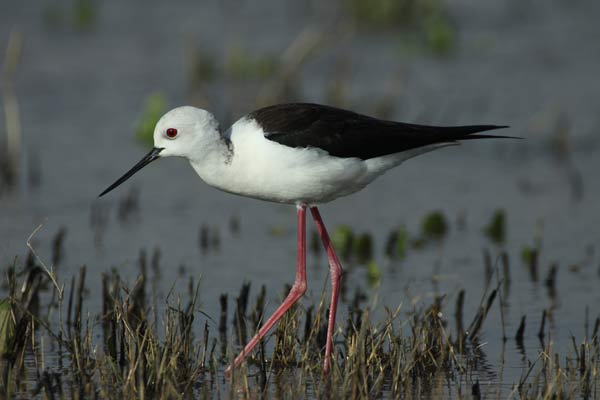
It was interesting to see in the August edition of British Birds magazine the report that a pair of Black-winged Stilts had attempted to breed this year in Somerset, news that had previously passed us by.  Of course, Black-winged Stilts are birds that we see every day around Tavira but breeding records in the UK have been very few.  Peter recalls seeing two juvenile birds at Belvide Reservoir in September 1987 that were almost certainly from a successful nest that year in Norfolk and the record books show that way back in 1945, three pairs laid eggs in Nottinghamshire and produced three young.  Sadly this year’s nest was deserted within just a few days of being found, reportedly falling victim to the weather.


Somerset seems to be the place these days for rare breeding birds to try their luck!  After an unsuccessful attempt in 2010, two pairs of Great White Egrets have managed this year to raise young there and it was also in Somerset that Cattle Egrets bred for the first time in Britain in 2008 and where there was the second proved breeding of Little Bitterns in 2010.

The numbers of Great White Egrets occurring in Britain has been increasing steadily in recent years at the same time as the species has been expanding its range elsewhere in Europe.  Breeding also took place for the first time in Germany this year while in Poland, where the first nest was found in 1997, there were reported to be more than 140 nests in 2011.  That the species should also begin colonising Britain is no surprise.  Interestingly, one of the Somerset breeding birds had been colour-ringed in France in 2009.


It was probably only a matter of time before Cattle Egrets also nested in Britain and perhaps surprising that there have been no reports of any further attempts since 2008.  The Cattle Egret has undergone one of the most rapid and wide reaching natural expansions of any bird species and seems able to flourish in the company of domesticated livestock as easily as it originally did with the herds of wild grazing mammals of Africa.  In the twentieth century they expanded to South Africa, Australasia, South America and North America as well as northwards within Europe.   They are birds that we see every day from our window in Tavira as they fly to and from their roost sites. 


The case of Little Bitterns is slightly different.  These are skulking birds that can easily be overlooked and although there is only one record of proved breeding in Britain prior to 2010 (in Yorkshire in 1984), they were strongly suspected of breeding in East Anglia in the nineteenth century and also in southern England in 1947.  Pairs are known to have summered in Surrey (1956), Somerset (1958), Huntingdonshire (1960) and possibly elsewhere.


To be fair, there have been similar breeding successes elsewhere than in Somerset.  After a pair of Purple Herons failed in their attempt to raise young in Suffolk in 2007, there was success for a pair in 2010 at the RSPB reserve at Dungeness in Kent.  Again, there has been a steady increase in the numbers of this species occurring in Britain since the 1970s, most of them turning up in the south east, suggesting that they originate from the Dutch population.


In one or two reports that we have seen of these events, it has been suggested that they have been brought about by climate change, presumably a change that is particularly affecting Somerset!  What is certain is that in Somerset the Avalon Marshes (Ham Wall RSPB reserve and Shapwick Heath National Nature Reserve) now represent one of the most extensive wetlands in Europe and provide just the right habitat for these colonising birds.

An important feature of the Avalon Marshes project has been the creation of reedbeds to encourage Eurasian Bitterns to breed and two nests at Ham Wall in 2008 were the first in Somerset for 40 years.  This has been just a part of a major programme of reedbed restoration and creation over a period of 15 years or more which has brought about a significant increase in the British breeding population of Bitterns.  Once widespread and numerous, Bitterns were in danger of being lost as a breeding bird in Britain mainly as a result of habitat degradation.  Now, as well as in Somerset, they can be heard booming in more than 50 sites around the country with definite breeding in Norfolk, Suffolk, Cambridgeshire, Kent and Yorkshire.

So far the return of Bitterns is a remarkable success story and a demonstration of what targeted conservation action can achieve.  It has had the added benefit of providing conditions suitable not only for colonisers like the Great White Egrets but also for Marsh Harriers, Bearded Tits, Reed Warblers and Sedge Warblers, not to mention mammals, amphibians, fish and a host of insects.

Get the habitat right and the birds will do the rest – it’s simple really!

Thursday, 19 November 2009

Vilamoura

Details of the birds trapped and ringed at Vilamoura last month by Colin McShane's group from the UK are now presented on the website of Brewood Ringers. The total number of birds ringed was more than 1200, a similar total to the last two years, although year on year comparisons are made less meaningful by the variation in ringing effort (i.e. the number of nets used) and by the slight changes in the timing of their visits. This year they were here for a week from 30th September, whereas last year their week was from 14th October and this will no doubt account at least in part for the difference in, for example, the numbers of Blackcaps (258 in 2008, 44 this year) and Willow Warblers (19 in 2008, 116 this year) that were trapped .

Colin's report again emphasises the importance of the Parque Ambiental for migrant and wintering birds from Northern Europe. There were recoveries this year of Reed Warblers that had been ringed in Holland, Bluethroats from Holland and Belgium and a Chiffchaff from the Channel Island of Jersey. In previous years they have trapped Reed Warblers, Blackcaps and a Bluethroat that had been ringed in France, Germany and the UK and these are just a tiny sample of the thousands of birds that rely on this site every year. Vilamoura's extensive reedbeds are also recognised as an important breeding area for species such as Little Bittern, Purple Heron and Purple Swamp-hen.

Purple Heron

Purple Swamp-hen

Unfortunately, all this is now under threat from further huge tourist development. Environmental group Almargem (Association for the Defence of the Algarve’s Cultural and Environmental Heritage) are threatening to submit an official complaint to the European Courts should the country's new Environment Minister approve the construction of a proposed project in Vilamoura named ‘Lacustre City’. While Almargem hopes that the arrival of the new Environment Minister will result in a re-evaluation of the project’s Environmental Impact Assessment, it has warned that failure to do so could ultimately result in legal action against the Government. Like several other sites in the Algarve, what little is left of Vilamoura's wildlife habitat should long ago have been designated a Special Protection Area under the EU Wild Birds Directive. It would be a tragedy to see it buried by yet more hotels and tourist resorts but based on what has gone before, we can't be optimistic.

It's ironic that this week the Algarve Tourism Board has announced its plan to promote the area as a birdwatching destination!

Monday, 6 April 2009

A Day in Doñana

We spent yesterday in and around Doñana National Park across the border in Spain. Although we drove through thick fog on the way there, the day turned out warm and sunny, thankfully lacking the cold wind that has been a feature here recently.

We always enjoy Doñana. We regularly see there species such as Red-knobbed Coot, White-headed Duck and Marbled Duck that are found only rarely in Portugal and others such as Glossy Ibis, Purple Heron and Whiskered Tern that occur there in greater numbers than we ever see them in the Algarve. Yesterday we also saw five Pin-tailed Sandgrouse, a species that we have never seen in Portugal.


Purple Heron

It is difficult to think of a day when we saw over 100 Black Kites and more than 50 Griffon Vultures as a poor day for raptors, but numbers of the other regular species were fairly poor.

Black Kite

On the other hand, we saw plenty of migrant passerines, a nice selection of waders and four species of larks - a total of 87 species in all.

Greater Short-toed Lark

It is impossible to do justice to Doñana in a one-day visit but we never come away disappointed.