Showing posts with label Great Horned Owl. Show all posts

Wednesday, 24 May 2017

South-east Arizona

An Avian Adventures tour in Arizona has become a regular feature of late April and early May and this year has been no exception.  Each year the itinerary tends to be similar, concentrating on the south-east corner of the state and the Santa Catalina, Chiricahua, Huachuca and Santa Rita mountain ranges.  There have been quite a number of blogs about previous tours, e.g. here, here, here and here.

Not for the first time, an important target species this year was Olive Warbler (Peucedramus taeniatus).  Although superficially this species seems like a typical New World wood warbler, evidence from anatomical and DNA studies has placed it into a family of its own, the Peucedramidae.

From time to time we have clients whose aim it is to see at least one representative of each of the world’s 200-odd bird families.  As Olive Warbler is the only member of the Peucedramidae, it therefore has particular significance.

It isn’t what you would describe as a difficult species to see but they do tend to forage high among clumps of pine needles and they never seem to be particularly vocal.  Finding the first one is always something of a relief!  Maybe one day I will manage to photograph one…

Here are some of the birds I did manage to photograph, although photography is never the main aim of these tours and that applies especially to the tour leader – me!


Vermilion Flycatcher – mostly found near water but a fairly common bird.  We saw them along the San Pedro River, at Whitewater Draw, at Patagonia Lake and Sweetwater Wetlands.


Elegant Trogon – another ‘must see’ species in Arizona.  Like so many species it’s not too difficult to find if it calls but can otherwise be elusive.


Northern Tufted Flycatcher – the first record in the USA was in 1991 and only a handful have been seen since then.  This bird was in Carr Canyon in the Huachucas.


Acorn Woodpecker – a very common bird and easy to see but always popular.


Eastern Meadowlark – this is the lilianae subspecies, earmarked as a potential future split, Lilian’s Meadowlark. 


Great Horned Owl – we saw seven owl species during the tour.  This one was at Whitewater Draw but a pair of Great Horned Owls also had young in a tree right next to Portal Peak Lodge.


Violet-crowned Hummingbird – the former home of Wally & Marion Paton in Patagonia, now taken over by Tucson Audubon, has long been the best place for this species.  We also saw one in the nearby state park.


Rufous-capped Warbler – a very scarce resident in SE Arizona but regularly seen in Florida Canyon.


Northern Beardless Tyrannulet – the curious name refers to the species’ lack of the rictal bristles that are a feature of most other tyrannulets.  This bird lacks almost any features!


White-throated Sparrow – a scarce wintering bird in Arizona, this was the only one we saw.


Ladder-backed Woodpecker – a bird of the desert and other arid areas where it nests in cavities in trees and cacti.


Cooper's Hawk - this accipiter is a surprisingly common bird around Tucson.

Friday, 25 June 2010

Montana & Wyoming - Part 3

After leaving Yellowstone, the last three days of our tour were spent in and around Grand Teton National Park. The name refers to Grand Teton, the tallest mountain in the Teton Range, rising to 13,770 feet (4,197 m). It says something for the Tetons that although in the last few days we had crossed the spectacular Beartooth Pass and visited the magnificent Grand Canyon of the Yellowstone River we were still impressed by the scenery here.

Everyone else takes this photo, so wouldn't I?

The Snake River

Jackson Hole Airport - only two US National Parks have airports.

One of two juvenile Great Horned Owls from a nest in the Gros Ventre Campground.

Dusky Grouse - typically very confiding and not too difficult to find.

American Robin - very common everywhere we went.

Ospreys - another species seen daily throughout the tour.

Northern Flicker - sometimes referred to as Red-shafted Flicker or Common Flicker, both with good reason.

Trumpeter Swan - now successfully re-introduced into areas where the species had been hunted to near-extinction.

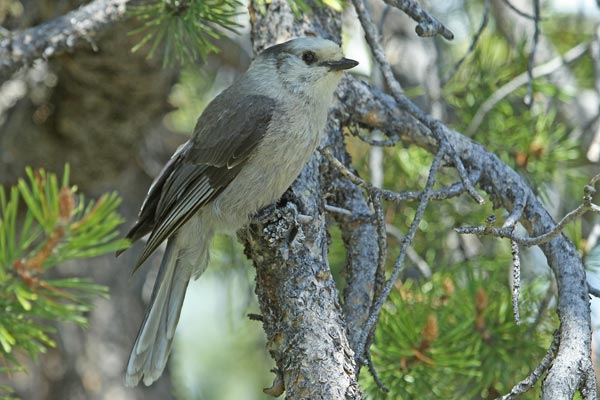
Grey Jay - a cheeky picnic table bird.

Violet-green Swallow - a cavity-nesting species associated with coniferous forests at higher elevations.

Red-naped Sapsucker - found nesting along the Moose-Wilson Road.

Tuesday, 11 May 2010

Arizona

I'm just back from Arizona, my 17th visit to my favourite 'Grand Canyon State'. It was another tour for Avian Adventures and followed the now familiar itinerary: Tucson, Portal, Sierra Vista, Green Valley, Sedona and then the Grand Canyon itself.

What made this trip different was the weather! This must have been the coldest late-April in Arizona in living memory. There was really late snow and as it began to melt, rivers and creeks were flowing that I've only been used to seeing completely dry! To give an example of how cold it was, the temperature in Sierra Vista on 30th April reached a high of only 57° F when the average for this date is 80° F. You might think that 57° isn't really cold but it was so unexpected and what made it worse was the wind, really strong wind that on one or two days made birding extremely difficult. Fortunately, we also had several more typical baking-hot Arizona days.

With the spring being late some of the migrant birds were hard to find but there weren't too many surprises and the total bird list fell only just short of 200 species. There was only one of these that I hadn't seen before in Arizona: Red-necked Phalarope - two birds at Sweetwater Wetlands. The total included 11 different hummingbirds and 'Flameboy', the unpaired male Flame-coloured Tanager that has returned for the eighth consecutive year to Madera Canyon.

'Flameboy' on his favourite feeder

Broad-billed Hummingbird - common in the Huachucas and elsewhere

Greater Roadrunner - 'Beep, Beep'

Desert Spiny Lizard - one of several reptiles seen

Great Horned Owl - seen here on its usual perch at Whitewater Draw

The Grand Canyon - one of the Seven Natural Wonders of the World

Zone-tailed Hawk - a Turkey Vulture mimic

California Condor - re-introduced to Arizona - a face only a mother could love

Painted Redstart - always on the move

American Robin - according to the IOC the only Turdus to remain a Robin.
Maybe it should be called North American Lawn Thrush

Gambel's Quail - flying the flag

Spotted Owl - one of the Miller Canyon birds

Mexican Duck - soon the be a separate species?

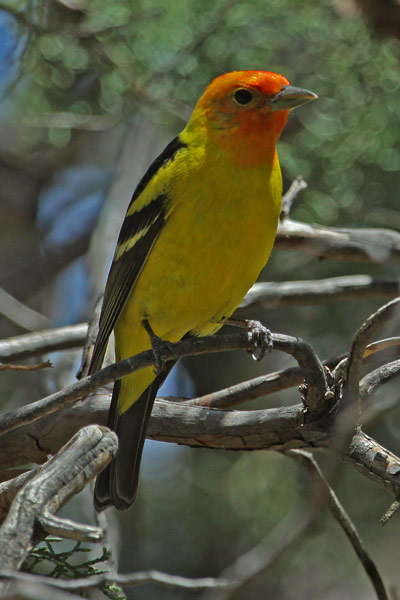
Western Tanager - heading for the jelly jar