Showing posts with label Golden Eagle. Show all posts

Thursday, 1 December 2016

Bad light fails to stop play!

After an enforced absence from the Algarve that lasted several long weeks, we returned to Tavira on Monday evening.  Those unproductive and frustrating weeks with very little birding or photography are the main reason why there has been no recent update here on the blog.

On Tuesday we managed a couple of hours birding around Tavira and Santa Luzia and it was good to see all the familiar species still in their regular places.  When we are here all the time it is easy to take for granted the Spoonbills, Greater Flamingos, Slender-billed, Mediterranean & Audouin’s Gulls, the Bluethroats and Caspian Terns but a few weeks away gave us a fresh appreciation of them.  We sat and watched Dunlins, Little Stints and Greenshanks and even took a few photographs!


 Greenshank

Yesterday, we spent the day in the Castro Verde area where we saw most of the species that we might have hoped for.  Great Bustards and Black-bellied Sandgrouse were easy to find but we didn’t see Little Bustards until three were flushed by a Red Kite.  That was one of perhaps thirty or more Red Kites seen during a day when raptors of one species or another were in view most of the time.

Great Bustards

We have seldom enjoyed a day with so many sightings of Black-winged Kites and after all the talk and debate in the UK about Hen Harriers it was good to have several opportunities to actually watch them.  It was also a treat to be able to watch a Golden Eagle but sadly there was no Spanish Imperial Eagle on this occasion.

 Black-winged Kite

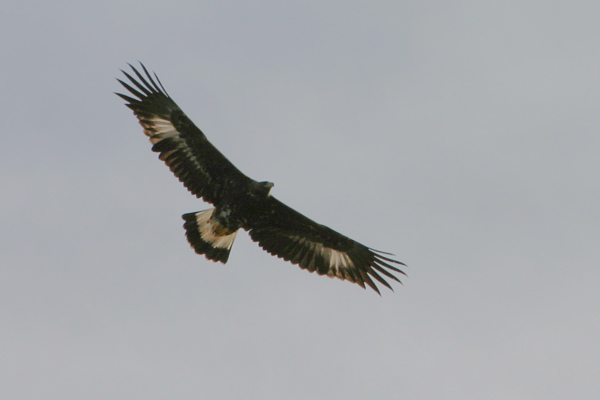
Golden Eagle

Hen Harrier

It was reported here last week that a Spanish Imperial Eagle was one of the victims of a recent poisoning incident in the Castro Verde SPA.  Eight Red Kites were also found dead.  To say that this is disappointing is a massive understatement.  After being absent from Portugal for many years, Spanish Imperial Eagles have been making a comeback and they had become birds that we would expect to see on most visits to the Baixo Alentejo.  This latest one is the fourth to die there this year from poisoning.

Common Cranes

We went to the Alentejo particularly in search of Cranes and we were not disappointed.  They were difficult to count but there were more certainly than 1,000 of them.  Unfortunately, they were too far away for worthwhile photographs and the light was very poor but that was the story of the day so we’re already thinking about when we can go again!  

Sunday, 25 March 2012

Castro Verde, Castro Marim and more

March is a month when we expect to spend a lot of time in the Castro Verde area and we’ve had two more trips up there this week, making three visits in the past eight days. The number of species recorded on each visit has averaged 76 but these days in the Alentejo are more about quality than quantity. During these trips we have not just seen but had really great views of 16 species of raptors with Golden Eagle, Bonelli’s Eagle, Peregrine Falcon, Common Buzzard, Griffon Vulture and Black Vulture now added to the list that was included in our last report. We’ve watched countless Great Bustards displaying, almost seeming to turn themselves inside out and looking like big white powder puffs; some Little Bustards are also displaying now but many still seem to be in flocks. Other popular species have been Calandra Larks and Great Spotted Cuckoos, Black Stork and the numerous nesting White Storks.

Golden Eagle

Short-toed Eagle

Of course, we’ve also visited several of our favourite sites in the Algarve. At Quinta do Lago, we were pleased to get good views of a Purple Heron and a Little Bittern and once again a couple of Sacred Ibises were seen alongside the more familiar Glossy Ibises. At Ludo, we expected to find Booted Eagles and we weren’t disappointed.

Little Bittern

At Castro Marim, we had several encounters with noisy Great Spotted Cuckoos and at Aldeia Nova there was a Common Cuckoo. Last year we sponsored ‘Chris’, one of the Common Cuckoos that the BTO tagged and have been tracking by satellite throughout the winter months. It’s interesting that we have Cuckoos returning here now to the Algarve but ‘Chris’ and the other BTO Cuckoos, that are presumably going to return to the UK, are still in West Africa.

Great Spotted Cuckoo

Yesterday, during the high tide period, we were at Castro Marim again to carry out a count of the waders and other birds, mostly Greater Flamingos and Spoonbills, on the saltpans there. Avocets, Dunlins, Grey Plovers and Ringed Plovers were the most numerous species but the job wasn’t made any easier by a male Montagu’s Harrier that spooked the birds on a couple of occasions. Normally we love to see Montagu’s Harriers but when we’re half way through counting a flock of several hundred birds and they all take off in panic…well that does tend to change our views! It recalled occasions at Belvide Reservoir years ago when a Peregrine Falcon would often be the culprit that disrupted wildfowl counts.

Meanwhile, here in Tavira we’re starting to see a few more migrants. This morning we came across several Woodchat Shrikes, Greater Short-toed Larks and a Subalpine Warbler and heard the familiar calls of Bee-eaters. Our ‘bird of the morning’, however, was probably a lovely Black-necked Grebe in fine summer plumage. We have still been seeing Bluethroats this week but they will soon be on their way north. The Slender-billed Gulls that have wintered here will also soon be leaving; there are currently 14 of them. Only three years ago this species was classified as a rarity in Portugal but in the south-east of the country we go out most of the year almost expecting to see them and maybe it won’t be long before they join Audouin’s Gulls and breed here.

Woodchat Shrike

Bluethroat

Slender-billed Gull

Friday, 5 March 2010

Another Alentejo Day!

For the second time this week we spent the day in the Castro Verde area. No two days up there are ever the same and today, in spite of some pretty unfriendly weather, we saw several species that we didn’t find on Tuesday and we also saw a lot more Great Bustards.

With 100% cloud cover, a strong wind blowing and occasional rain, it wasn’t a day when we would have expected to find many raptors flying. However, we finished up seeing four Short-toed Eagles, a Golden Eagle, a Spanish Imperial Eagle, a probable Booted Eagle, four Black-winged Kites, a Red Kite, three Montagu’s Harriers, six or more Lesser Kestrels, a couple of Common Kestrels and two Common Buzzards!

Some days we can struggle to find Great Bustards and Little Bustards. Today wasn’t one of those days! And we had reasonably close views of both although the largest group of Great Bustards (48 birds) was some distance away and we definitely needed a telescope to see them. In total we reckon we saw 108 Great Bustards and 14 Little Bustards.

The day’s bird list also included Stone-curlew, Green Sandpiper, Calandra Lark, Wood Lark and Thekla Lark, all of them species we not only like to see but particularly enjoy hearing.

All in all, quite a successful day but wouldn't some sunshine have been nice!