Thursday, 18 February 2016

Falkland Islands - 5

From Bleaker Island we transferred to Weddell Island, the third largest in the Falklands archipelago.  We were expecting a direct flight from one to the other but instead we had five flights!  We went from Bleaker to Stanley, then to Mount Pleasant, from there to Darwin, then to Sea Lion Island and finally to Weddell.  At each stop we either picked up or dropped off passengers or bags and sometimes mail or supplies of food.  Working out the FIGAS flight schedules can’t be an easy job!

Weddell Island is situated to the west of West Falkland.  It has an area of 265.8 square kilometres and a coastline of about 175km.  The highest point (Mt Weddell) is 383m above sea level.

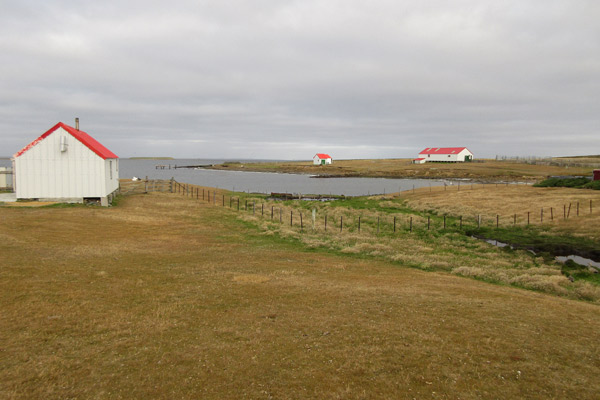
The plan was for us to have just one night on Weddell but the weather intervened and instead we had two nights.  It was windy but otherwise the weather on Weddell itself wasn’t too bad at all, it was fog around Stanley that prevented planes from taking off.  This surely made scheduling the flights even more difficult!  For us it just meant that we could see a little bit more of the island but with no roads we weren’t able to go very far!

Our accommodation on Weddell

We were also able to enjoy more of the excellent hospitality of Martin & Jane Beaton who I have seen frequently in the past at the Rutland Water Birdfair.  Martin and Jane are the only inhabitants of Weddell Island and after ten years have learned from necessity to turn their hands to an infinite variety of tasks.  Martin is an accomplished chef, an artist, an expert fisherman and something of a raconteur. On Weddell he has also become a capable mechanic and engineer as well as a sheep and cattle farmer!  Jane, too, has learnt over the years to turn her hand to the 1001 tasks essential to life on a remote island.  It was a bit strange finding these two familiar faces in this distant location in the South Atlantic!

For some reason the Patagonian Grey Fox, native to Chile and Argentina, was introduced to Weddell in the late 1920s.  On a couple of occasions we were able to watch a family of them chasing each other around.  What impact these aliens have on Weddell and its wildlife is unclear but there were plenty of birds on show and lots of young penguins.

Patagonian Grey Fox

As many as 54 bird species have been recorded on the island.  Those we saw included Falkland Steamer Duck, Southern Giant Petrel, Black-crowned Night Heron, Turkey Vulture, Falkland Skua and several more that were by now quite familiar.  It was the Gentoo Penguins that received most of our attention and it was interesting to see how quickly they came out of the sea onto the safety of the beach whenever a Sea Lion came close.  Young Gentoos constantly chased their parents begging for food.

Turkey Vulture

Falkland Skua

Upland Goose

Kelp Goose

Black-crowned Night Heron

Falkland Steamer Ducks

Southern Giant Petrel

I think I would have to say that it was the penguins, all five species of them, that have left the most lasting impression from this trip.  It would be nice to think that before long I might have the chance of another visit to the Falklands and perhaps an opportunity to see some of the other islands such as Carcass, Sea Lion and Saunders.  And, of course, I still need to see Cobb's Wren!


Gentoo Penguins

Thanks again to Tony Mason, to the Falklands Island Tourist Board and to everyone in the Falklands who contributed to making the trip possible. 
  

Wednesday, 17 February 2016

Falkland Islands - 4

From Pebble Island we flew next to the much smaller Bleaker Island located close to the south-east coast of East Falkland. This long, thin, low lying island covers just 2,070 hectares. It was previously known as Long Island and was referred to as such on the chart compiled by the Beagle survey of which Charles Darwin was a part in 1834. Later it became Breaker Island but since at least 1857 it has been called Bleaker.


The island has been a sheep farm for over 100 years and is now privately owned and under organic sustainable management. Wildlife and domestic animals appear to co-exist quite happily and there are attempts being made to restore some of the tussac grass habitat that has been lost through over-grazing in the past.

Here we were the guests for just one night of the owners of the islands, Mike & Phyll Rendell. We stayed in very nice accommodation in Cassard House built as recently as 2011 with solar-powered underfloor heating and hot water and triple glazing.

 Cassard House


Like Pebble, Bleaker has been designated an Important Bird Area. It has 40 species of birds breeding including Gentoo, Magellanic, Southern Rockhopper and the odd pair of Macaroni Penguins and a large colony of Imperial Shags. Watching the Rockhoppers at Long Gulch was one of the highlights of the whole trip and at the same time countless Imperial & Rock Shags were flying in and landing on nearby cliffs. Pale-faced Sheathbills and a Striated Caracara ignored us completely, coming within just a metre or so, sometimes too close to photograph.

 Rockhopper Penguins

 Imperial Shag

 Rockhopper Penguin

 Pale-faced Sheathbill

 Rock Shag

 Rockhopper Penguin

 Peale's Dolphins

 Striated Caracara, known locally as Johnny Rook

Bleaker is one of the islands where in the past rats have been accidentally introduced and now threaten ground-nesting birds. It is hoped that eventually they can be eradicated and bird populations restored to former levels but in the meantime we saw only a small number of Tussacbirds (Blackish Cinclodes) and there are no longer any Cobb’s Wrens to be found although we were told that they are present on the nearby rat-free islands, North Point, Halt and Sandy Bay.

Tussacbird

What I particularly liked about Bleaker was that I needed to walk only a short distance from the accommodation to get to the nearest Rockhopper colony and hundreds of Imperial Shags. What a great way to start the day!

Falkland Islands - 3

After a night at the Malvina House Hotel in Stanley our first full day in the Falklands began with a FIGAS flight to Pebble Island.  The flight took about an hour in a Britten Norman 2B Islander aircraft

Pebble Island lies just off the north coast of West Falkland.  With an area of 10,622 hectares it is the third largest of the offshore islands in the archipelago (after Weddell and Saunders).  It stretches 39km from east to west but is only about 7km at its widest point.  The settlement and airstrip are located on a narrow isthmus close to 6.4km Elephant Beach, the longest sand beach in the Falklands.

The east of the island is mainly low lying with many large lakes and ponds with imaginative names such as Big Pond and Long Pond that are good for ducks, geese, grebes and waders.  To the west there are three peaks, First Mountain (277m), Middle Peak (214m) and Marble Mountain (237m).

 Rufous-chested Dotterel

 Magellanic Snipe

 Silver Teal

White-tufted Grebe

The island has been designated an Important Bird Area.  It has 42 breeding species including over 1,000 pairs of Imperial Shags and several large colonies of penguins.  In our short time on the island we saw five species of penguins: King, Southern Rockhopper, Magellanic, Gentoo and Macaroni.

 Gentoo Penguin

Macaroni Penguins

 Imperial Shag

 Falkland Skua

 Dolphin Gull

 Black-browed Albatross

 Southern Giant Petrel eating a penguin chick

 Blackish Oystercatcher

We stayed just one night at the lodge where Riki Evans was a very good host.  The building was originally the farm manager’s house but was converted in 1987 to a lodge to accommodate visitors. There are no roads on the island so we were shown around in a Land Rover driven on the first day by local guide Montana Short and the following morning by Riki himself.

 The Lodge

 Falklands Thrush

 Dark-faced Ground-Tyrant

Memorial to those who died on HMS Coventry, sunk off Pebble in May 1982

I thought Pebble was great and I would have liked to have spent more time there.  However, it wasn’t that kind of trip!

Saturday, 13 February 2016

Falkland Islands - 2

The Falklands archipelago comprises more than 750 separate islands.  Of these East Falkland is the largest and covers a little over half the total land area.  Stanley, the islands’ capital, is in East Falkland and we spent three nights there during our trip, one at the beginning and two at the end of our stay.

We spent our first night in Stanley at the Malvina House Hotel.  Birds seen during a short walk along the waterfront on arrival and another one early the next morning included Southern Giant Petrel, South American Tern, Kelp Gull, Magellanic Oystercatcher, Upland Goose, Crested Duck, Kelp Goose and Falkland Steamer Duck.  Two ‘lifers’ amongst these so not a bad start!

Kelp Gull was the largest, most numerous and widespread of the three gull species we saw

 Magellanic Oystercatcher - note the conspicuous yellow eye and eye-ring

 Kelp Geese - these birds favour rocky shores where the all-white male is hard to miss

Crested Duck - the crest is hardly noticeable but the red eye is distinctive

Falkland Steamer Ducks - 
known locally as Logger, this flightless species is numerous around the coasts

The Falkland Islands rely heavily on just a small number of industries, mainly fishing, sheep farming, tourism, and increasingly oil.  The number of tourists arriving by air each year is surprisingly small (about 1,600) but of major importance are those that come to Stanley on cruise ships.  It is reported that as many as 60,000 cruise ship passengers come ashore each year and their spending makes a valuable contribution to the economy.

Cruise ship passengers are pointed towards the excellent Falkland Islands Museum and Christ Church Cathedral, while some simply want to buy souvenirs or fish and chips.  However, two popular attractions are excursions to see penguins at Gypsy Cove and Volunteer Point.  I have never seen as many Land Rovers and other 4x4s in such a small town as there are in Stanley and when the cruise ships arrive many of these vehicles are brought into use as taxis.

At the end of our trip we were taken on the two and a half hour drive to Volunteer Point, where the main attraction is the colony of more than 1,000 King Penguins.  Much of this trip is off-road in the true sense in that there is no road or track and a 4x4 vehicle is essential. 

King Penguin colony

Over 3,000 visitors come to see the penguins at Volunteer Point each year and clearly there has to be some management to prevent undue disturbance or harm to the wildlife.  Measures initiated by Falklands Conservation include a car parking area roped off to limit vehicle use and a ring of white rocks arranged around the King Penguin colony to mark out the recommended distance from which to observe the birds.  In addition information boards have been provided with maps of the site and facts about the main bird species.

Gentoo Penguin

We were lucky that there were relatively few other people visiting Volunteer Point on the morning we were there.  Not only were there King Penguins but also Gentoo and Magellanic Penguins.  Most of the Kings were packed tightly together in the colony, some with eggs and some with young.  Others were nearby on the white sandy beach.  Wherever we looked there were penguins and I’m not going to say how many photographs I took!


King Penguins

Unfortunately, the weather prevented our planned boat trip to Kidney Island where thousands of Sooty Shearwaters are the main attraction.  However, there were a few of these birds visible from the beach at Volunteer Point.

Wednesday, 10 February 2016

Falkland Islands - 1

Peter writes:
I have just returned from my first ever visit to the Falkland Islands where I was one of a group of six (four tour operators plus a journalist and a photographer) invited by the Falkland Islands Tourist Board to sample the islands for a week.  This invitation came to me via Avian Adventures.

Gentoo Penguin

Just getting to the Falklands is an adventure in itself.  Located in the South Atlantic about 300 miles off the coast of South America, the islands are not the most easily accessible destination.  The vast majority of visitors arrive by sea on cruise ships and stay for only a very short time.  The other way to get there is by air, either taking an RAF flight from Brize Norton via Ascension Island or doing as I did, flying from Heathrow to Santiago via Madrid and after an overnight stay in Chile, onward flights to Punta Arenas and finally to Mount Pleasant Airport on East Falkland.  Total flying time was more than 20 hours; I left home in the UK at 6.00am on Thursday and arrived in Port Stanley at 3.00pm on Saturday!

 Port Stanley from the air

Stanley Airport

And that was just the start of my ‘flying visit’.  After a night in the Malvina House Hotel in Port Stanley the next morning we flew from there to Pebble Island for a one night stay.  Then it was on to Bleaker Island for a night, Weddell Island for two nights and then back to Stanley for two nights.  The flights between islands were operated by Falkland Island Government Air Service (FIGAS) using Britten Norman Islander aircraft.  We didn’t always fly directly to our destination island and in all there were eleven FIGAS flights.

Britten Norman Islander aircraft

Although my main focus was on the birds and other wildlife, it was difficult not to be aware the whole time of ‘the conflict’, the war in 1982 that resulted in 907 deaths in just 74 days.  On Pebble Island, in particular, and on East Falkland we came across the wreckage of various aircraft strewn across the countryside; in Stanley and elsewhere there are war memorials and even after more than 30 years there is still a team of Zimbabweans clearing landmines.

Pebble Island

During what was just about a week actually on the Falklands I saw a total of 48 bird species, nine of which were ones that I hadn’t seen before.  Of those nine, four were penguins and it was penguins that dominated the entire trip.  I couldn’t raise much enthusiasm amongst my non-birding travelling companions for the likes of Dark-faced Ground-Tyrant, Blackish Cinclodes or even Upland Geese but even as non-birders they were all completely enthralled by the penguins.

 Imperial Shags

I get to meet two Kings...

In the next few days I’ll share some more photographs from what was a very tiring but most enjoyable trip. 

Friday, 8 January 2016

Algarve Bufflehead

We were pleased enough last Saturday to start 2016 with a couple of hours birding around Tavira and Santa Luzia, a session that produced 66 species.  These included an Osprey, 36 Stone-curlews, two Slender-billed Gulls, two Caspian Terns, a Bluethroat and four Black-necked Grebes but the highlight for us was probably a Dunlin, one that carried a combination of colour-rings that indicated that it originated from Svalbard in the Arctic Ocean.  We read and report a great many colour-rings but mostly they are on Greater Flamingos, Spoonbills, various gull species and larger waders such as Black-tailed Godwits; we don’t see many on waders as small as Dunlin and few from so far north.  We sent a report straightaway and now await formal confirmation and full details of a bird that unlike us has probably seen a Polar Bear! 

The following day brought an even better New Year present.  We had switched our attention to the Castro Marim area and having been to Cerro do Bufo and Venta Moinhos we decided to visit the Coastal Dunes National Forest, near Monte Gordo.  In particular, we like to take a look at a small lake there which in the past has sometimes produced something unusual.

On this occasion the little lake exceeded all expectations!  We usually see Common Pochards and Northern Shovelers on the water and sometimes Red-crested Pochards or even a Ferruginous Duck but almost the first bird we saw was a Bufflehead.  Yes, a Bufflehead, a North American duck that has only been recorded once before in Portugal!


We have both seen this species many times in the USA (also in Nottinghamshire and Staffordshire!) so the identification was easy enough.  We very quickly took a few photographs, sent some text messages to spread the news and then as it began to rain quite heavily we headed back to the car.  We were there watching the bird for probably no more than about 15 minutes, if that.  It was all a bit surreal!

It was inevitable that there should soon be some doubts expressed about the origin of this bird.  Records of exotic wildfowl are always subject to debate, quite often from those who haven’t seen them!  Did it have any rings on it?  Were there any signs of its flight feathers having been cut?  Did it show any fear of human presence?  These were valid questions and understandable from anyone contemplating a long trip to come and see it but it in the short time that we watched it, the bird gave no indication that it might be anything other than a genuine transatlantic vagrant.

There was also discussion about its age and sex.  Is it an adult female?  Is it a first-winter male?  Is it an immature female?  This doesn’t seem easy to resolve.  The key feature seems to be the wing pattern as described here and it’s easy enough to see if you have the bird in your hands!  Seeing that detail on a bird that is mostly swimming and diving is very difficult and the best chance may eventually be from photographs. 


There was a report on Monday that the duck had gone missing but that it had been relocated about 2km to the east on a wastewater pond at Altura.  On Tuesday, we went to take another look and found it back at the original site in the National Forest.  On Thursday it was again at Altura and we watched it for almost an hour during which it was quite active, frequently diving and on several occasions it got up and for no obvious reason flew across the water to resume feeding in a different area.  It still gave no reason to think it might be an escape.  It was reported again from Altura today.

During the week quite a number of the Algarve’s birders have been to see the bird and no doubt this weekend will bring more birders from further afield.

Buffleheads are members of the genus Bucephala and therefore closely related to the goldeneyes.  They breed around wooded lakes and ponds in Alaska and Canada and migrate south to spend the winter in the ‘Lower 48’ where they favour the coasts and large bodies of water, particularly shallow saltwater bays.  They feed on crustaceans, molluscs and insect larvae. 

They are quite small (length 32-40 cm, wingspan 55cm) and are able to nest in the disused tree cavities made by Northern Flickers.  These holes are usually too small to be used by Common & Barrow’s Goldeneyes and the main competition for nest sites is said to be from Mountain Bluebirds, Tree Swallows and European Starlings.

The previous record of Bufflehead in Portugal was in 1993 when a female was seen in the Sado estuary for ten days or more in January and February.  Maybe if this latest bird stays there can be agreement about its likely origin and about its age and sex.